Showing posts with label Navaho sand paintings. Show all posts

Friday, September 16, 2011

Indus Script and Semasiography

Seal M-314, bearing the longest Indus inscription: CARTWHEEL / BI-QUOTES //
FISH UNDER CHEVRON / WHISKERED FISH / FISH / SPEAR //
DOUBLY CAGED AY / CUPPED SPOON / TRI-FORK TOPPED POT / POT //
THREE POSTS / CIRCLED TRI-FORK / PANTS / MAN HOLDING DEE-SLASH /
TRI-FORK / CIRCLED VEE / QUADRUPED (probably 3 units of information).

At this point, we should examine the evidence presented against the hypothesis that the Indus script is a writing system (Farmer, Sproat, and Witzel 2004).  There are several indicators noted in this famous paper, all of them suggesting that this script is not a fully developed writing system:

(1)    Brevity of the inscriptions, with an average of 4 to 5 signs each, the longest by any count containing fewer than 30 signs;

(2)    The absence of evidence that longer inscriptions once existed on a perishable medium (such as remains of “inkpots, brushes, palettes, styli, pens, and other literate paraphernalia; representations of scribes, texts, and writing instruments in art or pictographic scripts; and major changes in the shapes and orientations of signs tied to scribal attempts to increase the efficiency of copying long texts” (2004: 25);

(3)    The odd sign frequencies, described above, in which twenty signs account for over 50% of all sign occurrences, while the vast majority of signs are rare;

(4)    The low frequency of sign repetition within single inscriptions, which suggests that the signs did not represent phonetic information;

(5)    Within the group of repeating signs, some seem to appear in groups (such as the various types of FISH that appear in a series), and when a specific sign does repeat in an inscription, it may repeat several times in a row, which suggests a possible enumerative function rather than encoding of phonetic information;

(6)    Besides the large number of singletons and rare signs, new excavations tend to turn up still more of this class, suggesting that new symbols were created as time went on, a characteristic not normally found in phonetic writing;

(7)    Some non-linguistic symbols “exhibit a kind of linearity that is not dissimilar from the sort found on some (but by no means all) Indus inscriptions,” including Vinča inscriptions from southeastern Europe and the symbols of deities on kudurru and elsewhere in the Near East;

(8)    Sometimes symbols with seemingly clear meaning behave in odd ways, such as apparent numerals appearing in inscriptions where they appear not to qualify or enumerate anything -(e.g., K-59 which reads: DEE-SLASH / SINGLE POST / STACKED THREE / STACKED FIVE; or K-49: THREE QUOTES / STACKED SEVEN / MAN WITH SHOULDER YOKE).

The conclusion of Farmer et al is that “Indus inscriptions were neither able nor intended to encode detailed ‘messages,’ not even in the approximate ways performed by formal mnemonic systems in other nonliterate societies.  Their most likely function, as suggested by Near Eastern parallels, was to associate individuals, families, clans, offices, cities, festivals, or professions, etc., with specific gods or their celestial correspondents, partly for identification purposes and partly to draw down whatever magic was accessible through those gods’ symbols” (2004: 42-43).
A sealed proto-Elamite economic tablet from Susa, with two numerals;
perhaps to be read "twelve [animals]" (after Potts 1999: 61, Pl. 3.1)

We may wish to examine some of these arguments in greater detail.  For example, some scholars counter the fact of the brevity of inscriptions by presuming that longer texts did occur, but on perishable media.  They may cite the existence of long texts on such media in later, historical periods, as evidence by analogy (e.g., Parpola 2009: 54).  Historical arguments of this type are very weak evidence, since we know of a great many things that only came to exist in later, historical periods.  For example, we cannot look at the bronze artifacts from the Indus Valley and say that, because iron and steel implements also appear later on, the Indus Civilization must also have produced iron and steel – in the Bronze Age.  No, in the Bronze Age, implements were made of bronze, while iron came into use later.  No doubt many objects were made of perishable material during the Bronze Age and so are lost to us.  For example, cloth has not survived from this period in the Indus Valley.  However, unlike the proposed long texts, there is evidence of cloth and clothing from Harappan statues and figurines that were modeled to depict clothing.  Thus, even though the cloth itself is gone now, we do find evidence that it existed during the Bronze Age.  This is the type of evidence that Farmer et al do not find when it comes to longer Indus texts.  Not only are there no long texts, there is no indirect evidence that lengthy inscriptions once existed.
Analysis of proto-Elamite tablet TY 7, showing the three typical parts: heading ("hairy triangle"),
entries in numerical form concerning grain, and total from the reverse (Damerow and Englund 1989: 39). 

This by itself is insufficient to make the case against Indus script being a fully developed writing system, of course.  Most of the evidence for a Lycian script comes from short inscriptions, for example, as is also true of Etruscan (although in each of these cases there is also at least one long text).  It is sometimes argued that absence of evidence is not evidence of absence.  But, of course, when no evidence is forthcoming, that does suggest something.  In other words, absence of evidence is indeed a kind of evidence for absence; it just is not proof. 

Regardless of this point, Farmer et al have additional arguments that are stronger.  The statistics on sign frequency suggest that Indus “script” is a proto-writing system along the lines of proto-cuneiform and proto-Elamite.  They themselves note this parallel.  Now, an Assyriologist may not focus on proto-cuneiform not being a fully developed writing system, because, in time, it did develop into such a system.  Determining the precise point at which this happened seems unimportant because of the continuity. 
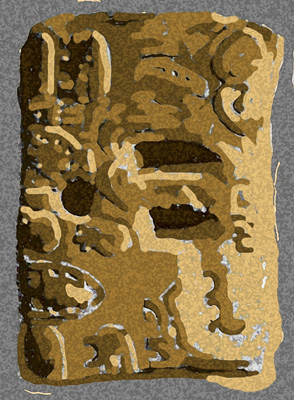
A tag from Egyptian Tomb U-j at Abydos bearing possible early hieroglyph
(after O'Connor 2009: 145).

Egyptian hieroglyphs also had an early phase that may have been proto-writing, as evidenced by the brief inscriptions on tags (small, flat, rectangular objects of wood or ivory on which there may be a glyph or two) found in pre-Dynastic tombs at Abydos (O’Connor 2009: 143-147).  Here again, the determination of the exact point at which proto-writing developed into true writing is not a major focus of scholars.  That it did develop into true writing is clear.

But in the case of both proto-Elamite and the Indus script, there is no continuity with later writing systems.  Instead, these early systems died out.  This is also the case with Aztec proto-writing in Mesoamerica.  Unlike the neighboring Mayans, the Aztecs (and their predecessors) did not develop true writing and eventually their symbols ceased to be used at all.
Detail from a Mixtec "map" (lienzo) with year sign (AO combination), attached numeral indicating date,
footprints on path indicating movement, and a geographical glyph for Zacatepec (Smith 1973: 268, fig. 89).

Moving to the second argument against the Indus script thesis, Farmer et al note the absence of Harappan artwork depicting scribes at work along with the equal absence of archeological evidence that writing occurred.  This, too, is rather weak evidence, but evidence it still is.  The third argument, the peculiar frequency data, with many rare signs versus a small core of frequent signs, was discussed in the previous post.

The fourth argument focuses on the behavior of the frequent signs, the core symbols that appear again and again.  I noted in the last post that the Egyptian glyphs representing single consonants tend to occur the most frequently, even in the limited area of royal names and titles in cartouches.  I noted that the bread loaf representing t is one of the most common glyphs, a symbol that appears twice in King Tut’s name (in the New Kingdom) and twice in the name of two First Dynasty kings, Atet I and II (during the Old Kingdom).  Other glyphs are sometimes doubled, as is the case with the irrigation ditches (N24) representing Semti, fifth pharaoh of the First Dynasty, and as is the case with Bebi, a king of the Second Dynasty (the glyph of a human leg and foot, D58, is doubled, representing b).  The final element in these names is –i or y, a sound that represents dual number in the Egyptian language.  In the names, the same sound may or may not represent the dual.  Glyphs can also be tripled to represent the plural, as in the name of the fifth king of the Fourth Dynasty, Menkaure.  But besides such consecutive repetitions, glyphs can be repeated in non-adjacent positions.  This is the case of the chick (G43) representing w in the name of Khufu (Fourth Dynasty), as is also true of the reed (M17) in Asa (son-of-Ra name of Shepseskara of the Fifth Dynasty).
Tablet H-764AB with inscriptions: CIRCLE / 3 TOED FOOT / POT (A side);
TRIPLE CUPS (B side) (tripling may be enumerative, i.e., equal to 3 + CUP).

A fair number of Indus signs appear either singly or doubled, e.g., the GRID, the CEE, and CIRCLE.  Less commonly, one finds a symbol repeated in a non-consecutive position: M-396 contains two of the BLANKET WITH FOUR TICKS separated by four signs; H-369 contains two of the POTTED ONE separated by one sign; M-634 contains three of the CARTWHEEL with one sign separating each instance.  If this type of repetition were common in Indus inscriptions, this would suggest that phonetic information was conveyed by the common, repeating signs, as in Egyptian.  But since this kind of repetition is infrequent, the argument against phonetic encoding is supported.
Reverse of seal M-326B with inscription (from right): STRIPED TOP / EX / THREE QUOTES / CARWHEEL // BARBELL ON POST / TWO POSTS & BACKSLASH / BARBELL ON POST / (?) POSTS (corner abraded).
(If we add these signs, those in the inscription on the A side, and those on the edges, there are 20 signs altogether).

The fifth argument addresses the kind of sign repetition that occurs more often, doubling and tripling in consecutive series.  Parpola mentions this:

A few signs occur with three- or fourfold repetition: [TRIPLE BOATS, TRIPLE RECTANGLES, TRIPLE CUPS, QUADRUPLE TRI-FORKS].  Of these signs, only [CUP] and [TRI-FORK] are preceded (in other texts) by groups of strokes, which evidently denote numbers.  The sequence [CUP / CUP / CUP] occurs on the reverse sides of some of the miniature tablets from Harappa, which normally show the sequences [CUP], [TWO POSTS / CUP], [THREE POSTS / CUP], or [FOUR POSTS / CUP].  The sequence [CUP / MAN HOLDING CUP] in the broken seal inscription 1165 [CUP / MAN HOLDING CUP / BI-QUOTES // BELTED FISH /...] is paralleled by the sequence [TWO POSTS / MAN HOLDING CUP] on the reverse of tablet H-247.  The sequences [TRIPLE TRI-FORKS] and [QUADRUPLE TRI-FORKS] form the entire inscriptions of two ivory sticks (2795 and 2803), but a third ivory stick (2792) bears the inscription [FOUR QUOTES / QUINT-FORK].  It therefore seems safe to regard [TRIPLE CUPS] and [THREE POSTS / CUP] as alternative ways to write ‘3 CUP' (2009: 81).

Farmer et agree that this kind of sign repetition is enumerative rather than phonetic.  It may very well be.  I would point out, though, that such repetition is only quasi-enumerative in Egyptian, with three repetitions of a glyph often representing a plural form (ending in –w), alongside rare instances of quadrupling where three instances still represent the plural form with the fourth representing phonetic repetition, as in Nefer-neferu-aten, with three nfr glyphs for –neferu- and a fourth nfr representing the initial Nefer-.
Impression of a cylinder seal with Mesopotamian images but Indus inscription, MS2046 (from right):
STACKED TWELVE / DEE & BACK DEE OVERLAPPING / MAN WITH SINGLE STRIPED EAR (?) / SPEAR.

Farmer et al further note that continuing excavations periodically turn up additional Indus symbols.  For example, there is an apparent lizard, depicted in bird’s eye view, on a seal in the Schoyen collection, a sign not included in any published list.  Another seal contains an inscription with another new symbol, a DEE with a BACK DEE overlapping it.  This type of open-endedness is to be expected in a proto-writing or non-glottographic system, especially if there is a need for new symbols to representing “owners” – just as in modern Texas, there is always room for another cattle brand to represent the owner of the livestock.
Stone block with Luwian hieroglyphs -- within the neatly incised lines separating the rows,
the hieroglyphs are grouped in a largely non-linear fashion, even though this is true writing
(from an old Turkish postcard).

An additional argument focuses on the linearity of Indus symbols.  The fact that the signs often appear in neat rows makes the script seem like writing.  But this is only a subjective judgment.  Symbols that are not linguistic have been known to appear in similar rows.  Farmer et al cite the symbols on kudurru, the foundation stones of Kassite Babylonia that bear both written texts and non-linguistic emblems of deities.  Both the signs of the text and the non-linguistic emblems are neatly aligned in rows.  To this observation I note some Navaho sand paintings, in which representations of yeis (supernatural beings) also line up in rows (Newcomb and Reichard 1975: Pl. III, with three rows of four Snake People).  In fact, the preschool child often arranges toys in a neat linear manner as a habitual form of play.  So the urge to make linear arrangements may be universal (although obviously that urge is much less strong in some people than in others).
Proto-cuneiform inscription on the Blau chisel, showing grouping of signs in compartments
rather than a strictly linear arrangement (drawn after Aruz 2003: 39).

The reverse of this argument is also of interest.  Signs of a known writing system may not necessarily be arranged in lines – whether rows or columns.  Egyptian hieroglyphs could be written either in rows or columns, from right to left or from left to right.  But even within each row or column, the glyphs do not always follow one another in a perfectly linear sequence.  Two small glyphs are frequently stacked one on top of the other in a row.  In effect, this creates a short column within a row.  And in a column, two tall and thin glyphs are frequently placed side by side, in effect forming a row within a column.  In addition, even within a word, glyphs sometimes follow a peculiar sequence.  Theophoric elements in names precede other glyphs, regardless of the sequence in the spoken language.  In King Tut’s name, for example, the last element is Amun, the name of the ram god.  But when the king’s name is written, the two glyphs spelling Amun appear in initial position, with Tut- and –ankh- following.  Luwian hieroglyphs appear even less ordered than Egyptian, in a great jumble of symbols minimally arranged in rows.  So linearity is not necessarily a sign of a writing system and writing is not necessarily linearly arranged.

Indus seal B-10 with non-linear arrangement of symbols in the inscription:
SEVEN QUOTES // TRI-FORK (or is the latter an abbreviated cult stand?).
Farmer et al also note some of the peculiarities of the apparent numerals in the Indus script.  Some of the oddest inscriptions seem to contain nothing for the “numerals” to enumerate.  With Korvink’s analysis of the various BEARER signs as terminals, how does one analyze such inscriptions as M-96 (FOUR QUOTES / POT-HATTED BEARER), or M-919 (THREE QUOTES / BEARER), or the bare "numeral" in B-10 (SEVEN QUOTES)?  Similarly, bearing in mind Korvink’s analysis of sign + BI-QUOTES as a prefix, how can one interpret M-692 (CIRCLED VEE / BI-QUOTES // FOUR QUOTES / SINGLE POST)? 
Tablet H-892A and B: note inscription on B begins with CUP on right.


Tablet H-951A and B: note the B begins with FOUR POSTS on right, ending with CUP.
The apparent numerals that do appear alongside other types of signs are sometimes described as preceding the other sign, supposedly an indication that qualifiers in general must have preceded their referents in the Harappan language.  For example, Koskenniemi and Parpola cautiously state, “Soviet scholars have expressed an opinion which we share that the Indus language appears to be fairly consistently left-branching” (1982: 12).  It is indeed common to find CUP preceded by an apparent numeral on tablets (reading right to left).  But there are also tablets with the opposite sequence, the “numeral” preceded by the CUP (H-771B right to left FOUR POSTS / CUP; H-777B CUP / TWO POSTS; H-784B TWO POSTS CUP; H-781B CUP / THREE POSTS). 

It is not just the tablets that present such contradictory data.  On seals, one frequently finds a sequence with one or another form of SEVEN preceding EF TOPPED EXIT (e.g., in H-268) (19 occurrences), but almost as common is STRIPED TRIANGLE followed by SEVEN (12 occurrences).  Similarly, some form of THREE precedes OVERLAPPING CIRCLES 18 times, but typically follows CUPPED POST or CUPPED SPOON (as in M-714).  Thus the “numerals” neither inevitably precede nor invariably follow a sign in pair-wise combinations.  If these symbols were interpreted linguistically, one would be at a loss to explain such contradictory pairings.

It is for these reasons that I accept the argument of Farmer et al that the Indus script does not represent fully developed writing.  Or, as Malcolm Hyman prefers to express it, this script is non-glottographic.  In his point of view, the important question is what relationship exists between glottographic and non-glottographic writing? (2006: 1-29).  His suggested answer is that there is no simple dividing line between these two types.  Even a society that has glottographic writing will often still continue to use non-glottographic “writing” or symbols.  As noted earlier, while we have true writing today, we also use non-glottographic numerals.  Thus, semasiography or non-glottographic systems are not failed writing, not mere historical stages on the way to true writing.  They may serve entirely different functions.  So it would be more useful to focus on the question of what functions a non-glottographic Indus system performed and how this was accomplished rather than attempting to assert that it was glottographic in the absence of clear evidence.


REFERENCES

Aruz, J., ed. 2003. Art of the First Cities: The Third Millennium B.C. from the Mediterranean to the Indus. New Haven: Metropolitan Museum of Art and Yale University Press.

Budge, E.A. Wallis. 1920 and 1978. Egyptian Hieroglyphic Dictionary. Volume I-II. New York: Dover (1978 reprint of 1920 original, published by John Murray, London).

Dahl, Jacob L. 2005. “Animal Husbandry in Susa during the Proto-Elamite Period” in SMEA 47: 81-134.

Damerow, Peter and Robert Englund. 1989. The Proto-Elamite Texts from Tepe Yahya. Cambridge, Massachusetts: Peabody Museum of Archaeology and Ethnology, Harvard University.

Englund, Robert. 2001. “The State of Decipherment of Proto-Elamite,” available at cdli.uncla.edu online.

Fairservis, Walter A. 1992. The Harappan Civilization and Its Writing: A Model for the Decipherment of the Indus Script. Leiden: E.J. Brill.

Farmer, Steve, Richard Sproat, and Michael Witzel. 2004. “The Collapse of the Indus-Script Thesis: The Myth of a Literate Harappan civilization,” in Electronic Journal of Vedic Studies (11) 2: 19-57.  Available at http://www.safarner.com/downloads

Hyman, Malcolm D. 2006. “Of Glyphs and Glottography,” in Language and Communication.

Koskenniemi, Kimmo and Asko Parpola.  1982. A Concordance to the Texts in the Indus Script. Helsinki: Department of Asian and African Studies, University of Helsinki.

Korvink, Michael P. 2007. The Indus Script: A Positional Statistical Approach. Gilund Press (Amazon).

Nakanishi, Akira. 1980. Writing Systems of the World: Alphabets, Syllabaries, Pictograms. Boston: Tuttle Publishing.

Newcomb, F.J. and G.A. Reichard. 1975. Sandpaintings of the Navajo Shooting Chant. New York: Dover (orig. 1937 by J.J. Augustin).

O’Connor, David. 2009. Abydos: Egypt’s First Pharaohs and the Cult of Osiris. London: Thames & Hudson.

Parpola, Asko. 2009 and 1994. Deciphering the Indus Script. Cambridge: University Press.

Potts, D.T. 1999. The Archaeology of Elam: Formation and Transformation of an Ancient Iranian State. Cambridge: University Press.

Smith, M.E. 1973. Picture Writing from Ancient Southern Mexico: Mixtec Place Signs and Maps. Norman: University of Oklahoma.

Wells, Bryan K. 2011. Epigraphic Approaches to Indus Writing. Oxford: Oxbow Books.
Old Persian cuneiform unicode document: http://titus.uni-frankfurt.de/personal/jg/unicode/table8.htm  

Friday, September 2, 2011

Last Group of Indus Signs

Bar seal M-411 with inscription: FLYING BIRD / 3 POSTS / POT //
WHISKERED FISH / SLASH IN FISH / OVERLAPPING CIRCLES / TRI-FORK.


When the signs become complex, it is difficult to count strokes, making this a less than ideal method of organizing them.  For this reason, I will briefly cover the rest of the signs in my list, from those classed as 19 strokes to 24.  The first of these is a variant of a previous sign, differing only in the number of stripes: FLYING BIRD (XIX 1).  Elsewhere it is enumerated KP70, W98 and Fs B-4. 
Bird depicted in northwestern North America (Keyser 1992: 96, fig. 70b).

Flying birds are frequently depicted as here, that is, with both wings spread.  In fact, that seems to be the most common form outside the Indus Valley.  I will note here only the North American Thunderbird, the designation most often given to birds with spread wings that appear in Native American art.  Examples occur in the southwest in Texas (Newcomb and Kirkland 1996: 47, Pl. 13, no. 3; p. 116, Pl. 74; p. 186, Pl. 135 no. 16-A), in the northwest in Washington (Keyser 1992: 90, fig. 63a & b; p. 96, fig. 70b), and in Navaho sand paintings (Newcomb and Reichard 1975: 47 and Pl. XV, detail p. 61 and Pl. XXIX as Thunderbirds).
Bar seal Krs-1 with inscription: CUPPED SPOON / QUADRUPED / SHISH KEBAB / PINCH //
THREE POSTS / CIRCLED TRIPLE BRICK / PANTS / CHEVRON / SINGLE QUOTE //
STACKED TRIPLE CIRCLES (possibly three units of information).

Broken seal M-1319 with partial inscription: QUADRUPED /
DOUBLE CEES / BI-QUOTES //CIRCLED TRI-FORK / CRAB / (lost).

Quadrupeds are the next symbols in my list.  There is a striped version with a rounded “nose” and simple vertical “tail” facing left (XIX 2) and another with ears that faces the opposite direction (XIX 3).  In his latest work, Parpola distinguishes two quadrupeds among the Indus signs, designated 46 a-j when facing right, 47 a-g when facing left.  Some depictions are reasonably realistic, while others are so stylized that it is anyone’s guess what they are.  Although horned bovines dominate as the iconic element (especially the “unicorn” bull), none of those used as signs appear to have horns.
Tablet M-1356 with inscription: SWASTIKA / ENDLESS KNOT (or two icons).

There follows another DOUBLE GRIDS (XX 1), that we need not discuss further (three columns of five squares each).  After it I have placed one of the more elaborate versions of the ENDLESS KNOT (XX 2).  This one occurs once at Mohenjo daro (M-1356).  Having previously discussed such motifs, I add nothing further here.
Broken seal H-577 with partial inscription: PRAWN (?) / 4 QUOTES / BUD & CHEVRON TOPPED POT / POT.

After this, I list BUD AND CHEVRON TOPPED DUBYA (XXI 1), found elsewhere as KP117 (without the additional chevrons), W320, and Fs J-3 (again without the additional chevrons).  Fairservis suggests that it represents a quantity of woven cloth or spun thread.  Wells states that it is a singleton from Harappa (H-577).  It is probably best grouped with other DUBYA symbols with various tops (LOOP TOPPED DUBYA, CIRCLE TOPPED DUBYA, BUD TOPPED DUBYA, etc.).
Broken seal M-639 with inscription: POTTED BI-RAKE ON CARTWHEEL
 / FEATHERED DUCK HEAD / BI-QUOTES // RAKE / CAGED FISH.

The following sign is a ligature of three elements: POTTED BI-RAKE ON CARTWHEEL (XXI 2).  It appears in the literature as KP330 and W328.  It is a singleton from Mohenjo daro (M-639).  Afterward, I noted another CRAB IN LEAF TOPPED POT (XXII 1), but as a variant of a previous sign, it needs no further discussion.
Seal M-288 with inscription: DOUBLE MEN CARRYING TRIANGLE / LAMBDA /
POTTED ONE / HAIRY HUNCHBACK / POT / MAN // CARTWHEEL.

Yet another DOUBLE GRIDS (2 x 7) follows based on Wells’ enumeration (XXII 2).  He designates it W513, finding a single instance from Mohenjo daro (M-25).  After this common type of symbol, there is another singleton, DOUBLE MEN CARRYING TRIANGLE (XXII 3).  It is also enumerated KP6, W52, and Fs A-11.  Fairservis sees this as two men with a carrying pole who bear a conical weight (a very large weight!).  Perhaps, he suggests, it should be defined as, “one who assembles.”  I would have expected, "one who carries."
Seal M-290 with inscription: COW LEG / QUADRUPED / COMB.

Afterward, I originally included three more quadrupeds (XXII 4, XXIV 1, XXIV 2), which need not detain us.  Suffice it to say that Wells enumerates each separately, being the “splitter” that he is, while others group these with the other quadrupeds, being “lumpers.”  I now think it better to “lump,” at least with regard to quadrupeds.
Bar seal M-1336 with inscription: QUADRUPED / MALLET / POTTED THREE.

The third sign of twenty-four strokes is POT HATTED BEARER WITH RAKE (XXIV 3), also known as KP5 only.  Following Fairservis’ criteria, this ligature would combine the meaning “Great Guardian” (the “bearer” with his “hat”) with “downriver, south” (the “comb”).  So, perhaps we should rename this fellow the Great Southern Guardian.  But he disappears from Parpola’s later list (2009).  I am inclined to delete him myself.
Bar seal M-1262 with inscription: DOUBLE EF PRONGED EXITS / FOOTED STOOL WITH
MID OVAL / POTTED THREE / SINGLE QUOTE // FOUR QUOTES / E TRI-FORK.

Wells prompts me to now note DOUBLE EF PRONGED EXITS (XXIV 4), his W479.  It occurs once at Mohenjo daro, he observes (M-1262).  I see another instance from Lothal (L-105).  The single “exit” of this type is Fairservis’ “irrigation sluice,” so I imagine he would say the doubled instances are “two irrigation sluices.”

This odd symbol is vaguely like the proto-cuneiform DUB~b, a rectangle filled with hash marks, with two strokes extending from the left side (the “ef prongs”).  This came to mean “clay tablet” as well as “to store, heap up; divide off; mark off a sector; move in a circle; shake; pour out; sprinkle; dye (fabric); beat, crush (cloth).”  It has no relationship to the Indus sign, I am sure.
Seal M-627 with inscription: FISH / SINGLE POST / SINGLE QOTE // GRID (3 X 7) / POTTED ONE / STRIPED LOOP UNDER CHEVRON / DOUBLE GRIDS (3 X 7) (this may be evidence that doubling creates a different symbol from the single appearance, and that Wells is correct in separating single from doubled instances in his list).

Another DOUBLE GRIDS appears here in my list (XXIV 5), with three columns of 7 squares each.  Then, finally, the last sign is DOUBLE STACKED TWELVES (XXIV 6).  Again, only Wells notes this to be a sign in its own right (W207).  He finds nine instances, one apiece from Harappa and Lothal, plus seven from Kalibangan (duplicate bas-relief tablets made in a mould).  On the Kalibangan tablets, there is a small separation between the two sets of strokes, so it really seems to be a doubling of the STACKED TWELVE.  However, in the other two examples, there is no such separation.  The Harappa and Lothal examples look like three rows of eight marks each, making 24.  I do not know if this is significant, so I include Wells’ sign here as a safeguard.  Note that Fairservis does not recognize this as one of the apparent numerals.  He thinks it means rain.
Tablet K-69 with inscription (from right to left): DOUBLE MEN (over SLASH?) / DOUBLED STACKED TWELVES / BI-QUOTES // RAKE OVER RAKE / DEE / DEE-SLASH (note the small space between 1st and 2nd "12").

It is interesting to note how many tally marks appear in other areas, where meanings remain unknown.  In North America, such marks are frequently found in rock art.  They are frequent in Texas (e.g., Newcomb and Kirkland 1996: 47, Pl. 13, no. 2; p. 90 Pl. 50, no. 1; p. 122 Pl. 80; p. 149, Pl. 99 no. 7).  Groups of two short marks may often represent deer tracks, while a single stroke may be the remnant of a more complex motif that has been largely lost to weathering.  But larger groups occur in great numbers through all periods and in all styles.  Smaller groups predominate -- threes, fours, and sixes being particularly common -- but much larger groups also appear here and there (including 9, 13, 16, 18, 26, 51, and 80). 

Replica of L-115 with inscription: SINGLE POST / DOUBLE STACKED TWELVES / CUPPED POST / TABLE.


Similarly, Australian rock art also includes so-called tally marks, groups of usually vertical lines (Layton 2009: 146, 197).  Some have construed these as enumerative, saying the people marked down the number of months they spent at the site (of the rock art) in this manner.  However, there is no way of verifying this for the oldest art, which was made over 10,000  years ago (2009: 242).  In any case, groups of more than 24 "tallies" are not at all rare.  This makes it all the more interesting that 12 and its double, 24, are the highest apparent numerals in the Indus script.  I take this as further evidence that the seals and tablets were not economic accounts and the apparent numerals were not functioning in the same way as those on proto-cuneiform and proto-Elamite tablets.

Detail from seal H-14 with inscription: DOUBLE STACKED TWELVES / RAKE / PINCH //
WHISKERED FISH / BI-RAKE & BI-FORK TOPPED POT / POT (no space between 12's here).
REFERENCES

Fairservis, W.A. 1992. The Harappan Civilization and Its Writing. Leiden: E.J. Brill.

Joshi, J.P. and A. Parpola. 1987. Corpus of Indus Seals and Inscriptions. 1. Collections in India. Helsinki: Suomalainen Tiedeakatemia.

Keyser, J.D. 1992. Indian Rock Art of the Columbia Plateau. Seattle: University of Washington.

Layton, R. 2009 (and 1992). Australian Rock Art: A New Synthesis. Cambridge: University Press.

Newcomb, W.W. Jr. and F. Kirkland. 1996. The Rock Art of Texas Indians. Austin: University of Texas.

Shah, S.G.M. and A. Parpola. 1991. Corpus of Indus Seals and Inscriptions. 2. Collections in Pakistan. Helsinki: Suomalainen Tiedeakatemia.

Wells, B.K. 1998. An Introduction to Indus Writing: A Thesis. (also see Epigraphic Approaches to Indus Writing. Oxford and Oakville: Oxbow Books.)

Thursday, August 25, 2011

A Catch-All Group of Indus Signs


Detail from seal C-16 with inscription: POTTED ONE / 3 QUOTES / BI-FORK TOPPED HAIR PICK.

I begin this post with the last of the Indus signs that are drawn with 13 strokes: BI-FORK TOPPED HAIR PICK (XIII 25).  In the literature it is enumerated KP306, W541 (as a variant), and Fs G-20.  Fairservis sees it as depicting a stockade, with the associated meaning “boundary; stockade.”  It is relatively rare, occurring 12 times, 7 of these from Mohenjo daro, 2 from Lothal, and 1 apiece from Harappa, Kalibangan, and Chanhujo daro.
Proto-cuneiform sign UBI~c, "a marine and fluvial fish."

This peculiar symbol vaguely resembles the proto-cuneiform sign UBI~c, which came to mean “a marine and fluvial fish.”  Neither the Indus sign nor the proto-cuneiform one resembles a depiction of a fish, though.
Egyptian hieroglyphs M8, "lotus pool" (above) and M20, "marsh" (below).

Perhaps a better comparison is to Egyptian, where the hieroglyphs M8 and M20 depict plant life.  The former represents a pool with lotus flowers growing out of it, which serves as an ideograph in š3, “lotus pool, meadow,” and as a phonetic biliteral š3 in “appoint, command” (Gardiner 1976: 480).  The second glyph, M20, depicts reeds growing side by side, the ideograph or determinative in sxt, “marshland, country” (1976: 481; the “x” replacing the “h” with a scoop underneath).
Swastika design on seal Mr-14 from Mehrgarh.

At this point, before beginning the discussion of 14-stroke signs, I will return to simpler figures, briefly.  I previously skipped two symbols that are commonly left out of lists.  They should be mentioned, though, as their status as signs is possible, though far from assured.  The first of these is the fylfot or SWASTIKA (VI 82).  It does not appear in the lists presented by Wells, Fairservis, or Koskenniemi and Parpola.  However, Mahadevan does apparently include it (M148).  Usually the swastika appears on Indus seals that contain no inscription (as does a cross or “X”) with or without additional decorative elements. 
Swastika design on stamp seal from Altyn Depe, identical to many from Indus Valley (Masson 1981: Pl. XXII, no. 1b). 

Such is the case on most of the following: M332-348 (17 seals with no inscription), M419F (on one end of a cylinder seal), M435 (seal with no inscription), M443A (bas-relief tablet with “endless knot” on side B), M-482 (bas-relief tablet after inscription and plant), M-488A (bas-relief tablet among icons), M-1225B (seal with inscription and icon on side A), M-1238-1251 (14 seals with no inscription), M-1389A (round tablet with no inscription); H-104-118 (15 seals with no inscription), H-182B (bas-relief tablet, repeated five times following inscription that also appears on side A with iconic animal), H-242 (bas-relief circular tablet, in center, circled by inscription), H616-629 (14 seals with no inscription); Rhd-150 (pot shard); Mr-14 (seal with no inscription from Early Harappan Period VII); L-69-73 (5 seals with no inscription), possibly L-258 (pot shard); and on two seals of uncertain provenance (Q-1 and Q-2, with no inscription). 
A triskele or 3-armed swastika of Celtic design (Leeds 2002: Pl. III. no. 5, Greenwich, Kent).

This yields a total of 79 occurrences, of which only 3 might possibly indicate its use as a sign in an inscription.  In the case of the majority, 76 instances occur alone on a seal with no inscription, on one side of a seal or tablet where it is separated from any inscription, or among iconic rather than sign-like elements.  The remaining three occurrences are all rather dubious as signs.  On M-482, the inscription is separated from the swastika by a plant which is considerably more elaborate than the GRAIN EAR sign (and thus is likely to be an iconic element).  On H-182, the short inscription occurs on both A and B sides, with iconic or pictorial elements alongside, thus suggesting that the swastika on side B is one of the latter.  And on H-242, the circular tablet, the placement of the swastika in the center, rather than among the signs along the perimeter, again suggests that the swastika is a different type of element, i.e., an icon.  Other circular tablets generally have nothing in the center encircled by the inscription.  Thus, I would agree with Wells, Fairservis, and Koskenniemi and Parpola that the swastika is not a sign.  It is still a significant symbol, however.
Hohokam rock panel including a triskele (Noble 1991: 62).

The swastika is also very widespread.  At Altyn Depe, two seals of “proto-Indian type” were found in Excavation 7, the tomb of the “priest” in room 7 (Masson 1981: Pl. XXII).  One bears an inscription of two recognizable Indus signs: TRI-FORK / RAKE (5 “tines”) (Pl. XXII, no. 1a).  The other not only bears the swastika, but adds the additional stroke between the arms also seen on multiple Indus examples (Pl. XXII, no. 1b).  Among many examples of seals adorned with crosses and “X” shapes, there is also a compartmented seal in the form of a triskele or three-armed swastika (Pl. XXXVII, no. 4).  While the stamp seals might be considered imports from the Indus Valley, this compartmented seal is of a type characteristic of Central Asia itself.
Two Moche pots with geometric designs, the one on the right
bearing a motif related to the swastika (Donnan and McClelland 1999: 27).

The swastika occurs on pottery and figurines of Old Europe (symbol 136) as well.  The related triskele is often seen in art of Scotland and Ireland (Megaw 2005: 13, 20, 34, etc.).  The swastika appears in China in addition, where it is said to be the character fang1, “square, regular, correct, a rule,” now the 70th radical (Wieger 1965: 271).  This author provides a colorful description: “The ancient forms represent the four regions of the space with two dimensions, the earthly surface” (loc. cit.).  However, the more recent dictionary notes the swastika to be a variation of the numerical character wan4, “ten thousand” (Fenn and Tseng 1940: 593).
Modern Celtic triskele, a necklace from Scotland.

The triskele and swastika appear frequently in the Americas.  The Hopi ascribe the meaning “earth” to the latter (1963: 114).  The former is an element in rock art of the Hohokam (Noble 1991: 62).  Another southwestern people, the Navaho, arrange elements in some sand paintings to form a swastika, as well as others in the form of a cross or asterisk (Newcomb and Reichard 1975: 42).  One particular element representing the Striped Mountain (home of Arrowsnake and Rainbow People) resembles the circled cross at first glance.  On closer inspection, it is seen to be a swastika-like form in which the arms are curved (1975: 72).
Indus seal M-1389 with swastika.

The swastika is found equally in South America, where an elaborated version is one decorative motif among many on an Incan garment (Appleton 1971: Pl. 69).  On pottery of the Moche, also of Peru, it is also apparently a decorative motif (Donnan and McClelland 1999: 27 and 58).  It appears in both rectilinear and curvilinear forms, with some elaboration.
Swastika designs on a Ghanaian goldweight dating to 15th or 16th century (Phillips 2010: 29, Pl. 27).

Africa is no stranger to the swastika either.  It appears on a number of goldweights from Ghana, all of which pre-date the Nazi region which gave the symbol such a bad name (Phillips 2010: 29, Pl. 27 and p. 51, Pl. 61).  This would seem to leave Australia as the only continent unfamiliar to the motif and it may be that I have simply missed it there.
A rectilinear ENDLESS KNOT from pot shard Rhd-157.

Another interesting Indus symbol is the ENDLESS KNOT, which should be added to the list of signs in the same tentative manner.  The simplest version contains a minimum of eight strokes, yielding a square or diamond shape with triangles attached at each corner (XIII 65).  This variation on the theme appears only on pot shards (Rhd-156-7 and Rhd-230). 
Seal M-1356 with "inscription": SWASTIKA / ENDLESS KNOT.

Another ENDLESS KNOT is more elaborate, involving a diamond inside a square, with round elements at the corners and additional circles between the corners (XX 2).  It appears just once on a tablet, next to a simple swastika (M-1356).  An even more elaborate variation occurs on duplicate tablets at one end (M-478-480).  Either the same or a similar element occurs once more, broken (M-443B).  Like the swastika, the ENDLESS KNOT seems to function as an iconic device, being typically separated from signs.
Interlaced KNOT or STAR from two seals, C-49B and C-50B.

These generally angular forms might be distantly related to a very curvilinear element found on two seals from Chanhujo-daro (C-49B and C-50B).  These use multiple parallel strokes to form an interlaced, five-“pointed” star.

Oddly enough, the closest parallels to these widely varying Indus symbols occur in Africa.  Among the Adinkra symbols of West Africa, there are two four-“pointed” stars that recall the Indus VIII 65 and XX 2.  One is an “endless knot” form named mpatapo, “knot of peace.”  It symbolizes reconciliation as a knot or bond formed after a dispute (Willis 1998: 134-5).  The second is an interlaced, curvilinear “X” shape termed kramo bone amma yeanhu kramo pa, which means “the bad Muslim makes it difficult for a good one to be recognized” (1998: 120).  It serves as a warning against deception and hypocrisy.
Tablet M507A and B: RAKE / FISH / OVERLAPPING CIRCLES / QUINT-FORK (A side);
ENDLESS KNOT (B side) identical in form to a Zambian symbol. 

One more curvilinear “endless knot” appears both on a few Indus tablets and as a sand-drawing in Africa.  In the Indus valley, it occurs three times at Mohenjo daro (M-507, M-508, M-1457B).  It is also depicted in Zambia, where it has the name liswa lyavandzili, “nest of the ndzili birds” (LeQuellec 2004: 90).  Not far from this region, in Angola, there are rock engravings that include the curvilinear, interlaced “star” of four “points” (2004: 88-90).  It is called mukánda, “the circumcision enclosure,” sometimes painted on the walls of buildings, sometimes drawn in sand as part of male-only assemblies.  The author notes that the Lunda people consider the symbols engraved in stone to be the work of divine beings, but also make the same marks in the form of tattoos.
Seal C-23 with inscription: BUGS ON STRIPED LEAF / 3 QUOTES (?) / CIRCLED BISECTED RECTANGLE / MAN HOLDING DEE-SLASH / CORN HOLDER (?) // SHIELD / PANTS (?) // MAN HOLDING DOUBLE DEE-SLASHES / CIRCLED VEE (many of the symbols in this inscription have unusual forms or else are rare, independent forms).

The last of the “forgotten” Indus signs is SHIELD, which must appear in two places for the two variants.  The simpler form contains four strokes, thus receiving the enumeration IV 47 in my list.  It occurs once among the signs of an inscription on a seal from Chanhujo daro (C-23).  Its name derives from its slight resemblance to the Mycenaean figure-eight shield.
Tablet M-592, sides A & B: on B, the SHIELD (X 53) stands alone. 

A variation with roughly triangular internal features appears on a single tablet from Mohenjo daro (M-592B).  Due to the additional strokes needed to draw the internal additions, this one is enumerated X 53.
Broken sealing HMs 260 from Mycenaean Greece depicting warriors
with figure eight shields (Younger 1988: 127, fig. 95 detail).

As a distant parallel, I note the Mycenaean shields borne by warriors on a sealstone designated HMs 260 (KSPI R60) (Younger 1988: 127, fig. 95).  It is possible, of course, that the people of the Indus Valley actually had such shields.  But there is no evidence of anything like this found in excavations.
Detail from seal K-22 with inscription: 6 POSTS (?) / BEARER WITH ELBOWS / VEE IN DIAMOND WITH ATTACHED TRIPLE SHISH KEBABS (the 6 "posts" may be intended as 3 POSTS + 3 POSTS).

Finally, we may begin the discussion of signs containing fourteen strokes with a variation on the BEARER (XIV 1).  This one has arms that are bent at the elbow, a feature not included in the lists of Fairservis (but cf. A-7) or Koskenniemi and Parpola (but cf. 1).  Wells enumerates this version W4 in four variants (f, l, n, and p).  Three of these have a dot for a head in addition to the elbows (“f” does not).  One has triangular elements rather than two ovals (“n”, which I do not see).  Wells finds 35 occurrences of all 16 variations of the BEARER, with 21 from Mohenjo daro, 6 from Harappa, 3 from Kalibangan, 2 from Chanhujo daro, and 1 each from Lothal, Dholavira, and Allahdino.  Those considered here include variant “f” (3 from Mohenjo daro, 2 from Kalibangan), “l” (1 from Mohenjo daro and 1 from Dholavira), and “p” (1 from Harappa).

In previous discussions of the BEARER (with or without arms), I noted that Fairservis defines the sign as “watchman.”  Parpola states that this sign “without a doubt represents ‘a man carrying pots by means of a shoulder yoke’” (2009: 109), thus terming it the “yoke carrier.”  He also notes cultic connections for such a “bearer” in later India:

The Āśvalāyana-Grihyasūtra (1, 12, 1-3) also contains a rare reference to the non-Vedic caitya cult well known from Buddhist and Jaina texts: if the caitya shrine (often a sacred tree with or without a railing or some more elaborate building) happens to be far off, one may send one’s sacrificial offering (bali) in the baskets of a shoulder yoke by a middleman (2009: 109-110).

He also connects the Tamil word kavati “carrying yoke” to the name of a subcaste, the Kuravar, whose duties include carrying offerings to the god Murukan on such a yoke (2009: 110).  Thus, he suggests that the Indus sign represents a worshipper or priest bearing such religious offerings.  It is from Mahadevan that I derive the term for the sign, BEARER (www.harappa.com/script/diction.html ).  He defines the sign as “officer” (perhaps better expressed in American English as “official”), noting later Indian references to senior functionaries of the king as “yoke bearers.” 
Egyptian glyph depicting a balance or scales, which Kinnier Wilson sees in the Indus BEARER (Gardiner 1976: 521).

Interestingly enough, not everyone sees this as an anthropomorphic sign, however.  One interpretation makes this a representation of “a pair of scales with the central stand, arms and two pans clearly visible” (Kinnier Wilson 1974: 10).  The definition derived from this becomes “to weight.”  In fact, this author considers a number of signs to be variants of this one, including MAN, MAN BY CHEVRON, CHEVRON-HATTED BEARER, and even FISH UNDER CHEVRON.  For this reason, I include the Egyptian hieroglyph U38 for comparison.  It certainly depicts a balance or scales, functioning as an ideograph or determinative in the word mx3t, “balance.”
Detail from seal L-16 with inscription: FOUR QUOTES / POT-HATTED BEARER (ARMLESS).

As a follow-up, I note POT-HATTED BEARER (ARMLESS) (XIV 2), in which the strokes forming the sides of the POT element are independent of those forming the “legs,” unlike previous variants.  This is enumerated KP4, W8, and Fs A-8 elsewhere.  Wells notes 19 occurrences of the armless variety, including 10 from Harappa, 7 from Mohenjo daro, and 2 from Lothal).  Fairservis makes this “Great Guardian” while Mahadevan sees it as an officer or functionary with priestly duties, citing Sanskrit satavahana.  Kinnier Wilson would only agree that the sign combines BEARER and POT, but suggests it has the same meaning as POT alone, in his view a word divider (1974: 15).
Seal M-813 with inscription: VEE IN DIAMOND / BI-QUOTES // MALLET /
TRI-FORK / CHEVRON-HATTED BEARER (VEE ARMS).

There is also a CHEVRON-HATTED BEARER (VEE/CHEVRON ARMS) (XIV 3), also known as KP3, W27, and Fs A-9.  Wells observes 3 occurrences, all from Mohenjo daro.  Fairservis sees this as an honorific title related to the guardian role of the other types of “bearer,” but specifically related to administration.  Mahadevan, though, sees the sign as a ligature of the BEARER and SPEAR, assigning it the meaning of “officer with military duties.”  And Kinnier Wilson, off in left field, views it as a variation on the theme of the balance, meaning “to weigh.”

REFERENCES

Appleton, Le Roy H. 1971. American Indian Design and Decoration. New York: Dover (orig. 1950 by Charles Scribner's Sons, entitled Indian Art of the Americas).

Donnan, Christopher B. and Donna McClelland. 1999. Moche Fineline Painting: Its Evolution and Its Artists. Los Angeles: UCLA Fowler Museum of Cultural History.

Fairservis, Walter A. 1992. The Harappan Civilization and Its Writing: A Model for the Decipherment of the Indus Script. Leiden: E.J. Brill.

Gardiner, Sir Alan. 1976. Egyptian Grammar: Being an Introduction to the Study of Hieroglyphs (3rd ed.). Oxford: Griffith Institute and Ashmolean Museum.

Joshi, Jagat Pati and Asko Parpola. 1987. Corpus of Indus Seals and Inscriptions. 1 Collections in India. Helsinki: Suomalainen Tiedeakatemia.

Kinnier Wilson, J.V. 1974. Indo-Sumerian: A New Approach to the Problems of the Indus Script. Oxford: Clarendon Press.

Koskenniemi, Kimmo and Asko Parpola. 1982. A Concordance to the Texts in the Indus Script. Helsinki: Department of Asian and African Studies, University of Helsinki.

Leeds, E.T. 2002. Celtic Ornament in the British Isles down to A.D. 700. Mineola, New York: Dover (orig. 1933 by Oxford University).

Le Quellec, Jean-Loic. 2004. Rock Art in Africa: Mythology and Legend. Paris: Flammarion.

Mahadevan, Iravatham. Summary of proposals available at: http://www.harappa.com/script/diction.html

Masson, V.M. 1988. Altyn-Depe. Transl. Henry N. Michael. Philadelphia: University of Pennsylvania University Museum.

Megaw, Ruth and Vincent. 2005. Early Celtic Art in Britain and Ireland. Buckinghamshire: Shire Archaeology.

Newcomb, Franc and Gladys Reichard. 1975. Sandpaintings of the Navajo Shooting Chant. New York: Dover (orig. 1937 by J.J. Augustin).

Noble, David G. 1991. The Hohokam: Ancient People of the Desert. Santa Fe, New Mexico: School of American Research.

Parpola, Asko. 2009 and 1994. Deciphering the Indus Script. Cambridge: University Press.

Phillips, Tom. 2010. African Goldweights: Miniature Sculptures from Ghana 1400-1900. London: Edition Hansjorg Mayer.

Shah, Sayid Ghulam Mustafa and Asko Parpola. 1991. Corpus of Indus Seals and Inscriptions. 2. Collections in Pakistan. Helsinki: Suomalainen Tiedeakatemia.

Waters, Frank. 1963. Book of the Hopi. New York: Penguin.

Wells, Bryan. 1998. Introduction to Indus Writing: A Thesis. Available at: http://www.collectionscanada.gc.ca/obj/s4/f2/dsk2/ftp03/MQ31309.pdf

Wieger, Dr. L. 1965. Chinese Characters: Their Origin, Etymology, History, Classification and Signification. A Thorough Study from Chinese Documents. New York: Paragon and Dover (orig. 1915 by Catholic Mission Press).

Willis, W. Bruce. 1998. The Adinkra Dictionary: A Visual Primer on the Language of Adinkra. Washington, D.C.: The Pyramid Complex.

Younger, J.G. 1988. The Iconography of Late Minoan and Mycenaean Sealstones and Finger Rings. Bristol: Bristol Classical Press.