Showing posts with label Luwian hieroglyphs. Show all posts

Friday, April 13, 2012

Comparison of Indus script with Luwian and Chinese oracle bone scripts


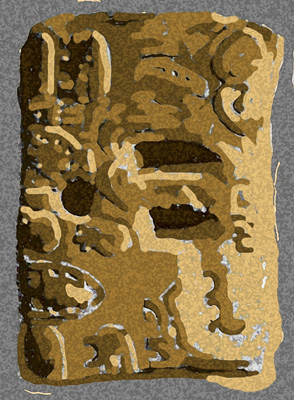
Block with Luwian hieroglyphs (from an old Turkish postcard).

I own a single resource with texts in Hieroglyphic Luwian (also known as Hieroglyphic Hittite) (Çambel 1999).  None of the texts in this volume come from seals – the main source of Indus inscriptions – although Luwian hieroglyphs do appear on seals.  This makes a direct comparison of statistical measures between the two scripts invalid.  In addition, this group of texts comes from a single location and is not necessarily representative of the script in general.  So any statistical measures cannot be generalized with any confidence.

Nevertheless, it may be of some value to compare sign frequencies between this corpus of Luwian (all on stone monuments) and that of Indus script (all on small objects).  The reason is that Indus script is sometimes characterized as a logo-syllabic writing system (e.g., Parpola 1994: 85; Wells 2010: 92-93).  It is worthwhile examining how the Indus script compares with a known logo-syllabic system, of which Luwian is one example.  Luwian is, of course, incompletely understood, but far better understood than Indus script.

I made a count of the number of times each Luwian sign occurred in the corpus of this single volume, with the exception of the highly fragmented portions.  With a combined total of 2,511 symbols, 133 potential signs occurred between 1 and 232 times each.  I say potential signs because I found it impossible to identify perhaps two dozen with absolute certainty due to broken or abraded surfaces.  Frequencies are summarized in the following table (data on Indus script is from Possehl 2002: 133).

Table 1.  Frequencies of Luwian hieroglyphs and Indus script.

Frequency of sign
No. of signs with this
frequency in
Luwian hieroglyphs
No. of signs with this
frequency in
Indus script
1-9
83 (62%)
219 (45.4%)
10-19
19 (14%)
100 (20.7%)
20-49
14 (10.5%)
86 (17.8%)
50-99
13 (9.8%)
46 (9.5%)
100 or more
3 (2.3%)
31 (6.4%)


To simplify the information in the table, we can combine the frequencies of all signs occurring fewer than 100 times, for which any statistical measures are likely to be invalid.  For this sample of Luwian hieroglyphs, that would yield 129 signs making up 96.3% of the total.  For the corpus of Indus signs, this yields 451 signs making up 93.4% of the total.  In both cases, only a very small proportion of signs occurs more than 100 times (3 Luwian signs making up 2.3% and 31 Indus signs making up 6.4%).  This broad similarity in frequency is one piece of evidence pointing toward the Indus script being a logo-syllabic script (along with the total number of signs).

In addition to these very general similarities in frequencies, both Luwian and Indus symbols demonstrate regularities in position.  For example, in the Indus inscriptions, POT is the most frequent sign by far, the only one that occurs over a thousand times.  When it appears, it is most often in final position.  In the Luwian inscriptions, the symbol for the syllable mi occurs more often than any other, multiple times in virtually every inscription and almost always at the top of each register (or row) of glyphs.  The precise total for mi should be approximately half the number I counted since “IC” occurs twice to make up this syllable.  Thus, instead of appearing 232 times, this syllable occurs 116 times.  But since I could not always see IC duplicated – i.e., I did not always find an even number of IC symbols – my counted total is probably inaccurate anyway. 

One of the main reasons that researchers consider the Indus script likely to be logo-syllabic writing system is the number of total signs.  Alphabets have fewer than 100 symbols; a syllabary may have 100 or so depending on the type of syllables represented; logographic writing such as Chinese has thousands of symbols.  Thus, the mixed type termed logo-syllabic writing is the best match with the Indus script, with symbols numbering in the hundreds.  In such a writing system, the syllabic (or other phonetic) symbols typically occur more frequently than the logographs.  This is clearly demonstrated in a previous post where I discussed Linear B (Mycenaean writing).  However, there may be some overlap in frequencies, with a small number of syllabic signs occurring rarely on the one hand, and a small number of specific logographs appearing especially frequently. 

The function of the most frequent logographs differs between writing systems and, indeed, between genres of inscriptions.  Logographs that represent a few commodities are the most common of this category in Linear B.  This is because the Linear B tablets are exclusively economic in nature, the texts being essentially names of commodities and numerals measuring them, with some proper names of people and places involved with transactions.  On Egyptian scarabs, glyphs that apparently represent wishes (such as ankh “life,” nefer “beauty, goodness” and djed “stability”) appear to be the most frequent logographs, while certain phonetic symbols are the highest in absolute frequency, especially the bread loaf t, zigzag n, and chick w (I have not yet completed an exact count of glyphs from a corpus of this type).  The prevalence of the ankh and similar signs, in this case, is probably due to magico-religious reasons.  Inscriptions that can be read mostly consist of personal names and titles or descriptions of professions.  Numerals are rare.  The Luwian texts I examined comprise a third type, neither economic nor onomastic.  Names of rulers do occur with some frequency, but the texts do not simply give names and titles, but also include descriptions of military and religious actions.  Numerals are rare in this corpus as on Egyptian scarabs.

Now let us examine the frequencies of Chinese characters as they appear in a small sample of oracle bone texts (Keightley 1985).  Since Chinese is the logographic system most commonly referenced in discussions of writing, it should prove illuminating.  Of course, modern Chinese could just as easily be described as “logo-syllabic” given the latitude with which that term is used (such as for Egyptian hieroglyphs, which do not actually represent syllables but only consonants).  That is, both semantic and phonetic information appear in most modern characters.  Often an element of the meaning resides in the “radical,” most often on the left side of a character, while a phonetic clue appears on the right in the form of a simple character whose pronunciation is indicated (or something close). 
A Chinese oracle bone inscripion: guei-mao [date] crack-making, [the] king divined:
[in the next 10-day] week, [there will be] no disaster.  In [the] 5th month, jia-chen
[date], yong ritual [performed to ancestor] Da Jia (Keightley 1985: 115, rephrased).

However, this type of combination character is not nearly as frequent in the early stage of writing on oracle bones (Keightley 1985: 68).  According to one study, 23% of oracle bone characters are pictographs or simple pictures, 32% are compound ideographs (such as the combination of the woman and child characters to form the word “good”), 27% combine radical and phonetic, 11% are “loans,” and 2% are abstract symbols.  The so-called loans are other types of characters (pictographs or compound ideographs) that have a second function representing an unrelated but homophonous word.  That is, where modern Chinese uses the radical + phonetic to distinguish characters representing homophones, oracle bone script often uses the same simple character for two different words that happen to sound alike.  Context distinguishes the two functions.  Of an estimated total script “vocabulary” of 5,000 or so characters, about half are understood by modern scholars (1985: 59). 

In the small, unrepresentative sample of texts included in this work, frequencies of characters are as shown in Table 2.

Table 2.  Frequencies of Chinese oracle bone characters.

Frequency of sign
or character
No. of signs with this
frequency in Chinese
1 occurrence
49 (38.6%)
2 occurrences
30 (23.6%)
3 occurrences
18 (14.2%)
4 occurrences
9 (7.1%)
5 occurrences
5 (3.9%)
6 occurrences
2 (1.6%)
7 occurrences
4 (3.1%)
8 occurrences
1 (0.8%)
9 occurrences
1 (0.8%)
10 or more
8 (6.3%)


Since no character appears more than 17 times in this small sample, the total numbers of occurrences are much smaller than for the Luwian or Indus samples.  Again, though, one can see that the majority of characters occur infrequently, with many singletons.  In these texts, the content is considerably more varied than in the texts of Egyptian scarabs, Near Eastern seals, or Linear B tablets.  Some of the Chinese texts are economic: the inscriptions may enumerate the turtle plastrons or animal scapulae brought in and prepared for divination.  But this is a relatively minor aspect.  Numerals are quite frequent – at least smaller ones – because the scribes write down the number of cracks made in the surface in the process of divination.  That is, each crack typically has a number.  Proper nouns are also common, both in the inscriptions describing preparation of oracle bones and in the main texts.  The main texts describe the charge – who performed the divination, when, and for what purpose – as well as often indicating the result (typically verification of the result that was foreseen).  Topics of divination include sacrifices, military campaigns, hunting expeditions, journeys, weather, agricultural activities, illness, childbirth, the source of various troubles, meanings of dreams, settlement building, tribute payments, and divine assistance or approval (Keightley 1985: 33-35).

The most frequent characters include the character referring to making cracks (bu 14 occurrences), or divining (zheng 17 occurrences), and those used in dates (e.g., jia 13 occurrences).  Dates often contain no numerals, instead combining the 12 celestial stems and 10 earthly (or horary) branches.  Some dates are more frequent than others because the people evidently performed divinations at the beginning of each 10-day “week,” to determine whether the coming period would be auspicious.  Many of the singletons in this sample are the names of the diviners, though the character wang, “king,” is the most common diviner referenced (14 occurrences).  In a more complete sample, particular diviners would appear frequently, each being involved with many divinations.

It is highly improbable that the Indus seals and tablets bear content comparable to the oracle bones.  But it is certainly possible that the inscriptions are magical and/or religious in nature.  In fact, magical and religious elements also appear within the restricted context of Near Eastern cylinder seals.  And as noted above, Egyptian scarabs often have magical or religious symbols alongside or instead of regular hieroglyphs.  Some scholars maintain that Indus signs are not writing, but magico-religious symbols (Farmer 2004).  While this may not be true of all the symbols, parallels from other Bronze Age cultures make this a distinct possibility.
Tablet H-316A with inscription (right to left): HAIRY HUNCHBACK // POT / COMB.

Specifically, Farmer suggests that the POT is a schematic representation of a tree, the so-called ritual stand in front of the unicorn on so many seals also representing a tree, pipal or fig (2004: 16).  He further states that the high frequency of POT in inscriptions indicates it was the central symbol of Harappan society (2004: 22).  He also sees the POT HATTED BEARER as the result of syncretic merging of a sacred tree and a likely divinity of water.  
Tablet H-308A with inscription (right to left): HAIRY HUNCHBACK // POT / COMB.

The common sequence of HAIRY HUNCHBACK / POT / COMB, in this author’s view, is a representation of a human sacrificial victim sitting before this same sacred tree (2004: 40).  This sign sequence is mostly found on miniature steatite seals, inscribed on both sides.  The reverse typically contains CUP alongside an apparent numeral (SINGLE POST, TWO POSTS, THREE POSTS, less frequently FOUR POSTS, and in a couple of rare cases, SIX POSTS).  This group of inscriptions (CUP + “NUMERAL”) may indicate an economic record of sacrifices (2004: 29).  The miniature inscribed objects might have served as something like vouchers for seasonal offerings.  For example, each “citizen” may have been required to present a measured amount of a particular commodity at a harvest festival.  In return, the “citizen” would receive one of these small seals showing that he had given his share.  These interpretations are speculative, of course, but provide some interesting possibilities to consider.

REFERENCES

Çambel, H. 1999. Corpus of Hieroglyphic Luwian Inscriptions. Vol. II Karatepe-Aslantaş. The Inscriptions: Facsimile Edition.  Berlin and New York: Walter de Gruyter.

Farmer, Steve. 2004. “Mythological function sof Indus inscriptions: Eight conclusions arising from the nonlinguistic model of Indus symbols,” Sixth Harvard Indology Roundtable, 8-10 May 2004.  Available online at http://www.safarmer.com/downloads .

Keightley, D.N. 1978 and 1985. Sources of Shang History: The Oracle-Bone Inscriptions of Bronze Age China. Berkeley: University of California Press.

Parpola, A. 1994 and 2009. Deciphering the Indus Script. Cambridge, MA: Cambridge University Press.

Possehl, G.L. 2002. The Indus Civilization: A Contemporary Perspective. Lanham, MD: AltaMira Press.
Wells, B.K. 2010. Epigraphic Approaches to Indus Writing. Oxford and Oakville: Oxbow Books.

Thursday, September 22, 2011

Universal Iconography (or is it?) and Indus Script

American pictographs of the Columbia Plateau, showing a bird and the "universal" X
(after Keyser 1992: 54, fig. 28c).


We are now in a better position to examine claims that one or another sign is universal.  If this term means that the symbol occurs in all cultures, we shall have a very short list of universals.  The vertical stroke – among Indus signs, the SINGLE QUOTE and SINGLE POST – and the CIRCLE may well be universal in the somewhat limited sense that they occur on every inhabited continent.  But these might well be the only universal symbols in that case.
African Adinkra symbol nyame nwu na mawu, "I live not when God is not," a variation of X
(after Willis 1998: 162).

If we expand the definition of “universal” to mean that a symbol appears in societies so widely separated in time and/or space that borrowing is unlikely, then the number of universals increases.  Universal motifs by this definition include CEE, CUP, and ROOF; CHEVRON; CIRCLE, CIRCLED DOT, and DONUT; QUOTES, POSTS, and ZIGZAGS; BARBELL and LOLLIPOP (whether round or angular); and GRID.  Other possibly universal symbols by this definition include EX, CROSS, ASTERISK, CIRCLED CROSS, CIRCLED ASTERISK (or CARTWHEEL), and MAN.  One or another bird as well as some type of quadruped also enter the ranks, but specific details of portrayal vary.
Small plaque from Altyn Depe showing a cross (a variation of the "universal" X),
two "posts," and a crescent (after Masson 1988: Pl. XXII, item 3).

This is beginning to sound much like the proposal put forward by Richard McDorman of a universal iconography (2009).  His thesis is that there is a set of universal symbols that various peoples draw from when creating symbol systems.  But while the shapes are similar from place to place and from time to time, the meanings are not consistent.
European tallies -- Alpine number billets representing numbers of cattle owned,
with X a numerical symbol (after Menninger 1969: 241).

It is this final point that my research reiterates.  Thus, using the meanings of symbols of one culture to interpret the similarly shaped motifs of another culture is unwarranted.  This means that Kinnier Wilson is on the wrong track in interpreting Indus signs as variations of proto-cuneiform signs, reading the Indus signs with Sumerian values, and assuming that this procedure reveals the meaning of the Indus inscriptions (1974).  This much is generally accepted.  That is, most researchers of the Indus script do not today espouse the Indo-Sumerian thesis. 
Indus seal M-326B with inscription including EX near center top.

But other scholars have fallen into the same enticing trap since Kinnier Wilson’s proposal.  Mahadevan uses Egyptian hieroglyphs to interpret various Indus signs (2008).  He notes the similarity of the Indus EX (my II 12) and Egyptian glyph Z10, an outlined “X” shape (which is interesting since this is the Old Kingdom form of Z9, a simple “X” like the Indus sign).  “The comparison enables us to assign the same general meaning to the corresponding Indus sign, ‘to divide, share’” (2008: 3rd page).  Is it that easy?  Unfortunately not.  In the first place, one might just as easily compare the Old Chinese “X” meaning “five,” the proto-cuneiform asymmetrical “X,” SILA3, which means “street, path, road” (and compare the proto-Elamite M006~b, also an “X”), the Runic “X” which represents g, the Luwian outlined cross representing the syllable lu, the Cretan hieroglyph of a cross with circles at the ends, no. 070, indicating the syllable ro, or North American and Australian “X” shapes in petroglyphs that may represent bird tracks.  Even assuming that the signs of the Indus script have the same underlying meaning as Egyptian glyphs – clearly an unwarranted assumption – the meaning of the glyph Z10 is not simply “to divide.”  As Gardiner notes, when a determinative, Z9 or Z10 can indeed mean “divide” (as in wpi and psš), but it can also mean “break” (as in hdi and gmgm), “to lessen” (as in xbi), to cross or encounter (as in d3i, wšb, 3bx).  The same “X” can mean “one-fourth” as well as serving as a determinative for no explainable reason (as in nkt and t3š).  Instead of a determinative, it can even represent any of half a dozen phonetic elements (including sw3, xbs, and wp).  Given these many uses of Z9/Z10, one cannot be confident that the Indus EX means only “to divide, share” (Gardiner 1976: 538-539).
Detail from a plaque showing the family of Ur Nanshe of Sumer -- note the three triangles above a "rake"
on the man to the far left, KUR, "mountain; (foreign) land; netherworld; the east" (after Aruz 2003: 31, fig. 16).

Mahadevan similarly interprets the Indus TABLE (my III 6) as a variation of the Egyptian glyph N1 (2008: 5th page).  Because the glyph represents the sky or heavens, Mahadevan reasons, so the Indus TABLE must mean “sky, heaven, pertaining to god.”  Instead of Egyptian, though, one might compare Old Chinese jiung3, “suburbs, country; the space,” now the 13th radical; or the runic symbol for e, or again similar shapes appearing in North American rock art (see my previous post on III 6 for full listing and references).  Assuming that Egyptian can provide the basis for interpretation of Indus signs, a further objection is that it is not obvious which Egyptian glyph is most similar to the Indus TABLE.  The sky glyph (N1) is not a simple, three-stroke motif as is the Indus sign.  Perhaps a closer match is glyph O1, pr “house.”  Even if we could be confident that the Indus sign followed the Egyptian N1 in meaning, we could not be certain that “sky” was the primary significance.  In some words, the Egyptian N1 appears to represent a gate or portal rather than the heavens (as in rwty, “the double gate,” ht or hyt, “portal,” and perhaps in h3t “ceiling”) (Gardiner 1976: 485).
Egyptian hieroglyphs from a Theban tomb, including the three hills (above three "posts")
glyph N25, determinative of foreign lands and the desert (after Gardiner 1976: frontispiece).

Mahadevan goes a step further when it comes to interpreting compound signs.  He assumes that the parts of the compound maintain their original meanings so that the meaning is also a compound.  For example, the ROOF means “heaven” (more or less) and the EX means “divide, share,” so EX UNDER ROOF must mean “god’s share” (2008: 5th page). 
Chinese oracle-bone script showing three variants of a character that may be ancestral to yue4,
"mountain peak" (or "wife's parents"), not the same character as shan1, "mountain" (Keightley 1985: 218).

However, in Egyptian, a combination of glyphs may or may not follow this simple additive pattern.  In the combination of the vulture (G1) and sickle (U1), both elements help to spell out m3.  The result is hardly a “harvest of vultures” or “vulture who wields a sickle.”  Both elements are phonetic and neither conveys the meaning (as in sm3wy, “to renew”). 

A second pattern appears in glyph O35, made up of the bolt (O34) atop the walking legs (D54).  As an independent glyph, the first can be an ideograph meaning “bolt” while the second can be an ideograph in “come” or a determinative of movement in general.  But the combination certainly does not signify a wandering bolt.  Instead, the bolt seems to convey the phonetic value s, with the feet still indicating movement.  This is the rule for compound glyphs with the feet (D54).  The reed with feet (M18) appears in the verb ii, “come,” where the reed provides a hint of pronunciation and the feet indicate movement; the pool with feet (N40) appears in the verb šm, “go,” where the pool provides part the first phonetic element and the feet again represent movement (see also T32, the knife with feet; V15, the tethering rope with feet; and W25, the round pot with feet). 

The forearm (D36) combines with other glyphs in a third manner.  While D36 frequently represents a consonant (transliterated with an apostrophe), it does not have this sense in D37, where the hand holds a triangular bread loaf (which is X8).  This combination of D37 + X8 means “to give” (and not “bread in hand” or “handful of bread”).  When the same forearm appears with the hand holding the round pot (D37 + W24) the combination is a determinative for “present” or “offer.”  When the hand holds the flagellum (S45), the meaning is often “protect.”  But if the hand is holding the ‘b3 sceptre (S24), the meaning becomes “administer, control.”  In these ligatures, neither element provides phonetic information.  The meaning derives from the combination though, not from an addition of the meanings of the individual parts.
Detail from Indus seal M-29 with inscription: STRIPED TRIANGLE / SPACESHIP / FISH / BI-QUOTES //
CIRCLED TRI-FORK / FISH UNDER CHEVRON / WHISKERED FISH / STACKED 12 / POT
(does the SPACESHIP mean the same thing as TRIPLE TRIANGLES or are they different?).

In Chinese, several patterns also appear.  There is a character resembling the Egyptian walking legs, ren2, “person.”  It is a common radical in compound characters, usually occurring on the left side.  Beside the character fang1, Mahadevan’s additive method of interpretation would yield something like “human region” or “square man.”  But in fang3, the person radical hints at the meaning while the second element provides the pronunciation.  This word means “to imitate, copy.”  Similarly, the same fang1 (“square, region”) appears to the right of mi4, the character for “silk.”  This compound character is also pronounced fang3, now with the meaning “to spin.”  This type of combination, where one element provides some of the meaning and the other conveys the pronunciation (in a rough way), is the most frequent.

But there are other patterns as well.  Two independent characters sometimes combine to represent a meaning that neither suggests alone.  Such is the case with hao3, “good,” which is written with the character for “woman” (niu3) beside that for “child” (zi3).  The character of the woman also appears beneath the Chinese roof element in the word for “quiet, rest” (an1).  When the same roof is over the pig character, the combination signifies “family” (jia1).  Thus, “woman” plus “child” does not mean “mother” or “family” and “woman” plus “roof” does not signify “woman’s house” or “housewife.”
Indus seal H-515 with inscription: TWO POSTS / MALLET / POTTED ONE / CORN HOLDER /
TRIPLE TRIANGLES / CRAB / POT (do the 3 triangles mean "mountain" or "dairy"?).

Thus, adding together the meanings of Indus signs – even if we could be certain that the separate meanings were correct – may not give the correct definition of a ligature.  This is not the only type of error that researchers make in moving from the known (signs in proto-cuneiform or in Egyptian hieroglyphs) to the unknown (Indus signs).  Fairservis, for instance, defines the Indus SPACESHIP as “mountains” (his N-1, my VIII 22).  The reason for this identification is that this symbol is a “universal sign” (1992: 1978).  Three triangles in a stacked configuration do appear in proto-cuneiform, transliterated KUR following the phonetic form of the later Sumerian descendant of the sign.  In Sumerian, this means “mountain; (foreign) land; netherworld.”  But this is not actually universal.  An Egyptian glyph representing three hills side by side (N25) suggests possible meanings “foreign land” or “desert,” not specifically “mountain.”  A stacked variation does not occur.  Three triangles side by side appear in Luwian hieroglyphs as the ideogram CASTRUM, “fortress.”  The Old Chinese shan1 has three vertical strokes rising from a triangular element with a rounded base.  Wieger interprets the pictorial elements as a single mountain with three rocks on top (1965: 208).  Thus, “mountain(s)” may appear as a symbol with three repetitions in it (as in proto-cuneiform and in Chinese), but such a meaning is not universally conveyed in this manner (as in Egyptian and Luwian).  Besides these facts, it would seem that by Fairservis’ own argument, the Indus TRIPLE TRIANGLES ought to mean “mountain” as well.  But Fairservis does not propose this, defining it rather as “dairy, storage.”
Four variants of Old Chinese yu3, "rain" (Keightley 1985: 217).

Fairservis would seem to be on firmer ground when he proposes the meaning “rain” for the Indus STACKED NINE UNDER TABLE (his F-10, my XII 35).  He compares with this the Egyptian glyph of vertical strokes descending from the sky (N4).  There is a certain resemblance, though the two are not identical.  The Chinese character for rain, yu3, is something like a “table” with a “stacked four” beneath, plus a horizontal stroke above, a vertical stroke descending from the latter down through the rest of the character (thus separating the “stacked four” into two “stacked two” elements).  Again, the character is not identical to either the Egyptian hieroglyph or Indus sign XII 35, but there is a resemblance. 
Two variants of proto-cuneiform GI6, "black, dark," resembling the Chinese "rain."

This Indus sign and the corresponding glyph appear in the list “Signs Universal in the Ancient World” (Fairservis 1992: 228).  In the same table there are two “archaic Sumerian” symbols.  The latter are now transliterated GI6 (a “stacked eight” under a chevron and a rounded “roof” over as many as 14 dots that are not neatly arranged).  This sign, in later Sumerian, does not represent rain but means “(to be) black/dark.” 

The “universal” sign for “rain” does not always mean “rain,” then.  Fairservis includes an Old European motif, a “C” with several horizontal strokes beside it, for comparison, as if to demonstrate the universality of the symbol.  But of course, the meaning of this European symbol is not known, so it may or may not represent rain.  We may also compare the horizontal “comb” element that depicts rain in the Puebloan style of North American art (Newcomb and Kirkland 1996: 198).  The symbol most likely to represent rain in Nevada and eastern California is similar to the “comb,” but also has the stem curving back over it so that it could be a schematic quadruped instead (e.g., Heizer and Baumhoff 1984: 140, fig. 77b).  There is, then, no single “rain” symbol that is truly universal.  A "comb" seems to be more common than dots or lines beneath a roof-like element, despite Fairservis' assertion.  However, the Puebloan comb-shaped element -- known to mean "rain" in the American Southwest -- is interpreted not as rain but as "comb," that is as depicting an actual comb when it appears in the Indus script (Fairservis 1992: 177, his L-9).

Having discussed each of the Indus signs in turn, I would note that such cross-cultural comparisons cannot reveal the meaning of the Harappan symbols.  At best, such comparisons can only suggest possibilities for interpretation.  And since several different meanings are generally ascribed to a given form, anyone who uses comparisons in this way must really investigate each one. 

REFERENCES

Aruz, J., ed. 2003. Art of the First Cities: The Third Millennium B.C. from the Mediterranean to the Indus. New York: Metropolitan Museum of Art and Yale University Press.
Fairservis, W.A. 1992. The Harappan Civilization and Its Writing: A Model for the Decipherment of the Indus Script. Leiden: E.J. Brill.
Gardiner, A. 1976 and 1927. Egyptian Grammar. Oxford: Griffith Institute and Ashmolean Museum.

Heizer, R.F. and M.A. Baumhoff. 1984. Prehistoric Rock Art of Nevada and Eastern California. Berkeley: University of California.
Keightley, D.N. 1985 and 1978. Sources of Shang History: The Oracle-Bone Inscriptions of Bronze Age China. Berkeley: University of California.
Keyser, J.D. 1992. Indian Rock Art of the Columbia Plateau. Seattle: University of Washington.
Kinnier Wilson, J.V. 1974. Indo-Sumerian: A New Approach to the Problems of the Indus Script. Oxford: Clarendon Press.

McDorman, R.E. 2009. Universal Iconography in Writing Systems: Evidence and Explanation in the Easter Island and Indus Valley Script. Amazon (Kindle edition).
Mahadevan, I. 2008. “Agricultural Terms in the Indus Script” in Journal of Tamil Studies, available:
http://www.harappa.com/arrow/indus-agricultural-terms.pdf

Masson, V.M. 1988. Altyn-Depe. Transl. H.N. Michael. Philadelphia: The University Museum, University of Pennsylvania.
Menninger, K. 1969. Number Words and Number Symbols: A Cultural History of Numbers. Transl. P. Broneer. Cambridge, Massachusetts: M.I.T. Press.
Newcomb, W.W. Jr. and F. Kirkland. 1996. The Rock Art of Texas Indians. Austin: University of Texas.
Wieger, L. 1965. Chinese Characters, Their Origin, Etymology, History, Classification and Signification. Transl. L. Davrout. New York: Paragon and Dover (orig. 1927 by Catholic Mission Press).

Willis, W.B. 1998. The Adinkra Dictionary: A Visual Primer on the Language of Adinkra. Washington, D.C.: Pyramid Complex.

Friday, September 16, 2011

Indus Script and Semasiography

Seal M-314, bearing the longest Indus inscription: CARTWHEEL / BI-QUOTES //
FISH UNDER CHEVRON / WHISKERED FISH / FISH / SPEAR //
DOUBLY CAGED AY / CUPPED SPOON / TRI-FORK TOPPED POT / POT //
THREE POSTS / CIRCLED TRI-FORK / PANTS / MAN HOLDING DEE-SLASH /
TRI-FORK / CIRCLED VEE / QUADRUPED (probably 3 units of information).

At this point, we should examine the evidence presented against the hypothesis that the Indus script is a writing system (Farmer, Sproat, and Witzel 2004).  There are several indicators noted in this famous paper, all of them suggesting that this script is not a fully developed writing system:

(1)    Brevity of the inscriptions, with an average of 4 to 5 signs each, the longest by any count containing fewer than 30 signs;

(2)    The absence of evidence that longer inscriptions once existed on a perishable medium (such as remains of “inkpots, brushes, palettes, styli, pens, and other literate paraphernalia; representations of scribes, texts, and writing instruments in art or pictographic scripts; and major changes in the shapes and orientations of signs tied to scribal attempts to increase the efficiency of copying long texts” (2004: 25);

(3)    The odd sign frequencies, described above, in which twenty signs account for over 50% of all sign occurrences, while the vast majority of signs are rare;

(4)    The low frequency of sign repetition within single inscriptions, which suggests that the signs did not represent phonetic information;

(5)    Within the group of repeating signs, some seem to appear in groups (such as the various types of FISH that appear in a series), and when a specific sign does repeat in an inscription, it may repeat several times in a row, which suggests a possible enumerative function rather than encoding of phonetic information;

(6)    Besides the large number of singletons and rare signs, new excavations tend to turn up still more of this class, suggesting that new symbols were created as time went on, a characteristic not normally found in phonetic writing;

(7)    Some non-linguistic symbols “exhibit a kind of linearity that is not dissimilar from the sort found on some (but by no means all) Indus inscriptions,” including Vinča inscriptions from southeastern Europe and the symbols of deities on kudurru and elsewhere in the Near East;

(8)    Sometimes symbols with seemingly clear meaning behave in odd ways, such as apparent numerals appearing in inscriptions where they appear not to qualify or enumerate anything -(e.g., K-59 which reads: DEE-SLASH / SINGLE POST / STACKED THREE / STACKED FIVE; or K-49: THREE QUOTES / STACKED SEVEN / MAN WITH SHOULDER YOKE).

The conclusion of Farmer et al is that “Indus inscriptions were neither able nor intended to encode detailed ‘messages,’ not even in the approximate ways performed by formal mnemonic systems in other nonliterate societies.  Their most likely function, as suggested by Near Eastern parallels, was to associate individuals, families, clans, offices, cities, festivals, or professions, etc., with specific gods or their celestial correspondents, partly for identification purposes and partly to draw down whatever magic was accessible through those gods’ symbols” (2004: 42-43).
A sealed proto-Elamite economic tablet from Susa, with two numerals;
perhaps to be read "twelve [animals]" (after Potts 1999: 61, Pl. 3.1)

We may wish to examine some of these arguments in greater detail.  For example, some scholars counter the fact of the brevity of inscriptions by presuming that longer texts did occur, but on perishable media.  They may cite the existence of long texts on such media in later, historical periods, as evidence by analogy (e.g., Parpola 2009: 54).  Historical arguments of this type are very weak evidence, since we know of a great many things that only came to exist in later, historical periods.  For example, we cannot look at the bronze artifacts from the Indus Valley and say that, because iron and steel implements also appear later on, the Indus Civilization must also have produced iron and steel – in the Bronze Age.  No, in the Bronze Age, implements were made of bronze, while iron came into use later.  No doubt many objects were made of perishable material during the Bronze Age and so are lost to us.  For example, cloth has not survived from this period in the Indus Valley.  However, unlike the proposed long texts, there is evidence of cloth and clothing from Harappan statues and figurines that were modeled to depict clothing.  Thus, even though the cloth itself is gone now, we do find evidence that it existed during the Bronze Age.  This is the type of evidence that Farmer et al do not find when it comes to longer Indus texts.  Not only are there no long texts, there is no indirect evidence that lengthy inscriptions once existed.
Analysis of proto-Elamite tablet TY 7, showing the three typical parts: heading ("hairy triangle"),
entries in numerical form concerning grain, and total from the reverse (Damerow and Englund 1989: 39). 

This by itself is insufficient to make the case against Indus script being a fully developed writing system, of course.  Most of the evidence for a Lycian script comes from short inscriptions, for example, as is also true of Etruscan (although in each of these cases there is also at least one long text).  It is sometimes argued that absence of evidence is not evidence of absence.  But, of course, when no evidence is forthcoming, that does suggest something.  In other words, absence of evidence is indeed a kind of evidence for absence; it just is not proof. 

Regardless of this point, Farmer et al have additional arguments that are stronger.  The statistics on sign frequency suggest that Indus “script” is a proto-writing system along the lines of proto-cuneiform and proto-Elamite.  They themselves note this parallel.  Now, an Assyriologist may not focus on proto-cuneiform not being a fully developed writing system, because, in time, it did develop into such a system.  Determining the precise point at which this happened seems unimportant because of the continuity. 
A tag from Egyptian Tomb U-j at Abydos bearing possible early hieroglyph
(after O'Connor 2009: 145).

Egyptian hieroglyphs also had an early phase that may have been proto-writing, as evidenced by the brief inscriptions on tags (small, flat, rectangular objects of wood or ivory on which there may be a glyph or two) found in pre-Dynastic tombs at Abydos (O’Connor 2009: 143-147).  Here again, the determination of the exact point at which proto-writing developed into true writing is not a major focus of scholars.  That it did develop into true writing is clear.

But in the case of both proto-Elamite and the Indus script, there is no continuity with later writing systems.  Instead, these early systems died out.  This is also the case with Aztec proto-writing in Mesoamerica.  Unlike the neighboring Mayans, the Aztecs (and their predecessors) did not develop true writing and eventually their symbols ceased to be used at all.
Detail from a Mixtec "map" (lienzo) with year sign (AO combination), attached numeral indicating date,
footprints on path indicating movement, and a geographical glyph for Zacatepec (Smith 1973: 268, fig. 89).

Moving to the second argument against the Indus script thesis, Farmer et al note the absence of Harappan artwork depicting scribes at work along with the equal absence of archeological evidence that writing occurred.  This, too, is rather weak evidence, but evidence it still is.  The third argument, the peculiar frequency data, with many rare signs versus a small core of frequent signs, was discussed in the previous post.

The fourth argument focuses on the behavior of the frequent signs, the core symbols that appear again and again.  I noted in the last post that the Egyptian glyphs representing single consonants tend to occur the most frequently, even in the limited area of royal names and titles in cartouches.  I noted that the bread loaf representing t is one of the most common glyphs, a symbol that appears twice in King Tut’s name (in the New Kingdom) and twice in the name of two First Dynasty kings, Atet I and II (during the Old Kingdom).  Other glyphs are sometimes doubled, as is the case with the irrigation ditches (N24) representing Semti, fifth pharaoh of the First Dynasty, and as is the case with Bebi, a king of the Second Dynasty (the glyph of a human leg and foot, D58, is doubled, representing b).  The final element in these names is –i or y, a sound that represents dual number in the Egyptian language.  In the names, the same sound may or may not represent the dual.  Glyphs can also be tripled to represent the plural, as in the name of the fifth king of the Fourth Dynasty, Menkaure.  But besides such consecutive repetitions, glyphs can be repeated in non-adjacent positions.  This is the case of the chick (G43) representing w in the name of Khufu (Fourth Dynasty), as is also true of the reed (M17) in Asa (son-of-Ra name of Shepseskara of the Fifth Dynasty).
Tablet H-764AB with inscriptions: CIRCLE / 3 TOED FOOT / POT (A side);
TRIPLE CUPS (B side) (tripling may be enumerative, i.e., equal to 3 + CUP).

A fair number of Indus signs appear either singly or doubled, e.g., the GRID, the CEE, and CIRCLE.  Less commonly, one finds a symbol repeated in a non-consecutive position: M-396 contains two of the BLANKET WITH FOUR TICKS separated by four signs; H-369 contains two of the POTTED ONE separated by one sign; M-634 contains three of the CARTWHEEL with one sign separating each instance.  If this type of repetition were common in Indus inscriptions, this would suggest that phonetic information was conveyed by the common, repeating signs, as in Egyptian.  But since this kind of repetition is infrequent, the argument against phonetic encoding is supported.
Reverse of seal M-326B with inscription (from right): STRIPED TOP / EX / THREE QUOTES / CARWHEEL // BARBELL ON POST / TWO POSTS & BACKSLASH / BARBELL ON POST / (?) POSTS (corner abraded).
(If we add these signs, those in the inscription on the A side, and those on the edges, there are 20 signs altogether).

The fifth argument addresses the kind of sign repetition that occurs more often, doubling and tripling in consecutive series.  Parpola mentions this:

A few signs occur with three- or fourfold repetition: [TRIPLE BOATS, TRIPLE RECTANGLES, TRIPLE CUPS, QUADRUPLE TRI-FORKS].  Of these signs, only [CUP] and [TRI-FORK] are preceded (in other texts) by groups of strokes, which evidently denote numbers.  The sequence [CUP / CUP / CUP] occurs on the reverse sides of some of the miniature tablets from Harappa, which normally show the sequences [CUP], [TWO POSTS / CUP], [THREE POSTS / CUP], or [FOUR POSTS / CUP].  The sequence [CUP / MAN HOLDING CUP] in the broken seal inscription 1165 [CUP / MAN HOLDING CUP / BI-QUOTES // BELTED FISH /...] is paralleled by the sequence [TWO POSTS / MAN HOLDING CUP] on the reverse of tablet H-247.  The sequences [TRIPLE TRI-FORKS] and [QUADRUPLE TRI-FORKS] form the entire inscriptions of two ivory sticks (2795 and 2803), but a third ivory stick (2792) bears the inscription [FOUR QUOTES / QUINT-FORK].  It therefore seems safe to regard [TRIPLE CUPS] and [THREE POSTS / CUP] as alternative ways to write ‘3 CUP' (2009: 81).

Farmer et agree that this kind of sign repetition is enumerative rather than phonetic.  It may very well be.  I would point out, though, that such repetition is only quasi-enumerative in Egyptian, with three repetitions of a glyph often representing a plural form (ending in –w), alongside rare instances of quadrupling where three instances still represent the plural form with the fourth representing phonetic repetition, as in Nefer-neferu-aten, with three nfr glyphs for –neferu- and a fourth nfr representing the initial Nefer-.
Impression of a cylinder seal with Mesopotamian images but Indus inscription, MS2046 (from right):
STACKED TWELVE / DEE & BACK DEE OVERLAPPING / MAN WITH SINGLE STRIPED EAR (?) / SPEAR.

Farmer et al further note that continuing excavations periodically turn up additional Indus symbols.  For example, there is an apparent lizard, depicted in bird’s eye view, on a seal in the Schoyen collection, a sign not included in any published list.  Another seal contains an inscription with another new symbol, a DEE with a BACK DEE overlapping it.  This type of open-endedness is to be expected in a proto-writing or non-glottographic system, especially if there is a need for new symbols to representing “owners” – just as in modern Texas, there is always room for another cattle brand to represent the owner of the livestock.
Stone block with Luwian hieroglyphs -- within the neatly incised lines separating the rows,
the hieroglyphs are grouped in a largely non-linear fashion, even though this is true writing
(from an old Turkish postcard).

An additional argument focuses on the linearity of Indus symbols.  The fact that the signs often appear in neat rows makes the script seem like writing.  But this is only a subjective judgment.  Symbols that are not linguistic have been known to appear in similar rows.  Farmer et al cite the symbols on kudurru, the foundation stones of Kassite Babylonia that bear both written texts and non-linguistic emblems of deities.  Both the signs of the text and the non-linguistic emblems are neatly aligned in rows.  To this observation I note some Navaho sand paintings, in which representations of yeis (supernatural beings) also line up in rows (Newcomb and Reichard 1975: Pl. III, with three rows of four Snake People).  In fact, the preschool child often arranges toys in a neat linear manner as a habitual form of play.  So the urge to make linear arrangements may be universal (although obviously that urge is much less strong in some people than in others).
Proto-cuneiform inscription on the Blau chisel, showing grouping of signs in compartments
rather than a strictly linear arrangement (drawn after Aruz 2003: 39).

The reverse of this argument is also of interest.  Signs of a known writing system may not necessarily be arranged in lines – whether rows or columns.  Egyptian hieroglyphs could be written either in rows or columns, from right to left or from left to right.  But even within each row or column, the glyphs do not always follow one another in a perfectly linear sequence.  Two small glyphs are frequently stacked one on top of the other in a row.  In effect, this creates a short column within a row.  And in a column, two tall and thin glyphs are frequently placed side by side, in effect forming a row within a column.  In addition, even within a word, glyphs sometimes follow a peculiar sequence.  Theophoric elements in names precede other glyphs, regardless of the sequence in the spoken language.  In King Tut’s name, for example, the last element is Amun, the name of the ram god.  But when the king’s name is written, the two glyphs spelling Amun appear in initial position, with Tut- and –ankh- following.  Luwian hieroglyphs appear even less ordered than Egyptian, in a great jumble of symbols minimally arranged in rows.  So linearity is not necessarily a sign of a writing system and writing is not necessarily linearly arranged.

Indus seal B-10 with non-linear arrangement of symbols in the inscription:
SEVEN QUOTES // TRI-FORK (or is the latter an abbreviated cult stand?).
Farmer et al also note some of the peculiarities of the apparent numerals in the Indus script.  Some of the oddest inscriptions seem to contain nothing for the “numerals” to enumerate.  With Korvink’s analysis of the various BEARER signs as terminals, how does one analyze such inscriptions as M-96 (FOUR QUOTES / POT-HATTED BEARER), or M-919 (THREE QUOTES / BEARER), or the bare "numeral" in B-10 (SEVEN QUOTES)?  Similarly, bearing in mind Korvink’s analysis of sign + BI-QUOTES as a prefix, how can one interpret M-692 (CIRCLED VEE / BI-QUOTES // FOUR QUOTES / SINGLE POST)? 
Tablet H-892A and B: note inscription on B begins with CUP on right.


Tablet H-951A and B: note the B begins with FOUR POSTS on right, ending with CUP.
The apparent numerals that do appear alongside other types of signs are sometimes described as preceding the other sign, supposedly an indication that qualifiers in general must have preceded their referents in the Harappan language.  For example, Koskenniemi and Parpola cautiously state, “Soviet scholars have expressed an opinion which we share that the Indus language appears to be fairly consistently left-branching” (1982: 12).  It is indeed common to find CUP preceded by an apparent numeral on tablets (reading right to left).  But there are also tablets with the opposite sequence, the “numeral” preceded by the CUP (H-771B right to left FOUR POSTS / CUP; H-777B CUP / TWO POSTS; H-784B TWO POSTS CUP; H-781B CUP / THREE POSTS). 

It is not just the tablets that present such contradictory data.  On seals, one frequently finds a sequence with one or another form of SEVEN preceding EF TOPPED EXIT (e.g., in H-268) (19 occurrences), but almost as common is STRIPED TRIANGLE followed by SEVEN (12 occurrences).  Similarly, some form of THREE precedes OVERLAPPING CIRCLES 18 times, but typically follows CUPPED POST or CUPPED SPOON (as in M-714).  Thus the “numerals” neither inevitably precede nor invariably follow a sign in pair-wise combinations.  If these symbols were interpreted linguistically, one would be at a loss to explain such contradictory pairings.

It is for these reasons that I accept the argument of Farmer et al that the Indus script does not represent fully developed writing.  Or, as Malcolm Hyman prefers to express it, this script is non-glottographic.  In his point of view, the important question is what relationship exists between glottographic and non-glottographic writing? (2006: 1-29).  His suggested answer is that there is no simple dividing line between these two types.  Even a society that has glottographic writing will often still continue to use non-glottographic “writing” or symbols.  As noted earlier, while we have true writing today, we also use non-glottographic numerals.  Thus, semasiography or non-glottographic systems are not failed writing, not mere historical stages on the way to true writing.  They may serve entirely different functions.  So it would be more useful to focus on the question of what functions a non-glottographic Indus system performed and how this was accomplished rather than attempting to assert that it was glottographic in the absence of clear evidence.


REFERENCES

Aruz, J., ed. 2003. Art of the First Cities: The Third Millennium B.C. from the Mediterranean to the Indus. New Haven: Metropolitan Museum of Art and Yale University Press.

Budge, E.A. Wallis. 1920 and 1978. Egyptian Hieroglyphic Dictionary. Volume I-II. New York: Dover (1978 reprint of 1920 original, published by John Murray, London).

Dahl, Jacob L. 2005. “Animal Husbandry in Susa during the Proto-Elamite Period” in SMEA 47: 81-134.

Damerow, Peter and Robert Englund. 1989. The Proto-Elamite Texts from Tepe Yahya. Cambridge, Massachusetts: Peabody Museum of Archaeology and Ethnology, Harvard University.

Englund, Robert. 2001. “The State of Decipherment of Proto-Elamite,” available at cdli.uncla.edu online.

Fairservis, Walter A. 1992. The Harappan Civilization and Its Writing: A Model for the Decipherment of the Indus Script. Leiden: E.J. Brill.

Farmer, Steve, Richard Sproat, and Michael Witzel. 2004. “The Collapse of the Indus-Script Thesis: The Myth of a Literate Harappan civilization,” in Electronic Journal of Vedic Studies (11) 2: 19-57.  Available at http://www.safarner.com/downloads

Hyman, Malcolm D. 2006. “Of Glyphs and Glottography,” in Language and Communication.

Koskenniemi, Kimmo and Asko Parpola.  1982. A Concordance to the Texts in the Indus Script. Helsinki: Department of Asian and African Studies, University of Helsinki.

Korvink, Michael P. 2007. The Indus Script: A Positional Statistical Approach. Gilund Press (Amazon).

Nakanishi, Akira. 1980. Writing Systems of the World: Alphabets, Syllabaries, Pictograms. Boston: Tuttle Publishing.

Newcomb, F.J. and G.A. Reichard. 1975. Sandpaintings of the Navajo Shooting Chant. New York: Dover (orig. 1937 by J.J. Augustin).

O’Connor, David. 2009. Abydos: Egypt’s First Pharaohs and the Cult of Osiris. London: Thames & Hudson.

Parpola, Asko. 2009 and 1994. Deciphering the Indus Script. Cambridge: University Press.

Potts, D.T. 1999. The Archaeology of Elam: Formation and Transformation of an Ancient Iranian State. Cambridge: University Press.

Smith, M.E. 1973. Picture Writing from Ancient Southern Mexico: Mixtec Place Signs and Maps. Norman: University of Oklahoma.

Wells, Bryan K. 2011. Epigraphic Approaches to Indus Writing. Oxford: Oxbow Books.
Old Persian cuneiform unicode document: http://titus.uni-frankfurt.de/personal/jg/unicode/table8.htm