Showing posts with label rock art. Show all posts

Sunday, May 15, 2011

More Indus Rarities: The Last 10 Seven-Stroke Signs


The last ten of the seven-stroke signs are quite rare.  None occurs more than three times, according to data I have at hand.  The first of these is one I have not seen, found only in the list worked up by Koskenniemi and Parpola (KP370).  I have assigned it the awkward title SLASH IN DONUT WITH EAR (VII 54).  Apparently it is a circle inside another circle, with an “ear” (or small chevron) attached near the top on one side, and a diagonal mark within the inner circle.  Although I have not seen this sign in the Corpus, I include an illustration showing how it might appear.

Indus sign VII 54 as it might appear in a seal impression.

In proto-cuneiform there is a parallel for the “donut” portion, i.e., the circle within a circle.  This symbol is transcribed |LAGAB~a x LAGAB~a|.  Placing two terms between lines in this way is the standard method for indicating that one sign is inside another, in this field.  The sign means “lamb.”  But there is no variant of LAGAB that has an “ear.”  Nevertheless, another sign does have an “ear” – though a much larger appendage than seen in the Indus sign – even though it has no internal circle.  This is KAB, “bit or bridle.”  Neither of these has a slash inside.

Luwian glyph hara/i, a distant parallel to Indus sign VII 54.

Luwian hieroglyphs include a “donut” with both internal and external marks.  It is a rather unusual glyph, not an ideograph but not a syllabic sign either: hara/i.  In form it is a circle in a circle with a short “tail” or slightly curved line attached to the base (rather than an “ear”).  There is a slash and a backslash as well, forming an “X” mark, inside the larger circle.  Thus, all in all, though this glyph is reminiscent of the Indus sign, it is also distinctly different.

A proto-cuneiform "donut," |LAGAB~a x LAGAB~a|, "lamb."

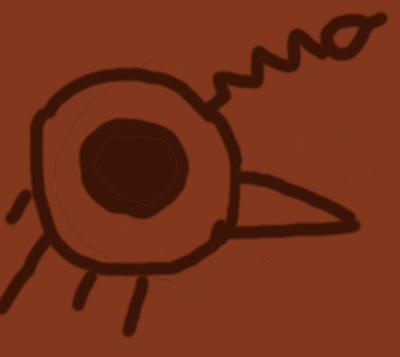
Modified circles and “donuts” also appear in the rock art of North America, though I have seen nothing quite like the Indus VII 54.  In Texas, one instance is a circle within a circle with an elongated “ear” on one side, an attached zigzag angling from near the top, and four short slashes protruding from the base.  Judging by the similarity of this complex motif to others that occur on or next to the arm of an anthropomorph, I think this represents a shield.

A proto-cuneiform circle with "ear," KAB, "bit or bridle."
An American "donut," probably a shield (Newcomb and Kirkland 1996: 82, Pl. 43, no. 1).


Today’s second sign is SKEWERED STACKED TRIPLE CIRCLES (VII 55), also known as KP353(b), W361, and Fs L-11.  Fairservis sees this as representing beads on a string or a necklace, though he suggests it means “great, superior.”  Wells notes three occurrences, two at Harappa and one at Kalibangan.
Seal H-155 with inscription: SKEWERED STACKED TRIPLE CIRCLES /
VEE IN DIAMOND / LAMBDA / SINGLE QUOTE // HUNCHBACK / POT.

Among the Egyptian hieroglyphs, there are two that resemble this Indus sign.  If the three circles stacked one on top of the other are to be seen as beads on a string, then glyph S16 is the best parallel.  It depicts a pectoral (or chest ornament) of glass or faience beads, a large circle with three strings of smaller circles dangling from it.  It is probably not significant, but the ones I have seen include four beads in each string.  The other glyph is V28, a wick of twisted flax, the common phonetic glyph h (with a dot beneath it).
Indus VII 55 (far left) and analogous signs (from second from left): proto-cuneiform NUNUZ~c,
NUNUZ~a2, proto-Elamite M308~e, and enigmatic symbol from American Southwest (lower right).

Old Chinese also provides two parallels.  Each of these characters contains two circles, one over the other, and a very short vertical stroke joining them.  Written in just this fashion, the first character is lü3, “the spinal vertebrae....By extension, tones in music, on account of their succession” (Wieger 1965: 227).  (Personally, I find it difficult to see any resemblance in meaning between the backbone and musical notes, but maybe I have less imagination than Wieger.)  The second character has one additional stroke, another short vertical mark attached to the top of the upper circle: yao1, “the lightest thread, as it is obtained from the simultaneous winding of two [silkworm] cocoons.  By extension, thread, slender, tender” (1965: 225).  The latter character is now the 52nd radical and shows no signs of having once contained circles.
More parallels for Indus sign VII 55 (from left): symbols from American Southwest (first two),
Egyptian glyph S16, Old Chinese lu3

Proto-cuneiform includes a better parallel to the Indus sign with NUNUZ~a2, made up of three impressed circles, one over the other, with an incised “V” inside each.  Another variant takes the form of just two stacked diamonds rather than circles, and instead of “V” marks it has a single vertical line running through both diamonds (NUNUZ~c).  However it was written, this sign came to mean”egg(s); offspring; female, woman.”  When the second variant is rotated 90 degrees, it becomes BALA~b, “spindle; bar; to revolve, etc.”  There is even a third possible analog in ZATU 706, which closely resembles the Egyptian twist or wick, but with a horizontal line passing through all of the loops -- i.e., it is "skewered" just as the Indus sign is.

Proto-Elamite contains few circles.  But if the diamond shapes sometimes seen in proto-cuneiform NUNUZ are the equivalent (by no means certain), then there is M309~b, two diamonds joined by a horizontal line passing across both.  There is also the less similar M308~e, two elongated “diamonds” that are stacked and “skewered” by a vertical stroke.  The meanings of these symbols (and of the ZATU series in proto-cuneiform) are unknown.

In the rock art of Texas, three circles are frequently joined, sometimes by an intervening line, sometimes simply by juxtaposition (Newcomb and Kirkland 1996: 100, Pl. 56, no. 1; p. 101, Pl. 57).  Occasionally circles are joined by a line that passes through them (e.g., 1996: 127, Pl. 84, no. 1, though only two circles, one large and one small, in this instance).
Seal M-112 with inscription: FOOTED ASTERISK / EXIT / POTTED ONE /
VEE-STRIPED LEAF / STACKED SIX / DOT IN FISH //
BI-FORK PRONGED POT / POT.

The following Indus sign is a type of LEAF (vee-striped).  I enumerate it VII 56 and Wells lists it as W257.  This particular version of a “leaf” is a singleton from Mohenjo daro (M-112), but there are quite a few different versions containing varying numbers of strokes.  This particular version reminds me of the LOOP ARMED MAN HOLDING SLASH, though he seems to be missing his head and both legs.  I mention this only because signs that appear very similar to us may have had very different meanings to the ancient Harappans.  Thus, although I do call this a LEAF, and some of the signs given this designation may in fact represent leaves, other signs with this same designation may represent other things.
Indus sign VII 56 and parallels (left to right and top to bottom):
proto-cuneiform DIN, Adinkra akoma "heart," Indus VII 56, Adinkra sankofa.

Proto-cuneiform includes a sign that resembles the Indus LEAF, though without a “stem” and without internal markings: DIN, “life, health; wine.”  If we ignore the “stem” of the Indus symbol and forget about internal markings, we could also invoke the Western symbol of the heart, seen in Valentines.  Among the Adinkra symbols of West Africa, one called sankofa is also similar.  This means “go back to fetch it” and symbolizes the wisdom of the past carried forward into the future.  Online sources suggest that this symbol originally depicted a bird with a long neck, the head turned back toward the tail.
Detail from round tablet C-32 with inscription: BLANKET / TRI-FORK /
COMB / BUD BETWEEN SLASHES (unless it should be read in reverse).

Another Indus singleton is BUD BETWEEN SLASHES (VII57), also known as KP104 and W252.  It occurs only at Chanhujo daro (C-32) although the simpler BUD is not quite so restricted.  I have not found any analogs for an apparent floral element between leaning posts, but there are several “buds” or “flowers.”  Egyptian has the glyph M10, a lotus bud.  Not surprisingly, it functions as a determinative in the word nhbt, “lotus bud.”  Proto-Elamite has a very angular “bud” that appears horizontally in the script (M496), although its meaning is not clear.
"Buds" of various scripts: Egyptian M10 or lotus bud (upper left), proto-cuneiform
|NINDA2 x MAR~b| (center top), Indus VII 57 (top right), proto-cuneiform |GI x GISZ @ t|
(lower left), and proto-Elamite M496 (lower right).

In proto-cuneiform there is also a very similar “bud” which can occur in ligatures with other simple signs.  For example, there is |GI x GISZ@t| (a “bud” with two “V” shapes for “leaves” and a curved stem that ends in a rectangle).  Another is |GI x KU~b1| (a “bud” with three “V”-“leaves” and a straight stem that ends in a coffin-like shape).  The bud-like element, GI, came to mean “reed; length measure of 6 cubits (3 meters).”  The rectangular GISZ seems to mean “tree, wood,” and the modified rectangle KU “to base, found, build.”  Proto-cuneiform also uses one sign to bracket another, just like the Indus SLASHES, in |NINDA2 x MAR~b|.  The bracketing sign, NINDA2, is apparently a vessel used to measure a bushel of some dry commodity, which the “mallet,” MAR could be either “wagon” or “spoon.”  I must admit I have no idea what the combination means.
Seal M-222 with inscription: PRAWN / COW LEG (VII 58a) / HEADLESS BIRD.

The next Indus sign, COW LEG (VII 58), is relatively easy to recognize in all its many variants.  But virtually every occurrence is a distinct variant, making it difficult to classify and enumerate in a straightforward manner.  I have chosen to separate the variants depending on the number of strokes, which would make KP45 and Fairservis’ D-4 a different sign (14 strokes).  Two of Wells’ variants have seven strokes, W155 (two variants, both from Mohenjo daro) and W159 (a singleton, also from Mohenjo daro).  If we count all three of these variants as a single sign, there are three occurrences: M-222 is Wells’ 155 “a,” M-168 is “b,” and M-226 is W159.
Detail from M-168 with inscription: CEE / PINCH (?) // CUP (?) /
obscure symbol / COW LEG (VII 58b) / SINGLE POST (seal is broken and heavily abraded).

As I noted before when discussing simpler variants of the COW LEG, there is a very similar Egyptian glyph (F25, leg and hoof of an ox, though it also appears in a word for “donkeys”).  There is also a bovine leg among the Luwian glyphs, the syllabic symbol .  Proto-cuneiform seems to use a similar leg and hoof as well: UMBIN~a, “claw, nail, talon, hoof.”  Proto-Elamite may have a schematic analog as well (M444).  While there are stylistic differences among all of these, the resemblance to the COW LEG is clearly there for all but the last.
Seal M-226 with inscription: LAMBDA / COW LEG (VII 58 C) / FAT LEG LAMBDA / POT.

The next two Indus signs are variations on the theme of the FISH: DOT IN WHISKERED FISH (VII 59) and BELTED WHISKERED FISH (VII 60).  The first appears elsewhere as W135, the second as W140.  The WHISKERED FISH, BELTED FISH, and DOT IN FISH signs are listed by Koskenniemi and Parpola, but these two singletons – both from Mohenjo daro – are not.  The very fact that such rare variations occur seems to me to give credence to the idea that the Indus script employed “gunification,” non-standardized modification of common symbols to convey related ideas, as in proto-cuneiform and proto-Elamite.
Detail of seal M-61 with inscription: DOUBLY CAGED ASTERISK / QUILT /
SPACESHIP / FISH / VII 59 / LEAF / POT (note that abrasion leaves VII 59 in doubt).

Still, it is difficult – if not impossible – to  figure out what distinctions in meaning are involved, if any.  Proto-cuneiform includes a number of variants of the basic SUKUD sign, all of which look like fish to me.  But the meaning of this fishy symbol came to be “height; high, tall.”  Real fish are hardly ever known for being tall though, so perhaps the original symbol was not really a fish after all.  Two other signs look like variants of SUKUD to my eyes, but they are not the same sign – KU6 and GIR.  The former came to mean “fish,” but the latter only referred to a particular fish, possibly a carangid, some of the time.  The rest of the time, it meant a female domestic animal, “cow; mare; sow.”  Proto-Elamite has a symbol that I originally took to be a fish, also, M281~f.  It is actually a two-handled beer jug!
Catfish as depicted in American Southwest (not a natural grouping).

There are a very few “whiskered” fish motifs in the rock art of Texas (Newcomb and Kirkland 1996: 86, Pl. 47, no. 4 and p. 87, Pl. 48, no. 7).  They are probably catfish.  But note how different they are from the Indus WHISKERED FISH (whether empty, dotted, or belted).  The Texan pictographs have five or six whiskers while these Indus signs have only two.  And the Texan catfish have two or more fins on each side – in addition to their tail fins – whereas the Indus FISH generally have only one on each side.  There is a motif in Texas that more closely resembles the Indus FISH, but there are two of these “fish” facing the center of the larger motif, one on each side.  They are, then, part of a “mask” motif and probably represent eyes (1996: 184, Pl. 132, No. 12-B).
Possible "fish" in various scripts: proto-cuneiform SUKUD (top left and center left),
KU (lower left), GIR (bottom center), Indus IV 26 (FISH upper right), proto-Elamite M281~f (lower right).

As we approach the end of the seven-stroke Indus signs, we encounter a HAIRY HUNCHBACK with three “hairs” or prongs (VII 61).  Neither Fairservis nor Koskenniemi and Parpola include such a sign, although both note the version with four prongs (KP194 and Fs Q-8).  Most of the HAIRY HUNCHBACK variants have four prongs, but occasionally there are fewer – the three-pronged types specifically discussed here – and occasionally more (the five-pronged variation).  Some of these have large “heads” and others small, some are more angular while others are more curvilinear, some face one way and others face the other direction.  It is anyone’s guess what this enigmatic symbol represents – a skinny fellow with his ribs showing, a mere skeleton remaining after a human sacrifice, a snake (yes, I read that once), or a quadruped (with the wrong number of “peds” from time to time). 
Broken and abraded seal M-804 with part of inscription:
VII 60 / RAKE AND ___ TOPPED POT (form of VII 60 is obscure).

The sign vaguely resembles the innumerable and ever-popular Kokopelli symbols found in the art of the American Southwest, so I have assigned the name accordingly.  I think it most likely this is a quadruped even though he sometimes has too few or too many legs.  I notice that preschool children some times give their drawings of people too many or too few fingers, although they do not usually make too large a mistake.  The tots I knew were not counting the fingers they drew, just drawing away until it looked about right (I knew they weren’t counting because they couldn’t count yet).  Mixtec glyphs of footprints are similar.  They usually have five toe prints, but occasionally too few and just as occasionally there is an extra toe.  So it is not too difficult to imagine Indus seal carvers stopping short or getting a bit carried away while cutting legs for their quadrupeds, with a similar result – mostly four legs but occasionally three and occasionally five.
Bas-relief tablet M-495 with inscription (right to left): CIRCLED TRI-FORK (or PACMAN) / CRAB
(or FOOTED STOOL) / HUNCHBACK (3 legs) / POT / BEARER / TRIPLED CUPS / SINGLE POST.

Old Chinese makes use of a number of four-legged characters.  That for “horse,” ma3, has four legs, a stroke for the tail, and three prongs to represent the mane (Wieger 1965: 307).  Later, the four legs became four dots, finally transforming into a single horizontal line in the simplified script of mainland China.  Another character is shi3, “boar, hog” (1965: 173).  Like the Indus sign, this quadruped is tilted, with all of his legs on one side, as if he were standing on his tail.  Finally, tuan3 is almost identical to the last except that it seems to have a more obvious head.  This “head,” however, seems to be the pig’s nose since this means “pig’s bristles.  Derived meaning, commentaries, accessories to the text” (1965: 173).
Tablet H-308 with inscription (from right to left): HUNCHBACK (3 legs) / POT / COMB.

Proto-cuneiform scribes mainly drew the head of an animal to designate the beast (a procedure that Egyptian scribes followed somewhat less frequently).  However, one proto-cuneiform glyph that seems to depict a quadruped is ZATU 703.  The meaning is unknown, but if I had to guess I would say it was a dog.  Like the Chinese pig, its legs are all on one side, as if it were standing on its tail.
Old Chinese variants of ma3, "horse."

The rock art of Texas provides examples of stick-figure Kokopelli (though perhaps not with that name), as well as schematic quadrupeds (Newcomb and Kirkland 1996: 94, Pl. 53, no. 1).  The example cited shows no fewer than 13 of the popular hunch-backed deity.
Kokopelli, the hump-backed deity of the American Southwest, as he appears on modern earrings
(playing a flute and wearing feathers, neither feature being universal in depictions of him).

The next to last Indus sign is DOWN FAT TEE (VII 62), which is not quite the same as KP274, but is also found as W523.  It is a tall, thin rectangle overlaid by a low, wide rectangle, a singleton from Harappa (H-74).  It reminds me a little of the stepped pyramid found in proto-cuneiform, URU~c, “city, town, village, district.”  This “stepped pyramid” appears in Egyptian glyphs (O41) where it is a double stairway, determinative in the word “stairway.”  It also appears in the art of North and South America (Newcomb and Kirkland 1996: 176, Pl. 124, no. 1-C; Donnan and McClelland 1999: 100-101), where it may represent (a) a North American cloud, and (b) a South American staircase or a building.  It also occurs quite often in the art of Altyn Depe in Central Asia (Masson 1988: Pl. I, IV, XVI, etc.).  This is the shape of many a niche found in excavated walls, a motif painted on pottery and carved into boxes.  It also decorates what appear to be stamp seals.
From top: Luwian TERRA / LOCUS, proto-cuneiform URUDU (2 variants), proto-Elamite M393~b.

But a better, more precise parallel to this “T” shaped sign – which would make a very small pyramid with its single step – is proto-cuneiform URUDU~a, “copper, metal.”  Only slightly more schematic is Luwian TERRA / LOCUS, “earth / place.”
Stepped pyramids, stepped crosses, and crosses on box from Altyn Depe.

And the final Indus sign for this post is VEE AND SLASH IN DIAMOND (VII 63), also known as KP388 and W395.  Wells notes three occurrences, though one is broken and doubtful.  All three come from Harappa.  Now, the basic diamond shape is common enough elsewhere, though not universal, but such a shape with these particular internal markings does not occur outside the Indus Valley, to my knowledge.
Tablet H-899 with inscription (from right to left):
MALLET / CUPPED POST / VEE AND SLASH IN DIAMOND.

Analogs of VII 63: blanket petroglyph from American Southwest (left),
Adinkra eban, "fence," from Africa (right).
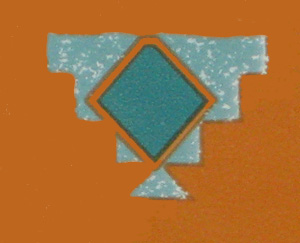
Luwian ku is a diamond with two “V” shapes, one in the corner on the right and the other in the left corner.  It also has two parallel, vertical lines bisecting it.  Thus, it has the same elements as the Indus sign but arranged quite differently.  Proto-cuneiform contains several variants of the rhomboid sign HI, “to mix; mixed.”  Some have internal marks, but no “V” shapes.  Similarly, the African Adinkra symbol eban is a diamond (more or less), but it is subdivided by an “X” into four smaller diamonds.  The name translates “fence,” representing safety, security, and love (Willis 1998: 98).  In Texas, we can also find an occasional diamond with various internal markings, one instance of which seems to contain a “V” and an additional line or two (Newcomb and Kirkland 1996: 199, Pl. 148, no. 25-E).  It is probably a mistake to view this last as a diamond, however, since nearly all of these type of motif appear to represent blankets.  This one just seems to be tilted.  This concludes the seven-stroke signs, at last. 
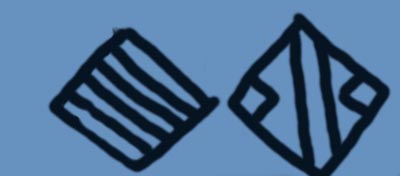
Proto-cuneiform HI @ g~a (left) and Luwian ku, analogs of Indus VII 63.

"Cloud" motif common to American Southwest -- resembles Egyptian stairway,
proto-cuneiform URU, "city, town," and perhaps Indus VII 62 (in reduced form).

Monday, May 9, 2011

Seven Rare Indus Signs of Seven Strokes


The most common symbol in the Indus script is the POT, or "flying U."  But not every Indus “pot” has “F” shaped prongs protruding from the sides.  Those “U” (and “V”) shapes that have some other element adorning the tops are still “pots” in my terminology.  The first I will discuss in this post is ONE IN CHEVRON TOPPED POT (VII 47).  A small chevron sits atop each “arm” of the basic “U” shape, while a short vertical stands between them.  Only Wells lists this sign (W34), noting it to be a singleton (MacKay XCIII 3).  I have not seen it since it does not appear in the first two volumes of the Corpus of Indus Seals and Inscriptions, but I include in the list nonetheless.

A second, equally obscure symbol is TRI-FORK AND BUD TOPPED POT (VII 48).  In this case, the left “arm” of the basic “U” is topped with the three-part division I term a “tri-fork” (also known as a trident).  The right “arm takes the form of the BUD symbol.  This asymmetrical sign appears only in the list prepared by Koskenniemi and Parpola (KP106).
Detail from seal M-777 with inscription: FOOTED STOOL / PINCH /
BELTED FISH UNDER CHEVRON / SPEAR // TABLE BETWEEN CIRCLES.

The third sign is TABLE BETWEEN CIRCLES (VII 49).  The “table” element is the version with one short “leg” and a second “long” one discussed among the three-stroke signs (III 6).  Sign VII 49 appears only in Wells (W372), noted as another singleton, although it closely resembles other symbols.  The five-stroke POST BETWEEN CIRCLES (V 48) is essentially the same except that a single vertical separates the circles rather than a “table.”  Similarly, BARBELL ON POST (VI 60) also includes two circles, this time separated (or joined) by a vertical plus a very short horizontal.  If one prefers to group these three signs together, one could term them all DIVIDED CIRCLES, designating the type of central divider either by name or by letter.  Thus, one might consider a variant “A” to be DIVIDED CIRCLES WITH POST, variant “B” to be DIVIDED CIRCLES WITH POST AND BAR, and variant “C” to be DIVIDED CIRCLES WITH TABLE.  If this method of grouping is preferred, then VII 49 A is a singleton from Chanhujo daro, VII 49 B occurs three times at Mohenjo daro according to Wells (although I find six from Mohenjo daro and perhaps eight from Harappa), and VII 49 C is another singleton from Mohenjo daro (M-777).

Only Luwian hieroglyphs provide a close analogy to these variations on a theme.  The glyph includes two small circles divided by an upside-down “L” shape.  This is a phonetic symbol representing the syllable wa or wi.  It is considerably more common in Luwian than in the Indus script.

The only other parallel to this that I have observed occurs in the art of Texas.  Here, two circles appear on either side of a central vertical line (Newcomb and Kirkland 1996: 107, Pl. 68, no. 24).  However, these marks are only part of a far more complex motif on a painted pebble.  Each circle contains a dot and there are diagonal elements above (or are they below?) these dotted circles.  The whole thing gives an impression of a face or mask, though without an obvious mouth.
Seal Ad-t with inscription: STACKED THREE / OVERLAPPING CIRCLES / POT//
BARBELL BETWEEN SLASHES / ANKH.

The next sign is VII 50, BARBELL BETWEEN SLASHES, also known as KP348 and W385, though not found in Fairservis.  The “barbell” element occurs independently in two published lists (KP347 and Fs K-11), but this existence is rather problematic.  Although both Fairservis and the Koskenniemi and Parpola team depict the BARBELL as two circles joined by a clear and obvious horizontal line of some length, I have only seen it in this form as part of a ligature.  Two circles are joined by a very short horizontal at their bases at Kalibangan (K-43).  A BARBELL may occur on the almost illegible M-1376, though this may be nothing but DOUBLE CIRCLES (or DOUBLE CIRCLED DOTS).  A caged BARBELL appears at Lothal (L-96).  But that ligature is a nine-stroke symbol.  Then there is the BARBELL BETWEEN SLASHES (more accurately, between a slash and a backslash).  This is a singleton from Allahdino (Ad-6).

The “barbell” motif is common in the rock art of North America, where it appears in various forms.  In Texas there are asymmetrical instances, where one circle is larger than the other, more symmetrical instances where the circles contain dots, fancier outlined versions, and even occurrences that are outlined and contain dots plus have assorted dots around them as if for added emphasis (Newcomb and Kirkland 1996: 100-104, Pl. 56-63, Pl. 56 nos. 1 and 2, Pl. 57, Pl. 60, Pl. 62, and Pl. 63).  In the Nevada collection there are 130 occurrences of connected circles (e.g., Heizer and Baumhoff 1984: 136, fig. 73 e).  Something like a “barbell” appears in proto-cuneiform as NUNUZ, “egg(s), offspring; female, woman”; it occurs again in proto-Elamite (M309~a and M371).  Barbell-like elements even appear among the enigmatic symbols carved on Pictish monuments.  But nowhere else does such a motif occur regularly between two leaning posts as in Indus sign VII 50.
Detail from seal M-115 with inscription (over unicorn): HAIRY DUCK HEAD / PANTS / BI-QUOTES //
CIRCLED TRI-FORK / HAIRY HUNCHBACK / LOOP ARMED MAN HOLDING SLASH /
QUOTES IN OVERLAPPING CIRCLES / TRI-FORK.

The next sign is VII 51, QUOTES IN OVERLAPPING CIRCLES.  Wells alone lists this form (W355).  He finds five occurrences, four of them from Mohenjo daro and one from Lothal.  Symbols that include an overlap are not frequent around the world, but a few do occur.  I mentioned a few of these previously, in the post on the simpler sign OVERLAPPING CIRCLES.  These parallels include the Old Chinese yu2, “to pass from hand to hand, to hand down, to give, communication, connexion” (Wieger 1965: 236).  This is a quite distant parallel, however, since the basic elements are stacked triangles, the apex of the upper one overlapping the apex of the lower.  A curving stroke is added at the base of the lower triangle.  The placement of this last stroke is significant, too.  If it appears at the top instead of at the bottom of the character, the word is changed to huan4, “fraud, deceiving, false” (1965: 237).

Among the African Adinkra symbols, there are overlapping diamonds.  The name for this symbol is epa, meaning “handcuffs” (Willis 1998: 100).  This represents law and justice, not surprisingly.  There is also a symbol comprising two elements overlapping that are more difficult to describe – something like a circle with two posts protruding at the top and bottom.  The name for this unusual symbol is nyansapo, “wisdom knot,” and it symbolizes wisdom, ingenuity, intelligence, and patience (1998: 164).  And while there may be no overlapping circles in North American rock art, there is a motif of a circle divided by a horizontal line, with a dot in each segment (Newcomb and Kirkland 1996: 101, Pl. 57).
Bar seal M-354 with inscription: MAN HOLDING DEE-SLASH / BACK CEE & CEE / BI-QUOTES //
CAGED FISH UNDER CHEVRON / SLASHES IN OVERLAPPING CIRCLES / QUINT-FORK /
CUP ON THREE PRONGS UNDER CHEVRON / POT.

The following Indus sign may well be a variant of this last one: SLASHES IN OVERLAPPING CIRCLES (VII 52).  It appears elsewhere as KP352 and W347, though not in Fairservis.  Wells notes 17 occurrences, 13 of them from Mohenjo daro, three from Harappa, and one from Lothal (eight from outside the Corpus).

The same analogs might be cited for this sign as for the previous one.  In addition, we may note the use of two overlapping circles – with additional ornamentation – to represent bracelets in Tibetan Buddhist art (Bryant 1992: 163).  This symbol appears as part of a naming ceremony for young student monks in a monastery.

Our final sign is VII 53, OVERLAPPING CIRCLES WITH ATTACHED TRI-FORK, also known as KP351 and W387.  This is another sign that I have not seen, since, as Wells indicates, it is a singleton not found in the Corpus (MacKay XCIII 2).  In this symbol, the overlapping elements have no inner markings, but on one side a trident protrudes.  Koskenniemi and Parpola’s list show the trident as a “Y” shape in which the central vertical continues up between the top “arms.”  Wells, on the other hand, shows the trident as a post to which three prongs are attached, rather like a long-stemmed letter “E.”  Since I cannot view the actual symbol, I do not know which is more correct.  And in any case, I see nothing comparable among the signs of other scripts, proto-scripts, and symbol systems.  However, this may be another instance of Indus-style gunification, the non-standardized modification of a standard sign in order to convey specific information, a process clearly used in proto-cuneiform and proto-Elamite.  The attached “tri-fork” appears relatively frequently in the Indus script even if this particular instance is rare.


SOURCES

(I include here only my basic sources and a few that I have acquired recently.)

Bryant, Barry. 1992. The Wheel of Time Sand Mandala: Visual Scripture of Tibetan Buddhism. Ithaca, New York: Snow Lion Publications.

Çambel, Halet. 1999. Corpus of Hieroglyphic Inscriptions. Vol. II. Karatepe-Aslantaş. New York: Walter de Gruyter.

Damerow, Peter and Robert Englund. 1989. The Proto-Elamite Texts from Tepe Yahya. Cambridge: Harvard University.

Fairservis, Walter. 1992. The Harappan Civilization and its Writing: A Model for the Decipherment of the Indus Script. Leiden: E.J. Brill.

Gardiner, Sir Alan. 1976. Egyptian Grammar. Oxford: Griffith Institute and Ashmolean Museum.

Heizer, Robert F. and Martin A. Baumhoff. 1984. Prehistoric Rock Art of Nevada and Eastern California. Berkeley: University of California.

Joshi, Jagat Pati and Asko Parpola. 1987. Corpus of Indus Seals and Inscriptions. 1. Collections in India. Helsinki: Suomalainen Tiedeakatemia.

Koskenniemi, Kimmo and Asko Parpola. 1982. A Concordance to the Texts in the Indus Script. Department of Asian and African Studies, University of Helsinki.

LeQuellec, Jean-Loic. 2004. Rock Art in Africa: Mythology and Legend. Translator, Paul Bahn. Paris: Flammarion.

Masson, V.M. 1988. Altyn-Depe. Translator, Henry N. Michael. Philadelphia: University of Pennsylvania.

Newcomb, Jr., W.W. and H. Kirkland. 1996. The Rock Art of Texas Indians. Austin: University of Texas.

Shah, Sayid Ghulam Mustafa and Asko Parpola. 1991. Corpus of Indus Seals and Inscriptions. 2. Collections in Pakistan. Helsinki: Suomalainen Tiedeakatemia.

Wells, Bryan. 1998. An Introduction to Indus Writing: A Thesis. University of Calgary. www.collectionscanada.gc.ca/obj/s4/f2/dsk2/ftp03/MQ31309.pdf

Wieger, Dr. L. 1965. Chinese Characters. Dover: New York.

Willis, W. Bruce. 1998. The Adinkra Dictionary: A Visual Primer on The Language of Adinkra. Washington, D.C.: The Pyramid Complex.

Websites:

Old Europe


Cretan hieroglyphs:


South American rock art:


Alpine rock art:


African rock art:


Proto-cuneiform:


Proto-Elamite:
http://cdli.ucla.edu/wiki/doku.php/linear-elamite

Six Indus Signs of Seven Strokes Each

Detail from seal M-113 with inscription: CEE BOAT / PINCH / POTTED ONE /
OVERLAPPING CIRCLES / TWO POSTS / POT (the 3rd is today's most common sign).

Sign VII 41 (the forty-first symbol comprising seven strokes) is what I term EARPHONES ON BI-FORK.  It is also known as KP345 (more accurately described as a nine-stroke sign), W74, and Fs K-9.  Fairservis identifies this symbol as weighing scales, defining it as “to weigh” (or as a substantive).  Wells finds three of the symbol, but each is distinct in form.  His “a” has a straight-stemmed “Y” shape at the bottom, “b” also does but the “V” shape at the top is tilted to the right, and “c” has a bent stem.  All three come from Mohenjo daro, so the differences do not appear to be geographical.
Seal M-1159 with inscription: TWO POSTS / EARPHONES ON BI-FORK (VII 41 B) / BI-QUOTES //
TWO POSTS / FISH / CAGED FISH (note that BI-FORK tilts to the left in 2nd symbol).


If the symbol actually represents weighing scales, we might compare the Egyptian hieroglyph U38 defined by Gardiner as a balance.  This rather different symbol acts as an ideograph or determinative in mh3t, “balance” (there should be a scoop beneath the “h”).  Another glyph has the form of the “earphones” element of the Indus sign, but this part is rotated 90 degrees (V13).  This glyph represents a rope for tethering animals and is used as a phonetic symbol for t (the underlined letter is traditionally pronounced “ch” in Egyptology, although that probably is not what the Egyptians themselves said).  This glyph is combined with the little walking legs element (D54) to make V15.  The combination serves to represent the word iti, “to seize.”
Detail from seal M-675 with inscription over unicorn:
TWO POSTS / EARPHONES ON BI-FORK (VII 41 C) / BI-QUOTES //
FISH UNDER CHEVRON / BACKSLASH IN FISH / CUPPED POST (OR SPOON) / THREE POSTS /
CAGED CIRCLED TRI-FORK / BUGS ON LEAF / POT (note curve of BI-FORK stem).
Now, the Indus EARPHONES appear as a distinct sign also (V49, also known as KP344 and W75).  This element occurs three times, including once at Mohenjo daro.  The other element, BI-FORK, has an independent existence (III 12) too, although only as a singleton from Lohumjo daro.  We may interpret EARPHONES ON BI-FORK as a composite symbol for this reason, i.e., as a ligature composed of two simpler signs.  Egyptian glyph V15, a composite symbol made up of two simpler glyphs, is then an excellent analog.  However, this interpretation is only one possibility.  Even if EARPHONES ON BI-FORK is indeed a ligature, the basic elements may be analyzed differently.  Another singleton, CUPPED DOWN BI-FORK, resembles this one, but inverted and without the circles (V35).  This sign, V35, occurs at Mohenjo daro just like the three variants of VII 41.  Finally, one of the ANKH variants may be a ROOF ON BI-FORK (V39), as Wells seems to suggest (W66) – also from Mohenjo daro.
Detail of seal M-101 with inscription: CIRCLED VEE / BI-QUOTES // EARPHONES ON BI-FORK (VII 41 A) /
POT // STRIPED TRIANGLE / TRI-FORK (note straight stem of BI-FORK, not curved, and not tilted to one side).

In proto-cuneiform, a symbol resembling the EARPHONES portion represents “child; young (of herd animals)” or low rank.  This sign, termed TUR, has an analog in proto-Elamite as well (M370~b), where it is more angular.  A variant of the latter has an additional element, a wedge-shaped impression between the “arms” of the “balance” (M370~k).  If one assumes that the people of the Indus Valley learned to write from their Near Eastern neighbors, then the symbol I call EARPHONES might be the local equivalent of proto-cuneiform TUR, meaning “offspring,” more or less.  The addition of an element such as the BI-FORK to the original symbol might then be another example of gunification – modification of the meaning of an original, standardized symbol by adding a non-standardized stroke (or strokes).  In proto-cuneiform (and proto-Elamite), gunification of the sign indicating a head of small cattle provides additional information on the specific type / gender / age of the livestock.  So, gunification of EARPHONES might indicate a the sex of the offspring (boy or girl for humans, ewe or ram for lambs, etc.).
From top down, proto-Elamite M370~k, pE M370~b, variants of proto-cuneiform TUR,
possible inspiration for Indus VII 41, indicating "child; young (of herd animals); low in rank."

There are other possibilities as well, though.  In Chinese, there is an element rather like a modern plus sign (+) with diagonal strokes below the central horizontal.  This is mu4, “tree; wood.”  In Old Chinese, the horizontal line was a “U” shape, the two lower diagonals a “roof” shape.  In the earlier Old Seal script, another character includes this early form, adding two small circles to the upper branches of the “U” and a small square to the top of the central vertical.  There is also a small, inverted “Y” shape on top of the small square.  Together, these elements form yao4, “a wooden support on which a drum and bells are hung....The orchestrion of old Yao, music in general.  When read lao4...the effect produced by music, pleasure, joy” (Wieger 1965: 224).  As far as the interpretation of the Indus sign is concerned, this suggests that combining basic elements can produce a symbol for an object or concept far removed from the original elements.  In Chinese, lao4 has nothing to do with trees, even though the character for “tree; wood” is still clearly there, but now means “pleasure, joy.”

One last parallel to the Indus EARPHONES ON BI-FORK comes from Luwian hieroglyphs.  The ideograph REL, “relative, kinsman,” has an upper portion resembling the Indus EARPHONES.  But the Luwian glyph has incomplete loops rather than circles.  In addition, the central stem of REL is merely a straight vertical line, in variant “a.”  In variant “b,” the stem of REL takes on a curve at the base, forming a “J.”  A third variant, “c,” has a squared off version of the “J” which more resembles a backward “L.”  In this script, the variations on the stem appear to convey no distinction in meaning.  It is quite possible that the variations in the Indus EARPHONES ON BI-FORK similarly carry no change in significance of the symbol, but are simply stylistic variants.
Indus seal H-413 with sign VII 42 over unicorn:
STACKED FIVE UNDER ROOF (seal is broken).

The second Indus symbol discussed here is STACKED FIVE UNDER ROOF (VII 42), also known as KP338 and W225.  It does not appear in Fairservis’ list.  Wells notes it as a singleton from Harappa (H-413).  What is worse, the single seal on which it appears is broken, so we cannot say anything about its position relative to other signs.

Nevertheless, it has an interesting parallel in the proto-cuneiform GI6, “night; shade.”  This symbol has the same basic “U” shape, though turned sideways compared to the Indus sign.  Inside there are many small strokes or dots, perhaps up to 14 rather than just five.  The dots or short strokes in the proto-cuneiform sign do not appear to be grouped, either, while the Indus sign shows a row of three short verticals stacked neatly over a row of two such strokes.  The STACKED FIVE appears independently among the apparent numerals of the Indus proto-writing system, so it is possible that this “number” (if that’s what it is) has significance.

In proto-Elamite, an angular parallel appears (M343~h + M354).  In this instance, the outside element or “roof” has an inverted “V” shape (cf. the Indus CHEVRON which may or may not be a variant of the more curved ROOF).  At the base of one “leg” of this inverted “V” is an impressed circle.  Another impressed circle appears beneath the angular “roof,” with seven short diagonal strokes around it.  The lower element, the impressed circle with dots around it, is a numerical measure found in two systems, the ŠE, both Š and Š#.  In the first of these, the circle-and-dots form the second lowest measure, two of which add up to one of the next higher measure (written with an impressed circle surrounded by six more circles).  In the second –probably related system from Tepe Yahya – the circle surrounded by dots is the lowest measure.  However, there are no other Indus signs made up of a ROOF over other numbers of short strokes.

Old Chinese writing makes use of a “roof” element as well, placing various other elements beneath this.  One such character is liang3, “two weights equal, state of balance” (Wieger 1965: 100).  Here there is a long, central vertical beneath the roof, with a small, inverted “Y” on either side.  Another character apparently derived from a roof over a more abstract symbol of five strokes is zong1, “an ancestral hall....The building from which emanates...the influence of the deceased ancestors over their posterity” (1965: 101).

Luwian hieroglyphs include a glyph something like a “U” turned sideways, inside which are three small circles.  This is MALUS, the ideograph for “bad.”  A variant resembles our number “3” (reversed), with two dots inside each “roof.”  This is an example of including number-like marks to form a non-numerical symbol.  Interestingly enough, the ideograph IUDEX / IUSTITIA, “ruler; justice,” appears to be a modified “roof” over two short strokes.  Again, an apparently numeral – two – helps to convey a completely non-numerical meaning.

In the rock art of North America, dots or short strokes sometimes appear inside “cups” or below “roofs.”  One western example contains no less than 42 dots: a row of 10 over another row of 10 over third and fourth rows, each containing 11 (Heizer and Baumhoff 1984: 356, fig. F-17l).  At the bottom of the symbol there are also nine prongs.  This combination of “cup,” contained marks in row, and prongs beneath, also appears in Texas (Newcomb and Kirkland 1996: 153, Pl. 105, no. 1).  In this instance there are four prongs asymmetrically arranged and 13 short, horizontal strokes inside (arranged 5 x 5 x 3).  These American motifs provide examples of an apparent combination of a CUP ON PRONGS and a container with contents, that is, a combination of Indus signs VII 42 and VII 43.
Bar seal M-354 with inscription: MAN HOLDING DEE-SLASH / BACK CEE & CEE / BI-QUOTES //
CAGED FISH UNDER CHEVRON / SLASHES IN OVERLAPPING CIRCLES / QUINT-FORK /
CUP ON THREE PRONGS UNDER CHEVRON (VII 44 A) / POT.

Sign VII 43 is a CUP ON FIVE PRONGS, found elsewhere only in Wells (W33).  It is a singleton, although possible variants with fewer prongs have been noted previously (see posts on V 37 and VI 57, CUPS on 3 and 4 PRONGS respectively).  This particular number of prongs (5) does not occur elsewhere, so far as I can tell, although “cups” on “prongs” are hardly rare.
Detail of seal M-89 with inscription: FISH UNDER CHEVRON / TWO POSTS /
CUP ON FIVE PRONGS / RAYED CIRCLE / POT.
In Old Chinese, a very low and flattened “U” on four prongs is part of the composite character meng2, meaning “to clear up an obscure affair, by swearing, in the old way, upon a vessel full of blood” (Wieger 1965: 119).  In this case, the “cup on prongs” portion represents the vessel containing blood, while the upper or contained element is an independent character meaning “bright” or “clear (up).”
Analogs to VII 43: motif from Texas (left) and proto-cuneiform UMBIN~b1 (right).

Proto-cuneiform makes use of few “cups on prongs,” but there is UMBIN~b1.  This is an outline “C” shape with numerous short prongs on the outer rim.  It came to mean “nail, claw, talon” in Sumerian although it does not much resemble any of these appendages in this early form.  Finally, a modified “cup” sits on four prongs in a Texan motif (Newcomb and Kirkland 1996: 154, Pl. 106, no. 2).

Detail from seal M-810 with inscription:
CUP ON THREE PRONGS UNDER CHEVRON (VII 44 B) / POT.
Our third Indus symbol is CUP ON THREE PRONGS UNDER CHEVRON (VII 44).  It is also noted by Koskenniemi and Parpola (KP314) and Wells (W315), but not Fairservis.  Wells finds two instances, both from Mohenjo daro, occurring in two variants.  The “a” variant has a longer, central “prong” which curves off to one side (M-354), while the “b” variant sits on three prongs that are equally short.

I noted the proto-cuneiform symbol U4, “sun, day,” in the blog entry that dealt with the Indus BOAT.  This “C” curve contains a reversed and smaller curve, said to represent the sun rising between hills (though it closely resembles representations of the lunar crescent of other cultures).  In proto-cuneiform, additional strokes are commonly added to enumerate days.  Sometimes the additional elements are wedges, as in |U4.3(N08)| for “three days,” and sometimes attached “prongs,” as in |U4.SZU2| for “two days.”  We might expect the number of prongs attached to the Indus CUP to be similarly enumerative.

However, in Old Chinese, a symbol resembling a modified “V” shaped cup sitting on three prongs has non-numerical meaning.  This character is man2, “before the equilibrium is perfect, the balance [is] oscillating hither and thither” (Wieger 1965: 100).  In this case – if Wieger’s interpretation is correct – the “prongs” represent a balance or scales, while the upper portion (the apparent “cup”) depicts oscillation.
Detail of seal M-120 with inscription: QUADRUPED (abraded) /
OVERLAPPING CIRCLES / POTTED ONE / EF PRONGED EXIT /
WINGED MAN / POT // HAMMER IN DIAMOND.

Indus sign VII 45 is similar but based on a different sign: POTTED ONE (KP325, W290 and W299, and Fs J-6).  Fairservis considers the basic “U” with “F” shaped sides to represent a pot (his J-5), here modified by the addition of affix P1 (my SINGLE QUOTE).  Although he considers the POT to be an honorific suffix, adding the genitive affix does not add up to an agglutinative super-suffix.  Instead, the ligature designates “up, upper, up river,” or even “north,” in Fairservis’ view.  It is probably significant that the apparent suffix, the simple POT, is the most common terminal in the analysis by Korvink, but the POTTED ONE is a medial element.  (And note that Parpola interprets the basic "pot" as cattle horns, not a container.)
Circular tablet from Chanhujo daro with inscription (right to left and top to bottom):
POTTED ONE / HAIRY HUNCHBACK (?) // POTTED ONE / FLAIL / FISH
(note the more or less "V" shaped POTS).
Wells usually groups “U” and “V” shaped elements together under a single heading, but here he separates them.  His W290 is the “U” shape, with 75 occurrences.  Of these, 52 are from Mohenjo daro, 12 from Harappa, three from Lothal, four from Kalibangan, three from Chanhujo daro, and one from Rangpur.  The V shape (W299) is a singleton from Nindowari-damb (Nwd-3).  I prefer to group these together, designating the first VII 45 A and the second VII 45 B.  In any case, the distinction between the "U" and "V" shapes is not all that clearcut, as the example from Chanhujo-daro demonstrates.

In proto-cuneiform, again noting the “day” symbol as a parallel form, an additional mark is typically numerical.  The addition of a line inside the “C” curve indicates “one day,” transcribed |U4 x 1(N57)|, as does the addition of a circular impression inside, transcribed |U4 x 1(N14)|.  If the Indus POTTED ONE includes a numerical element in such a fashion, we would expect this sign to represent one of whatever the basic POT designates.  However, it is a notable fact that POTTED ONE (and POTTED TWO, POTTED THREE, etc.) occurs in the inscriptions in a position unlike that of the basic POT, as previously observed.  This essential fact strongly suggests that, once again, additional strokes in the Indus system are not numerals.
Bloc of Luwian hieroglyphs.
Among the Luwian glyphs, an element resembling a pot typically contains two short strokes.  This symbol is a phonetic glyph representing the syllable pa.  Clearly, then, the inclusion of apparent numerals need not convey numerical information.

There is a west African Adinkra symbol that somewhat resembles the Indus CUP with a floral-like element inside.  This is called osram ne nsoroma.  It represents the moon and a star but symbolizes such qualities as faithfulness, harmony, love, loyalty, and femininity (Willis 1998: 178).
Harappan tablet H-228 with inscription (right to left):
COMB / POT-HATTED BEARER / DOUBLE BACK CEES / CUPPED SPOON ON FIVE PRONGS (W310a).

Finally, Indus sign VII 46 combines both an insert and added prongs: CUPPED POST ON FOUR PRONGS.  Wells alone includes this in his list, as W319.  He observes three occurrences, one from Mohenjo daro and two from Harappa.  Only the first of these is made up of seven strokes, being a “U” shape on four prongs with a single vertical inside (Wells’ “b” variant).  Grouped with this “variant” in Wells’ analysis is a “U” shape on five prongs, with the SPOON inside – his “a” variant, comprised of ten strokes.
Sign VII 46 from broken seal M-1049 (W310b).

Proto-cuneiform provides a parallel in another variation on the “day” sign: |U4 x 1(N01).5(N08)|.  Here, there is a single wedge inside U4, which appears to indicate “one day,” with an additional stack of eight wedges alongside (= “eight days”?).  Cretan hieroglyphs also include a “cup” shape on prongs with an insert.  This symbol sits on three prongs and contains a more elaborate internal element.  The glyph is enumerated O55 (according to Younger’s website) and may represent the syllable ke (it might also be an early Cretan ideograph that only later evolved into a phonetic symbol in Linear A and/or Linear B).
A tilted “U” shape appears in Texas, resting on three prongs and with its “post” above and to the right (Newcomb and Kirkland 1996: 101, Pl. 58).  This combination of elements may or may not comprise a single motif.