Wednesday, July 6, 2011

Rare Indus Signs Plus a Man Holding Two Sticks

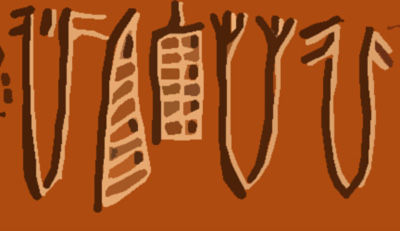
Detail from seal M-181 with inscription: BISECTED STRIPED TRIANGLE (VEE STRIPES?) /
PANTS / BI-QUOTES // HUNCHBACK / SPEAR (since I have smoothed and colored the image,
it is possible that I removed some marks -- but I don't anything else in the photo in the Corpus).


Of the signs I discuss in this post, the first poses the greatest problem.  It is basically a triangle with horizontal stripes which is also bisected by a single vertical.  That is, Koskenniemi and Parpola show such a triangle with three horizontals (see VII), as does Fairservis.  But Wells adds a variation on this, a triangle bisected by a vertical stroke, crossed by a single horizontal, and with two “V” shapes inside.  This variant, Wells’ “b” version, is the symbol at hand.  I term it BISECTED TRIANGLE WITH VEE STRIPES (IX 22).  Wells notes a single occurrence at Mohenjo daro (M-181).  I have included this symbol in my list with an enumeration showing the number of strokes in Wells’ version.  But that is not quite what I see on the seal in question.  In any case, Fairservis states that the STRIPED BISECTED TRIANGLE (my VII 16) pairs with the QUINT-FORK on a regular basis.  He suggests the meaning of this pair as “ninth month.”  I have to say that I have not noted that pairing being particularly common.  Besides that, the STACKED NINE would seem to be a more clear cut way of indicating “nine” or “ninth,” and the CEE (or BACK CEE) a better “moon” or “month.”
Proto-cuneiform parallels to sign IX 22:
|NI~b x 4(N47)| and |NI~a x 1(N57)| "butter" (top row);
SU~b, "skin, hide" and ZATU 732 (middle row); and
ZATU 639 (bottom row).

There are triangular symbols in proto-cuneiform as well, in any case, some with both vertical and horizontal markings inside.  A triangle with a rounded base and a single horizontal and vertical each is |NI~a x 1(N57)|.  It is a ligature of two elements, NI “butter” and the numeral “one.”  A triangle with a flat base, a bisecting vertical stroke, and three short diagonals is SU~b, “skin, hide.”  There are further possible analogs with unclear meanings, including ZATU 639 and ZATU 732.
Seal M-304 with inscription: MAN / FOOTED STOOL / FAT STOOL / POTTED TWO / FISH / POT
(over the famous "Proto-Shiva" and various animals -- but there is also another MAN just over the tiger,
which may or may not be part of the inscription).

The next sign is less troublesome: FAT STOOL (IX 23).  It occurs in others’ lists as KP220, W466, and Fs Q-14.  Fairservis sees it as a ligature, combining his I-11 (the basic STOOL, which he considers tongs) and K-1 (FAT CHEVRON, which he calls a carpenter’s square).  He proposes the meaning : ”united clans; great buffalo” for IX 23.
Luwian glyph 294 THRONUS, "throne."

Although rotated 90 degrees, this symbol resembles the Luwian THRONUS, “throne.”  When I discussed the STOOL, made of an “X” with a vertical stroke closing one end, I noted the similarity in the symbol and a depiction of a stool in Egyptian art.  On cylinder seals from ancient Iraq also, deities sometimes sit on stools of such a shape.  However, it is unlikely that this is what the Indus sign depicts since it is always on what would its side.
In this depiction of the goddess Ishtar (right) and a king (left),
the latter sits on a stool resembling sign IX 23.

Koskenniemi and Parpola include a sign in their list that is basically a “T” with two additional elements.  These additions take the form of the burdens apparently carried by the various BEARER signs.  These elements are also similar to the “spoon” in the CUPPED SPOON sign.  For want of a better descriptor, I thus call the sign SPOONS ON TEE WITH SLASH.  That last part, “with slash,” is based on Wells’ depiction, though the other lists do not show it.  Wells finds the sign to be a singleton occurring only at Harappa (H-455).
Detail of seal H-455 with inscription: TWO POSTS / SPOONS ON TEE WITH SLASH /
BI-QUOTES // CUPPED POST / THREE POSTS / SPEAR (over unicorn).

There is a roughly similar sign in proto-cuneiform, designated ZATU 730.  This has a thick central post with horizontal and vertical marks within.  Also, the “spoons” are rather different, ending in diamond shapes rather than ovals or circles.  The meaning is unknown.
Proto-cuneiform ZATU 730, a distant analog to sign IX 24.

Next, there is another GRID, this one with three squares across the top and four down (IX 25).  Elsewhere, it appears as KP268(a), W501, and Fs G-16.  Fairservis sees it as an enclosure divided into compartments, meaning “collect, store, storehouse or work area.”  He also observes that it is usually doubled.  Wells, for his part, enumerates such doubled signs independently, considering them to be distinct elements.
Copper tablet M-517 A and B sides, with inscription (from right to left, A side):
STRIPED TRIANGLE (5 stripes) / GRID (3 X 4) / POT // (B side) QUADRUPED.

I have discussed parallel signs in other scripts previously (see remarks on VII 7, for example).  This time, I note various artistic depictions from ancient cultures.  A cylinder seal from Iraq depicts a boat on which there is a grid that may be either the cargo or a cabin.  When deities on such seals are not sitting on stools, they often sit on grids.  And there are gameboards with similar patterns of squares, including the Egyptian Senet and the Sumerian Twenty Squares games.  Grids appear almost universally (though I have not found an example from Australia) and are included in the list of entoptic forms seen by a shaman in trance. 
In this image based on a cylinder seal, the Sumerian god Enki (Akkadian Ea) sits on a grid-like seat.

The twenty-sixth of the nine-stroke signs is BLANKET WITH 5 DIAGONAL TICKS (thus, IX 26), also known as W539 and Fs G-11.  The five-“tick” version that Fairservis shows has vertical marks, not diagonal ones.  He thinks that the square or rectangle represents one of the square weights found in archaeological contexts in the Indus Valley (1992: 101).  The varying numbers of “ticks,” he suggests, refer to specific weight measures.  If this is correct, there are no records of anything that weighed one measure or two measures.  And nothing weighs more than ten measures.  It’s an interesting idea but I find it hard to see what led to it.
Detail of sign IX 26 as it appears on bangle M-1635.

Wells notes this sign to be a singleton from Mohenjo daro (M-1635).  If it is just a variant of a BLANKET with five vertical “ticks,” then there a couple of additional occurrences (M-1169 and M-1636).  The occurrences M-1635 and M-1636 are incised on bangles and appear to be essentially the same inscription.  None of the strokes in the BLANKET seems to be perfectly straight, with top and bottom slanting one way, the “ticks” slanting the other, and the sides inwardly curved.  In contrast, on the seal M-1169, all of the lines are straight, either horizontal or vertical.  Since carving a seal appears to have been a more careful and (quasi-)artistic endeavor, it seems reasonable to assume that these are indeed the same sign.
Detail of seal H-517 with inscription: MAN HOLDING DOUBLE POSTS / RECTANGLE.

The last sign for this discussion is MAN HOLDING DOUBLE POSTS (IX 27).  In the literature it is designated KP33, W41, and Fs A-14.  Fairservis identifies it as a man with two staffs.  He proposes the meaning “an honorific quality” pronounced ira (presumably in Proto-Dravidian), and used as the proper name Iradaņdiyan.  Wells finds the sign to be a singleton from Harappa (H-517).
In this depiction of an Egyptian deity from the Book of the Dead, the "man" holds
the w3s scepter in one hand, the ankh ("life" glyph) in the other rather than two staffs.

Three versions of man holding a single staff from Egyptian hieratic writing.
The first and last are glyph A19, ideograph or determinative for "old."  The
middle one appears akin to the clearer depiction of one holding scepter and
ankh above (or perhaps a variant of A22, determinative in "statue").

In the scripts and art of other places, there are limited parallels.  The Egyptians often depicted people (and human-like deities) holding a single staff, but rarely show a person or deity holding two.  When there are two objects held, they normally differ.  For example, a god may hold the distinctive w3s scepter in one hand, while clasping the ankh sign (meaning “life”) in the other.
Detail from African rock shelter pictographs showing man
with inverted "L" shaped staff (a grid is to his left).

Petroglyphs of sub-Saharan African include several of a man holding one staff or two objects that differ.  In the rock art of Old Europe, too, men are sometimes depicted with two objects, but these are asymmetrical.  Even in North America, it is typically two different objects that appear on either side of an anthropomorphic figure, whether in Texas or further west. 
Incised Hohokam petroglyphs showing man with two asymmetrical objects
(note also the oval grid to the left and quadrupeds beneath him).

But now and again, one finds a symmetrical arrangement.  There is the famous “snake goddess” from Crete, a Minoan artifact that has been much disputed.  And on Elamite pottery of ancient Iran, sometimes human-like figures seem to hold two of the same peculiar object, one in each hand.
Replica of the famous "snake goddess" of Crete -- she holds symmetrical snakes.

Man with asymmetrical sticks (bow and arrow?) from rock art of Valcamonica, Italy.

Two examples of Elamite pot designs showing humans holding symmetrical objects.


.
REFERENCES


Aruz, Joan, ed. with Ronald Wallenfels. 2003. Art of the First Cities: The Third Millennium B.C. from the Mediterranean to the Indus. New York: Metropolitan Museum of Art and Yale University Press. (CYLINDER SEALS)

Cambel, Halet. 1999. Corpus of Hieroglyphic Inscriptions. Volume II: Karatepe-Aslantas. New York: Walter de Gruyter.  (LUWIAN)

Collon, Dominique. 1987, 2005. First Impressions: Cylinder Seals in the Ancient Near East. London: The British Museum Press.  (CYLINDER SEALS)

Damerow, Peter and Robert Englund. 1989. The Proto-Elamite Texts from Tepe Yahya. Cambridge, Mass.: Harvard University.  (PROTO-ELAMITE)

Fairservis, Walter A. 1992. The Harappan Civilization and its Writing: A Model for the Decipherment of the Indus Script. Leiden: E.J. Brill.  (INDUS SCRIPT)

Gardiner, Sir Alan. 1976 (originally 1927). Egyptian Grammar: Being an Introduction to the Study of Hieroglyphs. Oxford: Griffith Institute and Ashmolean Museum.   (EGYPTIAN)

Gimbutas, Marija. 1991. The Civilization of the Goddess. San Francisco: Harper.  (OLD EUROPE)

Halloran, John Alan. 2006. Sumerian Lexicon: A Dictionary Guide to the Ancient Sumerian Language. Los Angeles: Logogram Publishing.  (SUMERIAN)

Joshi, Jagat Pati and Asko Parpola. 1987. Corpus of Indus Seals and Inscriptions. 1. Collections in India. Helsinki: Suomalainen Tiedeakatemia.

Koskenniemi, Kimmo and Asko Parpola. 1982. A Concordance to the Texts in the Indus Script. Department of Asian and African Studies, University of Helsinki.  (INDUS SCRIPT)

Lamberg-Karlovsky, C.C. 1986. Excavations at Tepe Yahya, Iran 1967-1975. The Early Periods. Thomas Wight Beale, et al. American School of Prehistoric Research Bulletin 38. Cambridge, Mass.: Harvard University. (PROTO-ELAMITE)

Lamberg-Karlovsky, C.C. 1986. Excavations at Tepe Yahya, Iran 1967-1975. The Third Millennium. D.T. Potts et al. American School of Prehistoric Research Bulletin 45. Cambridge, Mass.: Harvard University. (PROTO-ELAMITE)

LeQuellec, Jean-Loic. 2004. Rock Art in Africa: Mythology and Legend. Transl. Paul Bahn. Paris: Flammarion.  (SUB-SAHARAN AFRICA)

Shah, Sayid Ghulam Mustafa and Asko Parpola. 1991. Corpus of Indus Seals and Inscriptions. 2. Collections in Pakistan. Helsinki: Suomalainen Tiedeakatemia.

Von Dassow, Eva, ed. 1994. The Egyptian Book of the Dead: The Book of Going Forth by Day. Raymond Faulkner, transl. with additional translations and commentary by Ogden Goelet, Jr. San Francisco: Chronicle Books.

Wells, Bryan. 1998. An Introduction to Indus Writing: A Thesis. The University of Calgary.

(see also: Wells, Bryan K. 2011. Epigraphic Approaches to Indus Writing. Oxford: Oxbow Books.)

Proto-cuneiform:

Proto-Elamite:


Saturday, July 2, 2011

More Indus Singleton Signs and Problematic Symbols

Indus sign IX 16 (top) and closest analog,
proto-cuneiform MUNSZUB, "hair, pelt."

Sign IX 16 in my list derives from KP390 and W396, but it does not appear in my database of inscriptions.  I call it VEE AND TRI-FORK IN DIAMOND, a descriptive phrase.  It is a diamond with the usual “V” shape attached to the top, inside.  But there is also an inverted “dubya” or the top of a trident, attached to the base of the “V.”  Wells observes two, both from Harappa (or, relying on his later book, Epigraphic Approaches to Indus Writing, it occurs five times).  All of the occurrences are on tablets, many of which I cannot discern as they do not photograph well.

This sign contains the same basic elements seen in the previous symbol, VEE IN DIAMOND WITH ATTACHED TRI-FORK (IX 15).  But the “trident” portion appears on the outer surface of the diamond in IX 15, while it is inside the diamond and attached to the “V” in IX 16.  Should these two be considered variants of a single sign?  Since neither occurs even a dozen times, we cannot use statistics to answer the answer.  The two do not seem to occur together, but this might be nothing more than coincidence given their sparsity in the record.

Indus sign IX 17 (top) and its closest analog,
proto-cuneiform MUNSZUB, "hair, pelt."

The next sign is just as troubling, HAMMER IN DIAMOND (IX 17), also known as KP363 and W405.  Wells gives it as a singleton from Mohenjo daro (M-120), but I do not see it.  According to my reading, M-120 has this inscription: STRIPED QUADRUPED / OVERLAPPING CIRCLES / POTTED ONE / EF-TOPPED EXIT / WINGED MAN / POT.  There seems to be nothing there that could be confused with a diamond containing anything at all.

Detail from seal M-101 with inscription: CIRCLED VEE / BI-QUOTES //
EARPHONES ON BI-FORK / POT // STRIPED TRIANGLE (6 stripes) / TRI-FORK.

The third sign provides better opportunities for analysis: STRIPED TRIANGLE (6 STRIPES), which I enumerate IX 18.  It appears in the literature as KP210(a) but with only three stripes, as W412 in four variants, and as Fs K-6a.  Fairservis sees it as a heap or pile of grain with the meaning “fullness, abundance.”  This is interesting since he thinks the striped triangle beneath the “table” represents a conical weight, suspended from a balance.  There are several sizes of conical objects made of clay in the archeological record, so it is reasonable to suggest a triangular sign is a depiction of one of these.  But it also seems a bit inconsistent to make the same symbol this conical object and a heap of something else.

Proto-cuneiform striped triangle NI~a, "oil, cream, butter" (on left).

However that may be, Wells notes 48 occurrences of striped triangles, 26 from Mohenjo daro, 16 from Harappa, three from Lothal, one from Kalibangan, and two from Allahdino.  As noted, there are four variants, with “A” containing three stripes and six strokes, “B” with four stripes and seven strokes, and both “C” and “D” sporting five stripes and nine strokes.  The last two are differentiated by the shape of the triangle: “C” is side and “D” tall and thin.

Detail from block of Luwian text -- note striped triangle in top register near left side,
URBS, "city," as well as three examples of doubled striped triangles, REGIO, "country." 

Such a symbol occurs in Luwian.  A glyph shown as a triangle with either horizontal or diagonal stripes represents URBS, “city.”  Interestingly, two of these side by side become another ideograph, REGIO, “country.”  Proto-cuneiform also presents parallels with IR~a and IR~d.  The first is triangular but has a rounded end, while the second variant has a flat base.  The first also has diagonal stripes while the second has vertical stripes.  This ideograph came to mean “odor, perfume.”  A similar symbol, again either with a rounded base or a flat one, but this time containing just a single stripe, is NI, “oil, cream, butter.”  There is a ligature of the first version of NI with the numeral “four” as well: |NI~b x 4(N57)|.  Here, the numeral takes the form of horizontal stripes inside the basic sign.  If the stripes in the Indus sign represent numerals in a parallel fashion, then the STRIPED TRIANGLE is actually several different signs (my total is 70). 

There are Indus triangles with two, three, four, five, six, and perhaps even seven internal stripes, as I count them:
  • Triangle with 2 stripes:   1 occurrence (M-1307)
  • Triangle with 3 stripes:   9 occurrences (?) (M-29, M-269, M-362, M-453?, M-523, , M-961, M-1363?; K-63; Ns-9?)
  • Triangle with 4 stripes: 42 occurrences (M-30, M-245?, M-374, M-551 through M-565?, M-678, M-809, M-861?, M-937, M-1353, M-1503 through M-1513?; H-139, H-157, H-187, H-641, H-666, H-707 through 710)
  • Triangle with 5 stripes: 6 occurrences ( M-174?, M-246?, M-408, M-516, M-517, M-1318)
  • Triangle with 6 stripes: 10 occurrences (H-13; L-22; M-14, M-101, M-374, M-859, M-1095, M-1271; Ad-4?, Ad-8?)
  • Triangle with 7 stripes: 2 occurrences (H-599; M-58, possibly M-551??)
Inscription from M-391: FIVE-TOED FOOT / STACKED STOOLS WITH MID QUOTE / VEE IN DIAMOND / BI-QUOTES // CIRCLED E TRI-FORK / BACKSLASH IN FISH / THREE QUOTES / CIRCLE BETWEEN CEES / POT // COMB BELTED ASTERISK / SLASHES IN OVERLAPPING CIRCLES / QUAD-FORK (at 12 signs, one of the longer Indus inscriptions -- but compare to the length of the Luwian block above).

Leaving aside such difficult decisions of how to group – or separate – striped triangles, we come to COMB BELTED ASTERISK (IX 19).  It occurs elsewhere as KP249 and W435.  In form, it is an “X” with two verticals or posts crossing it – the “asterisk” portion.  In addition, there is a “comb” lying horizontally across the middle, with the “tines” pointing downward.  This ligature – if that is what it is – occurs just once, at Mohenjo daro (M-391).  I see nothing comparable in the scripts of other cultures.

Tablet H-952, sides A and B (reading right to left):
FOOTED STOOL WITH HAIRY LEGS / POT (A side);
FOUR POSTS / CUP (B side).

Then there is another peculiar sign, FOOTED STOOL WITH HAIRY LEGS (IX 20), also known as KP237 and W455.  Wells notes two occurrences, both at Mohenjo daro.  I see a third at that city, with another at Harappa.  It is interesting to note that the “feet” are on the left in the examples from Mohenjo daro, but they are on the right in the example from Harappa. 

Wells often distinguishes two signs when they mirror each other in this way.  But he does not do so here.  Perhaps that is because the Harappan occurrence appears on a tablet, while the Mohenjo daro examples are on seals.  We expect reversal of sign order between these two types of object, since the seals were used for stamping while the tablets were “read” as is.  It would make sense for the symbols themselves to reverse as well.  But sometimes this does not happen (e.g., the HAIRY HUNCHBACK appears on multiple tablets with the “head” to the right as on H-934, as well as with the “head” on the left as on H-933).  This kind of failure to reverse signs also occurs on cylinder seals from the Near East, though (Collon REF).  It is possible that the appearance of both types on seals is a “scribal error” so to speak.  But it is hard to see why the same error should occur on tablets too.  Still, it does seem to happen that way.  Note that the otherwise identical inscriptions on tablets H-945B and H-946B read from right to left CUP / FOUR POSTS and FOUR POSTS / CUP, respectively.

Seal M-1134 with inscription: CARTWHEEL / STRIPED MALLET / CIRCLED GRID / FOOTED STOOL WITH MID EARS (note that without a prefix constant or a terminal, this inscription might be read in the opposite direction).

Then we have FOOTED STOOL WITH MID EARS (IX 21 A), also seen enumerated as KP232 and W459.  Here, the “feet” of the “stool” are on the right (although, since M-628 is a seal, both Wells and the Koskenniemi and Parpola team reverse the sign in their lists).  But another instance has the “feet” on the other side (M-1134).  Wells enumerates this version independently, as W468.  I think there may be two more examples of the first “variant” (M-715, partially abraded, and M-1186, partly missing on the top edge).
Inscription from bar seal M-1262: DOUBLE EF TOPPED EXITS / FOOTED STOOL WITH MID OVAL /
POTTED THREE / SINGLE QUOTE // FOUR QUOTES / E TRI-FORK (such a long prefix!).

I see that the large iconic animal on the seals varies, the head of the unicorn on M-628 placed on the left of the seal, the head of the rhino on M-1134 placed on the right side.  This suggests the possibility that the position of the animal’s head indicates the beginning of the inscription.  It is a handy hypothesis as long as we restrict our view to occurrences of this sign, IX21.  But it collapses when we widen our view.  For example, the unicorn on C-17 is unusually positioned with its head to the right.  But the left-most sign is HORNED MAN (or WINGED MAN), followed by POT on the right (and MAN down beneath the unicorn’s head in place of the usual cult stand).  Since POT is a terminal sign (as is MAN), we would not want to read it before HORNED/WINGED MAN.

Detail from seal M-17 with inscription: FOOTED STOOL WITH MID EARS (or oval?) /
CIRCLED TRIPLE BRICK / BI-QUOTES // STACKED SIX / TRI-FORK.

Finally, I mention FOOTED STOOL WITH MID OVAL, which I think is probably a variant of the previous sign, thus enumerated IX 21B (or VII 64, since it actually has just seven strokes).  It appears only as W460 elsewhere, where it is listed as a singleton from Mohenjo daro (M-1065).  Oddly enough, the “stool” on M-1065 is caged and thus an 11-stroke sign, which Wells apparently did not notice.  The sign occurs alone on a broken piece, but three of the four caging marks are clearly visible and there are traces of the fourth.  This sign actually does occur, though (M-1262).  I think M-17 is more likely my variant “A” rather than an example of “B.”  And there may be one more occurrence in an impression that is very hard to make out (L-141).  At any rate, I see eight examples, counting the problematic caged M-1065.

Five Problematic Indus Signs of Nine Strokes

Seal H-473 with inscription: STRIPED BOWTIE WITH ATTACHED TRIANGLE / BATTERY EXIT (?) /
 VEE IN DIAMOND (the top of the second sign is unclear, making classification difficult).

I begin this post with a discussion of BATTERY EXIT (IX 11), an elusive Indus sign that may not exist.  It appears in the list published by Wells (as H-473), where it seems to be a singleton, occurring once only in Harappa.  This particular seal shows up in the photograph in the Corpus with a dark area between the two short uprights at the top of the sign.  Thus, I cannot tell whether those are simply two uprights, as in KP287, or there is in addition a horizontal stroke joining them.  My inclination is to assume that it is the same sign as KP287 (my VIII 10, which also may not actually exist).  Now, if these two are indeed the same -- KP287 and W483 -- then should they/it be grouped with the "exits" without any adornment (as on M-112) or with those that have two uprights on top and two horizontals on each side in addition (as on M-120)?

Proto-cuneiform URUDU, "copper," in three variants (from top to bottom, "a," "d," and "c.")

In any case, there are proto-cuneiform analogs for the "battery" shape, but none of these have the little "arrow" at the base seen in the Indus sign.  Proto-cuneiform URUDU is a square with a thin rectangle attached to the left side.  It came to mean "copper; metal."  Then there is a series of battery-like signs, ZATU 737, some of which have an internal line.  The meaning of these is unknown.

Detail from broken seal H-599 with inscription: POTTED ONE / STRIPED TRIANGLE / BISECTED STRIPED MALLET (or TOP?) / TRI-FORK TOPPED POT / POT (appearing over bovine with missing head, so there may be a sign missing too).

The next Indus sign in my list is equally troublesome: STRIPED SKEWERED TOP (IX 12).  This version of the "top," a symbol made from a square with a post attached on top and below, should have four stripes.  It appears in Wells' list in this form (W487), another singleton from Harappa (H-599).  A similar sign appears as KP275(b) but with only three stripes.  There are proto-cuneiform parallels, including one with a square body, AK~b, "to do," and another with a rectangular body, BANSZUR~b2, "table."  Neither has four stripes.  But then, the Indus sign may not be correctly identified.  It appears to be a bisected, striped "mallet," to my eyes.

Proto-cuneiform AK, "to do" (above) and BANSZUR, "table" (below).

The third sign in today's discussion is STRIPED VEST (IX 13), which definitely does occur.  It appears in the literature as KP309, W498, and Fs L-1.  The version depicted by Koskenniemi and Parpola has two horizontal stripes and two verticals as well, internally.  Wells shows three versions, the "a" variant containing a single horizontal and three verticals, the "b" variant with a single horizontal (9 strokes), three verticals, and an "X" shaped top (9 strokes), and the "c" variant including the same three verticals and single horizontal but with additional striping in the top sections (15 strokes).  The "c" version should be classified with later signs containing fifteen strokes, not here.  Wells notes 17 occurrences of all types combined, with seven from Mohenjo daro (five of which are the "c" variant), nine from Harappa (three of which are "c" types), and one from Kalibangan (another "c").  I see at least 15 from the second of these cities and possibly an additional occurrence from Kot diji (Kd-8, which I listed once as this sign and a second time as something else).

Tablet H-800, sides A and B, with inscriptions (from right to left):
A: TRIANGLE / FAT EX / STRIPED VEST / POT;
B: THREE POSTS / CUP.

Fairservis considers this a representation of cloth that has been sewn or prepared in some fashion.  But parallels from other scripts suggest other possible meanings.  Luwian hieroglyphs include a sign with the same doubly peaked outline and either one or two internal stripes, used to indicate the syllable tu4.  In Old Chinese inscriptions on bronze vessels, the cowrie shell used for money sometimes takes this form or one like it (Wieger 1965: 376).

Two versions of the cowrie shell in Old Chinese, bao3.

But it is proto-cuneiform that provides the largest number of analogs.  Most of these are schematic renderings of an animal's head.  There is AMAR, "calf," ESZGAR, "young she-goat," and UD5, "she-goat."  In each of these cases, the peaks represent the animal's ears.  But it is TUM~b that is closest in shape, though lacking internal stripes.  It represents a quiver for arrows.  There are also a few obscure symbols that cannot yet be deciphered: ZATU 628~a, ZATU 629, and ZATU 675~b.

Proto-cuneiform AMAR, "calf" (top) and two variants of ZATU 629 (middle and bottom).

The next Indus sign is STRIPED TRIANGLE UNDER TABLE, also known as KP211 (and possibly also KP212), W420, and Fs K-6b.  Fairservis gives his example five stripes, making it an 11-stroke sign.  He suggests it depicts a suspended conical weight, with the meaning "sky high (heap of grain)."  Wells finds four occurrences in two versions.  His "a" variant contains three internal stripes and thus 10 strokes, appearing twice at Mohenjo daro.  His "b" variant has a single stripe, while the "table" has much longer legs; it occurs once each at Harappa and Kalibangan.

Seal K-1 with inscription: TWO POSTS / BLANKET / STRIPED TRIANGLE UNDER TABLE ("B") / SINGLE POST.

Despite the simplicity of the triangular element and the "table" portion of this sign, the combination does not seem to show up elsewhere.  The closest analogy I could find appears in Old Chinese representations of offerings made to deified ancestors.  In these inscriptions on bronze vessels, sometimes the presence of the ancestor in the temple is indicated with a triangle, this sometimes containing stripes (e.g., Wieger 1965: 371).  If the top of the enclosing temple element is considered the equivalent of the Indus "table" (a rather dubious proposal), then there is a Chinese "triangle-under-table."

Old Chinese inscription showing the presence (triangle) of the ancestor in the temple (top of temple and triangle are highlighted in red).  The ancestor also appears as the large eye on the tien1 character beneath the triangle.

Finally, I note Indus sign IX 15, VEE IN DIAMOND WITH ATTACHED TRI-FORK.  It can be identified with KP392 and W403.  Wells sees it as a singleton from Harappa (H-405).  It has a distant analog in proto-cuneiform MUNSZUB~b, which came to mean "hair, pelt, hide."  This Near Eastern symbol is also diamond-shaped, but has a whole series of "V's" inside, not just one.  It also has two prongs attached to the outside, not a trident.

Seal H-405 with inscription: VEE IN DIAMOND WITH ATTACHED TRI-FORK / BI-QUOTES //
CIRCLED TRI-FORK / CAGED FISH (?) (corner is broken off).

Tuesday, June 28, 2011

Indus Signs of Nine Strokes

Three types of proto-cuneiform "nine": N14 (circles), N01 (wedges), and N18 (slashed circles).

As usual, I begin the discussion of the Indus symbols made with nine strokes by noting apparent numerals.  There are three different signs that are made up of nine short strokes grouped together.  The first of these displays the marks in a simple row: NINE QUOTES (IX 1).  Koskenniemi and Parpola include this sign in their list as KP129(a), but Wells does not note it.  Neither does Fairservis, who states that there are no occurrences of this form “nine” (1992: 62).  If it does actually occur (and I have no reason to doubt Koskenniemi and Parpola), it is probably a singleton or at least very rare.

Detail of seal H-23 with inscription: STACKED NINE (5 X 4) / QUAD-FORK /
HAIRY HUNCHBACK / WINGED MAN / POT.

The second apparent numeral is STACKED NINE (IX 2), also known as KP129(b), W219, and Fs O-14.  I designate this form in my database on inscriptions as STACKED NINE (5 X 4) in order to differentiate it from a second stacked form, one to be discussed shortly.  Fairservis does not hesitate to identify this one as the number nine, adjectival form, noting two occurrences (1992: 62).  This identification is rather surprising since he elsewhere suggests that the Harappans had a base eight number system – in which case, they should use a distinct symbol for “eight” and that plus a single quote for “nine.”  That fact demonstrates to the satisfaction of most scholars that the Harappans did not have a base eight number system, or at least the evidence does not support the existence of such an unusual number system.  In any case, this form includes five short strokes in an upper row, with four short strokes in another row beneath them.

In proto-cuneiform, “nine” occurs in a variety of forms, most of which are not quite like this Indus sign.  Only the sign designated 9(N58) takes this precise shape.  Another form of “nine” includes the same configuration of strokes, but is rotated 90 degrees (N57).  Three types of proto-cuneiform “nine” are written as a column of four wedges alongside a second identical column, with a ninth wedge that is larger than those in the columns at the base (N01, the same but with larger wedges as N34, and the larger wedges with two short strokes added to the right and left sides of each wedge as N36).  The very similar pattern of five marks in a column alongside a second column of four marks occurs in six other forms of “nine” (simple wedges as N08, circular indentations as N14, larger circles as N45, small circles with a diagonal stroke added to each as N18, circles with two strokes on each side as N19, and circles with three diagonal strokes crossing each as well as a fourth stroke to the right as N20).

There are also two different forms of the numeral “one” that contain nine short strokes, in proto-cuneiform.  In the first of these, a long wedge bears nine horizontal strokes across it (N12).  In the second, a large circular impression contains a “stacked nine” of five strokes over four (N63).  There are many different types of numeral in this system because there were distinct enumerative systems for different types of item.  In much the same way, in modern English, we have special terms for measures of liquids that differ from the terms for weight, which differ yet again from terms for length or distance.  There are eight ounces in a cup, two cups in a pint, two pints in a quart, and four quarts in a gallon (in the U.S., that is).  But when speaking of weight, we say that 16 ounces make a pound, even though “ounce” is the same word in both systems.  In measuring length, we say there are 12 inches in a foot, three feet in a yard, and so on.  If we wrote these varying measures in a proto-cuneiform fashion, we might use N01 numerals for liquid measures, N02 symbols for weight measures, and N08 signs for length measures.
Tablet H-322A with inscription (from right to left): STACKED EIGHT (originally nine?) /
TWO POSTS / POT / COMB (note the marks in the "numeral" are not vertical but diagonal,
which some researchers consider significant; but the COMB also has diagonal "tines" and the
same researchers do not remark on this).

Moving on, the third Indus sign comprising nine strokes is STACKED NINE (3 X 3 X 3), or IX 3.  It occurs in the literature as KP141(b), W227, and Fs N-2.  Fairservis does not consider this a numeral, but describes it as a depiction of a river or stream, meaning “water.”  Since the individual strokes are not perfectly vertical, but “slashes” (and backslashes), it is possible that he is right about this not being simply a second version of “nine.”  Wells, for his part, notes this sign as a singleton from Mohenjo daro (identified as Marshall No. 273).  However, I find one of these at Harappa (H-322) and one from Lothal (L-47).
Proto-cuneiform LUM, "manure" (upper left) and "nine" (N19, upper right);
non-numerical Luwian nu (lower left) and ki (lower right).

Among the Luwian hieroglyphs, there is one that is made up of short, vertical strokes in three rows of three.  It is not a numeral, though it looks like it ought to be.  Instead, it functions as a phonetic symbol, representing the syllable nú.  There may still be an indirect relationship with a number, though, because “nine” in Luwian derives from Proto-Indo-European *newn (the second "n" needs a small circle beneath it to denote a syllabic nasal) (Watkins 2000: 58).  The Luwian "nine" itself is unknown.  If any of the Indus signs has a phonetic value – a possibility that has yet to be proven – some or all of the apparent numerals might serve a parallel phonetic function. 

Then again, this could be just another way of writing “nine” since proto-cuneiform provides such a parallel.  One variant of the N19 form of “nine” is made up of nine circles, each with two strokes attached to either side, in three rows of three.  Still, there is another analogous proto-cuneiform sign, one made up of stacks of diagonal marks.  In LUM, seven strokes angle one direction alongside another stack of seven strokes, these angling the other direction, and a final set of seven angles like the first.  Thus, the whole symbol resembles a stack of “Z’s” (rotated 90 degrees).  Having no numeric significance, this sign came to mean “manure” and “cloud” (Halloran 2006: 164).

Sometimes elements that resemble numerals are combined with something else, in various writing systems.  In proto-cuneiform, for example, a “stacked eight” of four strokes over four appears beneath a chevron, the whole thing rotated 90 degrees (GI6).  This came to mean “night, shade.”  Thus, while it appears numerical, the presence of the chevron changes its function to a semantic one.  Similarly, in Luwian, a “stacked four” is bracketed by two lines resembling elongated “Z” shapes to form ki, perhaps the first syllable in a word meaning “fourth, quarter” or something similar (< Proto-Indo-European *kwetwer- / *kwetwor; Watkins 2000: 45).
Tablet H-205 with inscription (from right to left): DIAMOND WITH BACKSLASH / CUP /
STACKED SEVEN BETWEEN PARENTHESES / POT.

Indus signs provide a parallel, with STACKED SEVEN BETWEEN PARENTHESES (IX 4), also known as KP136(b) and W204.  Wells notes a total of 16 occurrences, with two from Mohenjo daro, two from Harappa, and 12 from Lothal.  Of the last group, items L-161 through L-170 are duplicates.  There is also SEVEN QUOTES BETWEEN PARENTHESES (IX5).  It appears in the literature as KP136(a) and W214, a singleton from Harappa (H-156).  A third example may be a variant of the latter, SEVEN POSTS BETWEEN PARENTHESES (IX 6).  It appears only in Wells’ list, as W215, where it is a singleton from Chandigarh (Ch-2).  The distinction between “quotes” (or short strokes) and “posts” (or long strokes) is not always entirely clear, especially where there are no other signs for comparison.  But in these two cases, the distinction is clear enough. 
Inscription from H-156: SEVEN QUOTES BETWEEN PARENTHESES / POT.
Inscription Ch-1 (right to left): DUBYA / SEVEN POSTS BETWEEN PARENTHESES / POT.

Not all the nine-stroke symbols appear to be numerals, though.  There is another STRIPED MALLET (IX 7), this one with three internal stripes.  It is also identified as KP280, variant “B” of W470, and Fs N-10.  Fairservis suggests that it represents a sign for a place, perhaps in the sense of a determinative like Egyptian O49 (a “fat ex” in a circle).  Wells finds a total of 23 occurrences of striped “mallets,” but does not indicate which ones contain what number of stripes.  They appear at Mohenjo daro, Harappa, Lothal, and Kalibangan.  However, I see this or a similar sign 16 times at Harappa and 20 times at Mohenjo daro, in addition to the single instance from Lothal and that from Kalibangan.  If my count is correct, then there are 38 in all.
Detail from seal H-1 with inscription: FAT EX / BATTERY / STRIPED MALLET (3 stripes) / CARTWHEEL.

The next sign is CAGED MALLET (IX 8), also KP277, W471, and in Fairservis a combaintion of G-9 + P-9.  Fairservis defines the “mallet,” which he sees as an enclosure with a pillar, as “number nine; cow(s).”  The four dots (or short vertical strokes) surrounding the central element are drops of milk, he thinks.  Putting these two together makes “tribute (of milk cattle); to flow (as with water).”  Since there are several better possibilities for a “nine,” I think it most unlikely that the “mallet” element has that meaning.  In any case, Wells cites three examples of the CAGED MALLET, one from Mohenjo daro and two from Harappa.  I see three from Mohenjo daro and three from Harappa (two of the latter being duplicates), giving a slightly larger total of six occurrences.
Detail from seal H-67 with inscription: SINGLE POST / CAGED MALLET.

We come to a very peculiar sign next, STRIPED MALLET BETWEEN BI-QUOTES (IX 9).  It appears as a separate symbol only in Wells’ list (W474), one which he thinks is a singleton.  However, I see quite a few duplicates of the copper tablets bearing this sign: M-519 through M521, M-575 through M-577, and M-592.  If each object bearing the sign is counted, there are seven occurrences.  Some scholars count elements in the duplicates only once apiece.  Following this procedure, there are three distinct occurrences.  In each case, the “striped mallet” portion is adorned with a short “quote” mark on each side of the “handle,” near the top. 
Tablet M-592A with broken inscription (right to left): MAN HOLDING QUOTE / STRIPED MALLET BETWEEN BI-QUOTES / SINGLE QUOTE (?) / MAN HOLDING POST / DOUBLE GRIDS (note that "shield" on B side, right, is not listed as a sign, although other symbols found in the same context -- alone on the "B" side of a tablet -- are so listed).

While there are no parallels for the four-mark “caging” that appears so often in the Indus script, I do find an analog for this peculiar two-mark “cage.”  It occurs in proto-cuneiform, where TAR~a – which alone resembles the Indus BI-QUOTES – appears in combination with other elements to form additional signs.  Alone, this symbol came to mean “to cut, separate.”
Tablet M-519A with inscription (right to left): POTTED TRIPLE SLASHES (?) / CUPPED TRIPLE SLASHES (?) / MAN HOLDING QUOTE / STRIPED MALLET BETWEEN BI-QUOTES / SINGLE POST / MAN HOLDING POST / DOUBLE GRIDS (probably the same inscription as on M-592).

The last sign for this post is EXIT UNDER TABLE (IX 10).  It is a singleton, elsewhere known as KP286 and W478.  I reminds me of an Old Chinese character, ting2, “the phonetic ding1 [which resembles our letter “T”]...replaced the [mouth, later a square] at the bottom [of a previously discussed character, gao1]....Pavilion, terrace” (Wieger 1965: 191).

Detail from seal M-742 with inscription: EXIT UNDER TABLE / PINCH / TWO POSTS / DIAMOND / MAN.
Proto-cuneiform, which so often provides parallels, does not have a similar sign.  There are elements resembling thicker versions of the “table” (ZATU 750), other symbols comparable to the “exit” (ZATU 737 and |ZATU 737 x SZE~a1|).  And there are signs made up of one symbol beside or beneath another (e.g., |SILA3~a x HI|).  But these individual pieces do not combine in a manner resembling the Indus EXIT UNDER TABLE.  This will become a familiar pattern as we proceed through the remainder of the Indus signs, those containing nine or more strokes.  The more complex signs have analogs much less often than the simple ones, with a few notable exceptions.  But I will have more to say about this later.
Old Chinese ting2, "pavilion."
And proto-cuneiform:
ZATU 737, three variants.