Saturday, July 16, 2011

Potted Spoons and Ornamented Circles in the Indus Script

Broken seal M-1281 with partial inscription:
SPOON IN BI-FORK TOPPED POT /COIL / PINCH // MAN WITH ANKLET (LEFT).

Continuing the discussion of Indus signs containing nine strokes, I introduce a sign I call SPOON IN BI-FORK TOPPED POT (IX 45).  It appears only in Wells’ list where it is enumerated W325 and noted to be a singleton from Mohenjo daro (M-1281).  It bears a passing resemblance to an Egyptian hieroglyph, Gardiner’s F15.  The glyph represents the horns of an ox (glyph F13 alone) with the circle of the sun (glyph N5) between them.  In addition, a symbol rather like an inverted “J” stands atop the sun (glyph M4).  The latter glyph appears in the word rnp, “be young.”  Combined with the horns-cum-sun, the symbol becomes wpt-rnpt, “New Year’s day.”  Despite the similarity in shape, I doubt very much that the Indus sign represents an animal’s horns, though.

Figurine of Egyptian goddess Isis wearing the ox horns plus sun symbol (glyph F13 plus N5).

Old Chinese provides a second distant parallel with yue1, “to speak, to tell” (Wieger 1967: 184).  This “U” shaped character depicts a mouth either exhaling a breath or speaking a word.  It has now become a square with a horizontal crossing stroke, as the 73rd radical.
Modern Chinese radicals, arranged by stroke number; the 73rd is yue1,
derived from an old "U" shape containing a coil, "to speak, to tell."

There is a second nine-stroke Indus sign in my list that is much like IX 45.  This is SPOON IN FLANGE TOPPED POT (IX 46), a sign that appears only in the list prepared by Koskenniemi and Parpola, as KP316(b).  So far as I can tell, this is actually the same symbol that Wells perceived a bit differently, as it occurs in my database for the same inscription: M-1281.  Thus, my IX 45 and IX 46 ought to be collapsed into a single entry.  But for now, since the forms shown in the lists differ, I include both.
Broken seal M-1333 with partial inscription: STRIPED FAT CEE / POTTED TRIPLE SLASHES CROSSING / CRAB / ?
(note that the "slashes" actually slant the opposite way, here, so it should be variant "b").

The next sign is more clearly distinct: POTTED TRIPLE SLASHES CROSSING, shown elsewhere as W298 (my IX 47).  Wells finds two occurrences, both from Mohenjo daro.  In one case the strokes crossing the “pot” are angled like slashes; but in the other they are angled the other way, like backslashes.  Thus, I need to add letters to indicate the two variants, “A” and “B.”
Luwian CAELUM, "sky," a "U" shaped
symbol containing additional strokes.

Proto-cuneiform includes a few curves with strokes between them.  The sign DU6 is a half-circle with either six short backslashes inside (variant “a”) or four horizontal strokes and one vertical (variant “b”).  These came to mean “mound, heap; ruins.”  An apparent homophone is something like the Indus “pot” but more rounded and with just a single prong on each side: DU8~c@g.  Inside, there are four horizontal strokes, creating a symbol that came to mean “to crack, loosen, open, untie.” 
Detail from seal M-9 with inscription: POTTED THREE / GRID WITH ATTACHED LOOPS / SINGLE POST.

Sign IX 47 may be an unusual variant of the next Indus sign, POTTED THREE (IX 48), also known as KP327(a), W292, and Fs Q-18.  This symbol takes the usual “pot” form and inserts three short vertical strokes in a row, which is the more common method of adding strokes to a “pot.”  Fairservis sees this as a combination of his J-5 (the “pot,” defined as an honorific ending) and his O-3 (“three quotes,” defined as the numeral three and as “foremost”).  Together, he suggests, these elements mean “high, foremost (a superlative).”  Wells observes 15 occurrences, 12 from Mohenjo daro and three from Harappa.  I see eight from the latter city and possibly one from Lothal as well.  Still, there are not many.

There may well be yet another variant of the last sign, namely, POTTED TRIPLE SLASHES (IX 49).  This variation occurs in the literature as KP327(b) and W296.  Since Koskenniemi and Parpola give it the same identifying number as the previous sign, they apparently see it as a variant.  But Wells enumerates the forms differently, probably because he finds insufficient reason to lump them together.  He notes four occurrences, three from Mohenjo daro and one from Lothal.  This symbol differs from my IX 47 (W298) in that the slashes in the “pot” are very short and do not touch the sides.
Seal Krs-1 with inscription: CUPPED SPOON / QUADRUPED / SHISH KEBAB / PINCH //
THREE POSTS / CIRCLED GRID (or TRIPLE BRICK) / PANTS / CHEVRON / SINGLE
QUOTE // STACKED TRIPLE CIRCLES (possibly including three units of information).

Having completed the “U” shapes of nine strokes, I move now to round symbols.  The first of these is CIRCLED GRID (2 X 3), which is the fiftieth of the nine-stroke signs (IX 50).  It occurs in Wells’ list as W366 but nowhere else.  Wells finds two instances, one from Mohenjo daro and one from Khirsara.  I may be wrong (my eyes being weak and the photos unclear) but the Khirsara example does not seem to contain the “grid.”  Instead, I think it is an element I call the TRIPLE BRICK.

In any case, proto-cuneiform provides parallel examples of circular signs containing grid-like elements.  A circle with a “V” shape attached to one side is DU8 and this may contain a rounded “window” in |DU8~c x UDU~a|.  The first sign came to mean “to release, untie,” while the internal element represents “sheep.”  There is also an unadorned circle with grid-like markings inside: SIG2~a1, which came to mean “hair, fur, wool, hide.”
Seal C-30 with inscription: STACKED FIVE / LOOP ARMED MAN HOLDING SLASH / CARTWHEEL BETWEEN DOUBLE POSTS (or should the last sign be divided into three: TWO POSTS / CARTWHEEL / TWO POSTS?).

A second circular element among the Indus signs is CARTWHEEL BETWEEN DOUBLE POSTS (IX 51), found elsewhere as W389.  Apparently other researchers separate this into three symbols: TWO POSTS / CARTWHEEL / TWO POSTS, but I have followed Wells’ list here.  He notes two occurrences, one from Mohenjo daro and one from Chanhujo daro.  I think he is mistaken about the first (M-190), since that inscription has OVERLAPPING CIRCLES between the two pairs of double “posts.”  But there is indeed a second occurrence besides that at Chanhujo daro, namely H-598e from Harappa.

In proto-cuneiform, the circle containing a cross (or with the arms of the cross protruding outside the circle) stands for a sheep.  It may appear between two bent strokes which represent another sign, NINDA2, a “bushel measuring vessel.”  Together, the meaning is obscure to me, since one hardly ever measures sheep in bushels (transliterated |NINDA2 x ((UDU~a x TAR)~a)|).  Later on, each of these symbols takes on a variety of meanings, though, so the combination probably has nothing to do with either bushels or livestock.
Broken seal M-1105 showing RAINY CARTWHEEL below zebu's dewlap.

There is a nine-stroke RAINY CARTHWEEL also (IX 52).  It has several variations, only one of which contains this many strokes (Wells’ “a” variant).  I include it in my list at this point on the basis of Wells’ depiction (W569), but I do not actually see this form in the Corpus.  In any case, though Wells finds just four, I see seven, all occurring in Mohenjo daro and Harappa.  The sign also appear in the literature as KP339(b).
Detail from broken seal M-1101 with inscription: RAKE OVER RAKE / GRID (3 X 4) /
SKEWERED CHEVRON (?) // RAINY CARTWHEEL (over zebu).

In proto-cuneiform, there is a diamond-shaped symbol containing nested “V” shapes.  It also has two prongs attached on one side, which reminds me of the Indus IX 52.  The proto-cuneiform sign is MUNSZUB~b, eventually defined as “hair; hairy skin; pelt, hide; horns; barber.”
Seal M-252 with inscription: DOT IN FISH / BELTED FISH / CAGED CIRCLED TRI-FORK.

Another Indus circle appears in CAGED CIRCLED TRI-FORK (IX 53), also known as W358.  Here, the very common sign of a trident inside a circle is further modified by the addition of four short strokes (the “cage”).  Wells notes four occurrences from Mohenjo daro and Harappa.
Seal M-1081 with inscription: ARROW SKEWERING STRIPED CIRCLE / CIRCLED THREE /
POTTED ONE / FISH UNDER CHEVRON / DOT IN FISH / STACKED TWELVE / FOOTED
STOOL WITH ATTACHED BACKSLASH. 

Another rare Indus sign is ARROW SKEWERING STRIPED CIRCLE (IX 54), listed elsewhere as KP47 and W244.  Wells notes four occurrences in this case also, all from Mohenjo daro.  I think there may be one from Harappa in addition (H-92).  Proto-cuneiform provides a near analog in SZIR~b, a pointed oval skewered by a horizontal “post.”  This “b” version adds both horizontal and diagonal stripes to the oval.  But it does not have the chevron shape at one end of the post, seen in the Indus sign.
Seal H-61 with inscription: FIGURE EIGHT WITH ATTACHED LASHES (? LADDER) / PINCH //
SINGLE QUOTE // PRAWN / ZEE / CROSSROADS EX / POT.

Next, two round shapes are stacked in FIGURE EIGHT WITH ATTACHED LADDER (IX 55), also described as KP77 and W360.  Wells finds three, all from Harappa.  In some cases, I think the “ladder” is only two parallel strokes (lacking “rungs,” in other words).  A similar sign from Mohenjo daro has just a single added stroke (FIGURE EIGHT WITH BACKSLASH).  I see no parallels for this symbol.
Seal C-29 with inscription: TWO POSTS / BLANKET / OVERLAPPING CIRCLES / PANTS //
TWO POSTS / STRIPED LEAF / POT // BACKSLASH & TWO POSTS.

The final Indus symbol considered here is STRIPED LEAF (IX 56), also known as KP112 (with 11 strokes), W254 (one of four variants), and Fs E-6 (with 10 strokes).  Fairservis states that the symbol depicts a pipal leaf, a reasonable explanation.  However one enumerates the sign, it comes in many variations, in which the main difference is the number of stripes.  Fairservis defines this sign as “head or high superior as in Chief or God (not royal).”  I imagine that he derived this meaning from the various depiction on seals of an anthropomorphic figure wearing horns and apparently a plant of some sort on his/her head.
Note the horns and plant on the head of tiger-lady (?) on far left
in this unusual seal (inscription seems to be in front of "her": THREE QUOTES / (over) QUAD-FORK).

However that may be, other cultures commonly depict vegetation also.  Egyptian hieroglyphs include a lotus flower (M9) and an herb with three leaves (M2), for example.  Proto-cuneiform contains GI4 “reed,” GIBIL (perhaps wheat), GISZIMMAR “date palm,” and NAGA “saltwort” among others.  None of these resembles the Indus STRIPED LEAF.  The Old Chinese characters for “tree” and “grass” also appear quite different and will not be shown here.

Saturday, July 9, 2011

An Indus Bug and a Few Fish of Nine Strokes

Seal M-782 with inscription: TRIPLE BRICK / POT (POTTED ONE?) / SINGLE QUOTE //
CAGED TETRAPOD (B) / POT (note the "tetrapod" is a reversed "C" shape).


Among the Indus signs that occur rarely and are difficult to make out, there is one I term CAGED TETRAPOD (IX 39).  Fairservis does not note its presence.  A single version appears in the list of Koskenniemi and Parpola (KP171).  Wells not only notes it (W584), he also lists separately a mirror image version (W580).  There are only four occurrences of these enigmatic symbols, as well as a variation with six “legs” instead of four (CAGED HEXAPOD, my XI 38, to be discussed later).  They occur at Mohenjo daro mostly, but once at Harappa as well.  I would guess that the central curve with its prongs represents a bug, perhaps a caterpillar.  But I could easily be wrong.
Luwian variants of syllabic wa/i, "a" (above) having a central vertical,
"b" (not shown) lacking any central element, and "c" (bottom) with four
to six dots (the four-dot version resembles the elements of Indus IX 39 rearranged).

In Luwian there is a syllabic symbol for wa or wi that arranges much the same elements in a different way.  A “C” shape on the right is matched by a reversed version on the left, in this glyph.  There are then two short strokes attached to the inside of each curve.  In one variant there are also four short vertical strokes resembling the Indus STACKED FOUR (or, in another variant, STACKED SIX).  Thus, the “caging” elements are optional in Luwian and when they occur, they are between the curves rather than outside them.  In the Indus symbol, the “caging” dots always appear outside the other element.

Analogs to the Indus TETRAPOD in proto-cuneiform: ZATU 855 (upper left),
and three variants of KUSZU, "crab or possibly turtle or shark."

In proto-cuneiform, one of the enigmatic ZATU series is made of a single curve (or “C”) with three attached strokes (ZATU 855).  In addition, there is a sign representing some sort of aquatic creature, though just what is unclear given the wide variation in the sign’s form (KUSZU~a, ~d, and ~e).  By the time of early cuneiform when the signs had developed into a true writing system, the sign meant “an aquatic animal, most likely crab, with turtle and shark as possibilities” (Halloran 2006: 154).

Detail of broken seal M-25 with inscription: MALLET / CUPPED POST / STRIPED LOOP UNDER CHEVRON / DOUBLE GRIDS (2 X 7) (note that the chevron rests directly on the loop in this version, not always so configured).

Returning to the Indus symbols, the fortieth of the nine-stroke signs (IX 40) is STRIPED LOOP UNDER CHEVRON, also known as KP48, W121b, W128, and W136.  Wells thus divides these very similar signs into three distinct ones.  The first has a space between the chevron shape at the top and the loop beneath it, while in the third the chevron rests directly on the top of the loop.  The second one varies the shape of the chevron in Wells’ eyes.  The striping inside the loop also differs among these variations.  Combining them, there may be as many as nine in all, all but one from Mohenjo daro.

Catfish as depicted in the rock art of Texas (Newcomb and Kirkland 1996: 86, 87; not a natural grouping).
The closest analog is proto-cuneiform ZATU 784, which resembles a fish with fins only at the back, and which is striped.  However, this symbol has nothing comparable to the Indus chevron either above or touching the fish/loop.

Seal C-21 with inscription: FISH WITH QUINTUPLE WHISKERS / POT HATTED BEARER.

In a previous post I mentioned the WHISKERED FISH, a common Indus sign (VI 69).  The forty-first sign in my list is much the same, but it has five rather than the usual two “whiskers.”  Thus, I term it FISH WITH QUINTUPLE WHISKERS, also known as W134.  Koskenniemi and Parpola include a variation with four “whiskers” in their list (KP62).  But they do not add one with five.  There is a single occurrence of the four-whiskered “fish” at Mohenjo daro (M-1284) and a single instance of the five-whiskered variety at Chanhujo daro (C-21).  These might depict catfish, which actually have whiskers.

Tablet H-794A and B with inscriptions (right to left): FISH UNDER CHEVRON /
CAGED DOT IN FISH / COMB (A); CUP / TWO POSTS (B).

Although fish-like symbols appear in the art and/or scripts of many cultures, not many sport “whiskers.”  In proto-cuneiform, for example, there is an ichthyomorph with an inverted triangle at the top (and the sign is rotated 90 degrees, as usual).  This is |(SUKUD + SUKUD)~c|, which developed the meaning “height.”  Another similar sign resembling a fish seems to have an open mouth, as well as internal stripes: SUMASZ, which came to mean “a common marine fish.”  There are also rare depictions of whiskered catfish in the rock art of Texas.

Seal M-227 with inscription: CAGED BELTED FISH.

In a similar fashion, we previously examined the Indus DOT IN FISH (V 63).  This sign also appears in a ligature created by surrounding it with the four dots that Wells calls “caging.”  Using his terminology, I designate the sign CAGED DOT IN FISH (IX 42).  It is mentioned in the literature as KP57 and W122, a sign with only seven instances from three cities: Mohenjo daro, Harappa, and Chanhujo daro.

Tablet H-888, sides A and B, with inscription(s?):
CAGED BACKSLASH IN FISH / COMB (A); THREE CIRCLED DOTS (B).

There is also a CAGED BELTED FISH (IX 43a), also known as KP59 and W124.  It too is rare, appearing only five times in three cities: Mohenjo daro, Lothal, and Kalibangan.  An apparent variation on this is a CAGED BACKSLASH IN FISH (IX 43b) which appears three times at Harappa. 

Egyptian carving depicting men fishing -- note two whiskered catfish.

There is nothing akin to caging in proto-cuneiform, though the local “fish” symbol does occur inside another sign in |MAH~a x KU6~a|.  This version of the “fish” appears to be belted.  The apparent container, MAH, came to mean “large quantity.”  If the two meanings are to be added together, the combination could mean “large quantity of fish.”

Detail from broken seal C-13 with inscription: POT TOPPED WITH BI-FORK AND LOOP
WITH EF PRONGED TAIL / PINCH // TWO POSTS / FISH / (? a WHISKERED FISH perhaps).

That concludes the fish-like signs comprised of nine strokes.  The next symbol contains a loop resembling the “fish,” though.  POT TOPPED WITH BI-FORK AND LOOP WITH EF PRONGED TAIL.  This singleton is listed only in Wells (W327).  It appears at Chanhujo daro (C-13).
Proto-cuneiform MAGUR (two variants) depicting a boat.
 
An ancient Iraq cylinder seal impression showing a reed boat with upraised prow and stern;
compare the sign MAGUR, which mimics the curve, though it is simplified further.

There are no precise parallels, so far as I can see.  The basic curve of the “pot” element is faintly reminiscent of representations of boats in proto-cuneiform, such as MAGUR, variants “a” and “b.”  This sign seems to have taken on the specific meaning, “large cargo boat” in later times.  The “a” version shows the ends of the upraised prow and stern as trident-like.  In the “b” version, these raised parts end in inverted triangles.  In neither case is there a difference between the prow post and the stern post, though.  In addition, both variants contain an element that appears to represent the cargo.  It is a dotted circle in “a” and a semi-circle crossed by stripes in “b.”  The boat is interesting in itself, but I do not really think the Indus sign represents a vessel, whether a boat or a container.

Detail from the Egyptian Book of the Dead, showing two boats, versions of the sacred bark; in some
variants of this boat (which is also a hieroglyph), prow and stern differ in shape.

Depiction of a sailboat or ship from a Cretan seal.

REFERENCES:

Evans, Arthur J. 1909. Scripta Minoa. Oxford: Clarendon Press. (Cretan seal)
Faulkner, Raymond. 1994. The Egyptian Book of the Dead: The Book of Going Forth by Day. San Francisco: Chronicle Books. (depiction of Egyptian sacred bark above based on Pl. 34)

Halloran, John Alan. 2006. Sumerian Lexicon: A Dictionary Guide to the Ancient Sumerian Language. Los Angeles: Logogram Publishing.

Newby, P.H. (year?) The Egypt Story: Its Art, Its Monuments, Its People, Its History. New York: Abbeville Press.  (picture of fishers above based on photo p. 76)

Thursday, July 7, 2011

Eleven Little Men

Elamite pottery designs resembling men holding a shish kebab (on right).

There are 11 more Indus signs based on an anthropomorphic sign, each of which contains nine strokes.  I will try to present these in a more concise fashion than previously, noting fewer analogous symbols from other cultures.  Since the human form is essentially the same everywhere, it should be no surprise that depictions of humans show similarities across most cultures.  Thus, it is unnecessary to be exhaustive in pointing out generally similar representations.
Two depictions from Old Chinese bronzes of offerings of cowrie shells (Wieger 1967: 365).

This post begins with MAN HOLDING SHISH KEBAB (IX 28).  Elsewhere, it is enumerated KP28, W46, and Fs A-24.  Fairservis considers this a representation of a man with a stick marked with slashes as a form of record.  He assigns this symbol the meaning “record keeper (one who records by length, depth, amount).”  Wells notes that the sign occurs only once at Mohenjo daro (M-991).  This symbol is reasonably similar to depictions of Old Chinese offerings to ancestors, in which a man carries strings of cowrie shells (used as money).  In some cases, these strings of “cash” look like the Indus SHISH KEBAB (Wieger 1967: 365).
Detail from seal Sktd-1 with inscription: CARTWHEEL / MAN HOLDING (BACK) DEE-SLASH /
QUAD-FORK / BI-QUOTES // FOUR QUOTES / TRI-FORK.

There is also an Indus bowman which I term MAN HOLDING DEE-SLASH (IX 29).  It also appears as KP35, W9, and Fs A-15.  Fairservis considers it a man with bow and arrow, either a hunter or a warrior.  But he proposes that it is a calendrical symbol, indicating either the first or the twelfth month.  Wells finds 14 of these, five from Mohenjo daro, seven from Harappa, 1 from Lohumjo daro, and one from Surkotada.  I see some with the “D” and slash on the right of the “man,” others with a backward “D” and a backslash on his left, 42 in all.
Bowman as depicted in a Texas petroglyph (Newcomb and Kirkland 1996: 88, Pl. 49, no. 9).
In any case, depictions of men with bows and arrows are nearly universal – though such are not found in Australia.  This type of pictograph appears in North America, in both Texas and Nevada, in Africa, among the Old European petroglyphs at Valcamonica, and in later art on cylinder seals from Iraq.

Seal C-17 with inscription: WINGED MAN (one wing/horn broken off) / POT // MAN (below unicorn).

The next sign is a variation on the WINGED MAN (IX 30), although those might just as easily be called horns.  This variation has an inverted triangle for a body, arms and legs, and a chevron-shaped head.  The “wings” (or horns) are curved.  This variant appears elsewhere only in Wells’ list (W1) as one of seven varieties.  There is also just one occurrence of this form out of 62 total, according to Wells.  Only the stick figure variant shows up in Koskenniemi and Parpola’s list (KP9), and the same is true of Fairservis’ list (A-4).
Variants of Old Chinese di4, "emperor" (note apparent horns on the first).

Some depictions of the emperor in Old Chinese writing seem to have horns.  The character di4, “emperor,” is described as “a man, clad in long robes” (Wieger 1967: 281).  Here, the “horns” represent a crown or other headdress.  Another character seems to have horns, namely sui2, “to partake...the pigs, in bands, in flocks” (1967: 174).  Again, what appear to be horns do not represent that at all.  The character is, instead, a combination of the pig and the numeral “eight,” the latter taking the form of two strokes, one on either side of the pig’s head.
Proto-cuneiform heads with "horns": |SAG X LAM~c| (top), and
|SAG X GESZTU| below, variants "a" and "c."

There is a series of heads only in proto-cuneiform in which ears or horns are added: |SAG x GESZTU|.  These are combination of the signs for “head” and “ear, hearing.”  In North America, many of the images interpreted as shaman figures have curved or oblique strokes attached to the heads (examples appeared in the previous post discussing the seven-stroke WINGED MAN).  At least in Navaho art, such elements are feathers rather than horns (or wings).
The "horned god" from Enkomi, Cyprus.

Among the Egyptians, certain deities had horns or wings (or both).  Isis, for example, often has a type of seat on her head, the hieroglyph used to spell her name.  But other times, she has ox horns with the sun between them.  And she is sometimes winged.  In ancient Iraq, some of the kings wore crowns with horns, and typically the anthropomorphic deities appear on cylinder seals wearing multiple sets of horns.  There is a famous figurine of a horned god from Enkomi, Cyprus, and a Sardinian figurine of a centaur-like creature has horns.  Sometimes a horned figure is partly bovine, as is the case with the Bull Man who appears with a hero battling wild animals on cylinder seals.  The Central Asian shaman sometimes wore reindeer horns as well.
Detail from seal H-45 with inscription: CARTWHEEL / BI-QUOTES // WINGED MAN BETWEEN CEES / POT / MAN.

The simpler variant appears in the Indus ligature WINGED MAN BETWEEN CEES, also known as KP10(b) and W18.  Wells notes a total of six of these, from Mohenjo daro, Harappa, and Chanhujo daro.  Despite the common appearance of horned or winged figures, it is not easy to find such a being between two parts of another symbol (though we might recall here the Old Chinese sui2, the pig between the two strokes that indicate a division).  In South America, the Moche sometimes flank a human figure with plants such as cacti or an element resembling an ear of grain (Donnan and McClelland 1999: 216).  There are also some horned and some winged figures.  The horns on one figure end in snake heads, on a another bird heads.  So they probably do not actually represent horns.
Depiction of a Moche man between plants, probably cacti, from South America (Donnan and McClelland 1999: 216).

Among Indus signs, there is also a WINGED MAN BETWEEN ESSES (IX 32), elsewhere enumerated KP10(a) and W72.  Wells cites three instances, all from Mohenjo daro.  I see only one (M-1418).
One of many figures painted near the overhang of Songo at Sanga, Mali, one which
seemingly depicts a horned man, but it is an elephant (LeQuellec 2004: 69).

Another anthropomorph is MAN WITH SINGLE EAR HOLDING SLASH (IX 33), which Wells enumerates W62.  It is a singleton from Mohenjo daro (M-35).  The Egyptian goddess Maat wears a single feather on her head, the glyph for her name, which also means “truth, justice, righteousness.”  The Hittite thunder god, Tarhuns, wears a tall, peaked cap rather than the Akkadian series of horns.  And Navaho figures in sand paintings often have a feather on their heads, typically bent to the side as the Indus “ear” is.  Some of the anthropomorphic figures on early Elamite pottery also have asymmetrical protruberances on their heads, probably representations of hair drawn back in a bun.
Detail from seal M-35 with inscription: MAN WITH SINGLE EAR HOLDING SLASH / BI-QUOTES //
DOT IN FISH / BELTED FISH / MALLET / QUAD-FORK / POT.

Another rarity among Indus signs is MAN HOLDING COMB (IX 34), Wells’ W30.  This “comb” extends from one hand, with three “teeth” rising from it.  Wells cites two occurrences (H-76 from Harappa and K-25 from Kalibangan).  There might be a third, from Mohenjo daro (M-704).  The sign might be a variant of another, MAN HOLDING RAKE (3 PRONGS).  This one appears in other lists as KP26 (with 11 strokes), W15, and Fs A-22.  Fairservis calls it a man with a comb, defining it “scribe.”  Wells classifies this one as the “c” variant of a man with a wider rake (“a” has five tines while “b” has four).  He sees seven instances.  Whatever the object in the figure’s hand, I tend to think the variations are depicting the same thing.
Detail from seal M-699 with inscription: BARBELL ON POST / FIVE POSTS /
MAN HOLDING RAKE (3 PRONGS) / BI-QUOTES // RAKE / WINGED MAN / POT.

Inscription from M-1281: SPOON IN BI-FORK TOPPED POT / COIL / PINCH // MAN WITH ANKLET (LEFT).
The next item is MAN WITH ANKLET (IX 36).  It occurs in a number of variants.  In the literature it is KP19 (with a rectangular “anklet” on the right), W24 (two variants, one rectangular “anklet” and one a simple line, both on the left) plus W29 (with the rectangular “anklet” on the right).  I group all three of these versions together under this sign, noting that the “anklet” also has a less than rectangular variation in one case (H-976). 
Seal H-584 with inscription: MAN WITH ANKLET (RIGHT) / COMB.

One might expect seals to show the “man” with the “anklet” on one side, the tablets with the “anklet” on the other side.  But it is not that simple.  Two seals from Mohenjo daro have the “anklet” on the left (M-380 and broken M-930), while a third seal moves it to the right (M-386).  Four instances from Harappa have the “anklet” on the right (one seal and three tablets), but a fifth has it on the left (a tablet, H-829).  The source of the variation remains a mystery.
Detail from seal H-57 with inscription: STACKED TWELVE BETWEEN CEES /
CHEVRON HATTED BEARER (of the armless and bodiless variety!).

There is next an armless anthropomorph, CHEVRON HATTER BEARER (IX 37).  The more realistic KP3 and Fs A-9 also show this character with the triangular head or hat, but they include arms.  Wells gives three variants, including this one designated W28c.  Fairservis suggests that it serves as an honorific title like the POT HATTED BEARER (his A-8) related to a guardian role, but designating an administrator.  Korvink, for his part, classifies this sign as a terminal.
Luwian MAGNUS, "great" (above) and NEG, negative (below), vaguely similar to the armless BEARER.

Luwian includes two hieroglyphs that vaguely resemble just this peculiar variant.  One of these has two coils at either end of a horizontal line.  There are then two descending strokes, one short, the other longer and angling off to one side.  This is MAGNUS, “great,” something like our “bearer” with his hat missing.  A more peaked version of this sign with two backslashes beneath it becomes NEG, sign of the negative.
Seal B-1 with inscription: MAN ON BASE / PANTS / BI-QUOTES / CAGED FISH UNDER CHEVRON
(over a composite animal, part bovine, part tiger, and a cult stand).

The last of these anthropomorphs is MAN ON BASE (IX 38), also known as KP17 and W37b.  This “man” stands on a horizontal line, unlike the majority of such signs.  He also has a circular head and a short horizontal stroke delineating shoulders.  Wells cites two instances, one from Mohenjo daro and one from Banawali.
Signs analogous to IX 38: Old Chinese li4, "to stand" (top) and
proto-cuneiform GU, "yarn, flax" (below).

Although it looks more like a little house with a peaked roof to me, the Old Chinese character li4 is a reasonable parallel.  It represents “a man standing on the ground...to stand” (Wieger 1967: 157).  And in proto-cuneiform, essentially the stick figure “man” on a base – rotated 90 degrees – is GU, which came to mean “yarn, flax, thread, needle.”  I imagine it was originally a depiction of a plant.

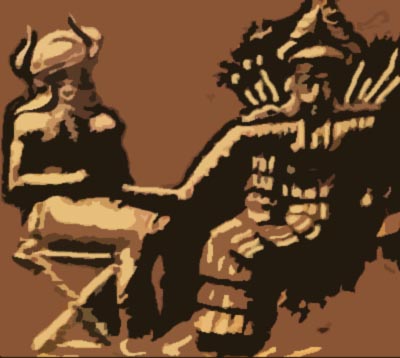
Depiction of a king with the goddess Ishtar from ancient Iraq
(king on left wears a horned crown while Ishtar has multiple horns,
plus weapons rising from her shoulders).