Monday, July 25, 2011

Angular Ten-Stroke Signs in Indus Script

Detail of inscription from seal H-506: CARTWHEEL / BI-QUOTES /
CARTWHEEL / STRIPED MALLET / CORN HOLDER / PANTS.

This post begins by considering STRIPED MALLET (5 stripes), the eleventh of the ten-stroke signs (X 11), enumerated elsewhere as KP280(with 3 stripes), W470d (5 stripes), and Fs N-10 (3 stripes).  This may be a variation on the previously discussed DOUBLY STRIPED MALLET (VII 37), which Fairservis suggests may indicate a place.  Wells observes 23 occurrences of all variants, including 12 from Mohenjo daro, 9 from Harappa, 1 from Lothal, and 1 from Kalibangan.  However, most of these have two stripes (i.e., are instances of DOUBLY STRIPED MALLET), with a few containing three stripes.  One instance has four (H-506).  But I do not see one with five.

In any case, there are a few parallel signs in other scripts.  The Egyptian hieroglyph O28 is rectangular (except that the top is indented, in a “V” shape) and has a short post on top.  It represents a column with a tenon, an ideograph in iwn, “column.” 

Proto-cuneiform sign MAR~a@t is a better analogy, a long rectangle with a post attached on the right.  The rectangle contains a single vertical striped with several horizontal stripes on the right side.  It came to mean “wagon, cart; winnowing shovel; spoon.”  USZ~b, “foundation,” is a similar shape, but with the post on the left side and no horizontal stripes.  Proto-Elamite also includes parallels, one with a short post on the left and diagonal cross-hatching inside (M155~f), another with two short posts and two horizontal stripes inside (M159).
Proto-cuneiform signs MAR, "wagon" (two variants, top row)
and USZ~b, "foundation" (center, bottom), variations on a "mallet."

In the rock art of Texas, there are a few parallels as well.  In these, the rectangle is taller than it is wide, as in the Indus sign.  But instead of a post on top, there is either a small square or an inverted triangle.  Both this top portion and the larger rectangle typically contain some sort of internal markings (e.g., Newcomb and Kirkland 1996: 188, Pl. 138, no. 17-A).  These may be incomplete anthropomorphic figures; the small element represents the head and the larger rectangle the body, with limbs either not included or lost due to weathering.
Texas rock art, with a mallet-like element on right (Newcomb and Kirkland 1996: 188, Pl. 138, no. 17-A).

A similar rectangle in which the post crosses through and descends beneath the rectangle is what I term a “top,” among Indus signs.  Koskenniemi and Parpola list one of these with three horizontal stripes, previously discussed (KP275).  Wells also finds one with five stripes (W489).  Basing my list on others’ observations, I thus include STRIPED SKEWERED TOP (5 stripes) (X 12).  Wells states that this is a singleton from Harappa (H-599).  However, to my eyes this is not a “top” at all, but a “mallet.”  I would consider it a variant of the previous sign, because the only difference is that the “post” continues through the rectangle.
Detail of (partial?) inscription from seal H-599: POTTED ONE / STRIPED TRIANGLE / STRIPED SKEWERED MALLET (or TOP?) // TRI-FORK TOPPED POT / POT (appears over the back of a bovine, probably the "unicorn," but head is gone).

However that may be, proto-cuneiform again provides a parallel with AK~b, a square with a post at the top and another at the bottom.  Inside the square, there are six neatly stacked “<” (less than) signs.  This symbol came to have the definition “to do, act, place.”  A variant has posts on either side, instead, and six diagonal strokes inside (AK~a).  A second sign resembles the latter variant, except that the central portion is rectangular rather than square and it contains two vertical stripes: BANSZUR~b2, “table; container.”
Proto-cuneiform "tops": AK~a, "to do" (above) and BANSZUR~b2, "table" (below).

We have seen many instances of VEE IN DIAMOND, especially as part of an inscription’s prefix.  On rare occasions, this common Indus symbol has additional elements.  Sign X 13 in my list is one of these, VEE AND BROKEN VEE IN DIAMOND, which occurs elsewhere only as W408.  Wells notes it to be a singleton from Mohenjo daro (M-23).  While symmetrically divided diamond shapes appear often among symbols in many parts of the world, such an asymmetrical form does not.
Seal M-23 with inscription: CEE BOAT / SINGLE QUOTE // FISH UNDER CHEVRON / FISH / SPEAR //
FAT EX / PINCH // FAT CHEVRON / POT // STRIPED FAT LEG LAMBDA / DUCK HEAD / VEE &
BROKEN VEE IN DIAMOND / CAGED OVERLAPPING CIRCLES (possibly three units of information). 

Another Indus sign with a ten-stroke variation is STRIPED TRIANGLE UNDER TABLE (X 14).  A variation appears as KP211 (9 strokes), while Wells alone notes a version with ten strokes.  Sign W420 is subdivided into two forms: “a” is a triangle with three stripes, under a short-legged “table”; “b” a single-striped triangle under a long-legged “table.”  Wells gives four occurrences, two from Mohenjo daro (both “a”), one from Harappa (“b”), and one from Kalibangan (“b”).  Those from the first of these cities appear to contain only two stripes in my view.
Seal M-52 with inscription: FOUR-TOED FOOT / STRIPED TRIANGLE UNDER TABLE / BI-QUOTES //
CIRCLED TRI-FORK / FISH UNDER CHEVRON / RAKE / FISH / TWO POSTS / DOUBLE CEES / POT.

Triangles are not particularly common in Egyptian hieroglyphs, but in the case of U38, there are two.  This is a depiction of a balance or scale, with the two triangles joined by a horizontal line passing from apex to apex, a central vertical, and a truncated triangle at the base.  The glyph is ideographic or a determinative in mh3t, “balance.”  Except for a portion of this glyph – a single-striped triangle under a horizontal line – the Indus sign does not much resemble U38.
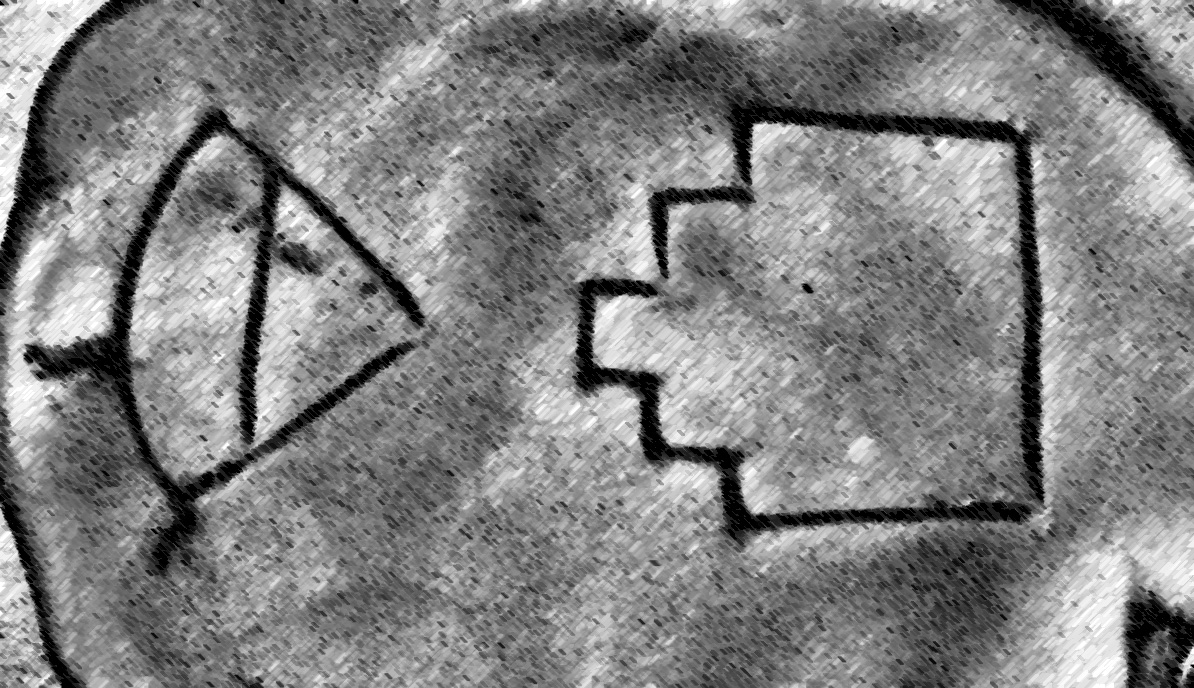
Proto-cuneiform analogs of the STRIPED TRIANGLE element: NI~a, "butter" (left) and URU~c, "town" (right).

Proto-cuneiform provides a better analog once again, with KAL~a, a single-striped triangle rotated 90 degrees, with a long-armed, backward “C” shape touching the apex.  It came to mean “precious, valuable.”
Bar seal L-86 with inscription: GRID (2 X 4) WITH ATTACHED POST / BACKSLASHES IN OVERLAPPING CIRCLES / TRI-FORK (execution of signs is rough, making precise identification difficult).

Another singleton among the Indus signs is GRID (2 X 4) WITH ATTACHED POST (X 15).  In this form it appears only in Wells’ list, as W505 (where it is reversed, as is typical of symbols found on seals).  The similar KP269 is made up of a post attached to a grid, but this one has three squares across and four down (3 x 4).  It appears only at Lothal (L-86).
Proto-cuneiform sign |E2~a.LISZ|, a combination of elements meaning "house" and "crumb."

There are no exact parallels, although proto-cuneiform does include a grid-like element alongside a “greater than” sign, |E2~a.LISZ|, a combination of symbols for “house, temple” and “morsel, crumb.”  The significance of the ligature is beyond me.
Seal M-751 with inscription: DOUBLE ZIGZAGS / FAT EX
(seal is heavily scratched and abraded, but the signs are clear).

Finally, the Indus signs include the doubling of an element previously discussed in DOUBLE ZIGZAGS (X 16), also known as KP192 and W431.  Wells notes a single occurrence at Mohenjo daro (M-751).  There is another instance where two zigzagging lines occur, but in this case they are the horns of an animal, perhaps an antelope (Rhd-1B).
Near Eastern signs for "water," Egyptian (above) and proto-cuneiform (below).

There are two signs containing the zigzag in Egyptian, one a single zigzagging line representing the consonant n, the other containing three of these in stacked form (N35).  The latter represents three ripples of water, an ideograph in mw, “water.”  Proto-cuneiform, on the other hand, appears to lack a zigzag, although it has the vaguely similar “double lazy esses” symbol A@t, “water; canal.”

Round seal Rhd-1B with two quadrupeds, perhaps antelope, as well as small "fish" (upper left)
and possibly a variation of the BOWTIE sign beside the head of the right-hand animal
(a seal that shows scorpions on the "A" side, perhaps an imported item from Altyn Depe or thereabouts).

Saturday, July 23, 2011

Squares and Diamonds in the Indus Script

Seal K-1 with inscription: TWO POSTS / BLANKET WITH 6 TICKS / STRIPED TRIANGLE UNDER TABLE /
SINGLE POST (note the appearance of apparent "numerals" both preceding and following another sign).

There are a number of Indus signs that are basically squares or rectangles with a few additional marks inside them.  One of these is what I term BLANKET WITH SIX TICKS, enumerated X 2 as the second of the ten-stroke symbols.  In the literature it appears with these designations: KP270(a), W538, and Fs G-12 (perhaps also Mahadevan's sign M245).  Fairservis considers it to represent an enclosure with six diacritical marks added.  His definition is non-architectural, though: "Note terms for superintendance; a prestigious title in Harappan?"  He also suggests that the basic square/rectangle indicates a weight, with the number of marks inside representing the measure.  Wells notes a total of 20 occurrences of this sign, 10 from Mohenjo daro, 5 from Harappa, 2 from Kalibangan, and 1 apiece from Chanhujo daro, Nindowari damb, and Kot diji.

Indus BLANKET analogs: proto-cuneiform SIG2~d4, "hide, fur" (top left) and
ZATU 759 (center top); Egyptian S32, "piece of cloth" (lower left) and O11, "palace" (far right).

In proto-cuneiform, in contrast, a square or rectangle filled with little marks -- not restricted to the tops and bottoms -- is SIG2~d4, which came to mean "hair; wool; fur, hide."  There is another squarish symbol with marks attached to the top and bottom only, ZATU 759.  However, in this case, the added marks are on the outside, while they are invariably on the inside in the Indus BLANKET.

Egyptian hieroglyphs include another rectangle, usually wide than it is tall, with a few strokes attached to one side.  This glyph, S32, depicts a piece of fringed cloth, as found acting as an ideograph or determinative in si3t, "piece of cloth."  The same glyph also functions as a phonetic element, a triliteral (symbol for a series of three consonants), si3.  This is not too different from a symbol found in Linear B (Mycenaean Greek), another rectangle with a "fringe."  It too represents a piece of cloth.

Tablet H-206A with inscription in bas-relief (right to left): TRIPLE BRICK / CUPPED POST /
FIGURE EIGHT WITH TRIPLED LASHES / WHISKERED FISH / BLANKET WITH FOUR
TICKS & TWO HYPHENS / POT (note that one "hyphen" is horizontal, the other diagonal).

A variation on this theme among Indus signs is X3, BLANKET WITH FOUR TICKS AND TWO HYPHENS, also known as KP270(e), W530 and 535, but not shown in Fairservis' list.  Wells distinguishes two versions, the first having two "slashes" and only the second showing the two "hyphens."  He sees five of the slanting variety, all from Harappa, and only one of the straight variety, this from Mohenjo daro.  In the photographs, the distinction is not entirely clear, however, since the "blanket" (or rectangle) does not have neat 90 degree angles in many of the Harappan instances, making it difficult to judge whether the additional marks were intended to be parallel to the top and bottom.  Accordingly, I have included both variants as a single sign in my own list.

Tablet H321, sides A & B, with inscriptions (left to right):
WHISKERED FISH / BLANKET WITH FOUR TICKS & TWO HYPHENS /
CROSSROADS EX / POT (A); TWO POSTS / CUP (B).

As parallels, I note the same symbols as mentioned previously.  In proto-cuneiform, the second example, ZATU 759, comes in a second version, this one with multiple diagonal stripes.  In Egyptian, another glyph matches the fringed cloth, but is set upright, with the "fringe" on top.  This symbol, O11, represents a palace with battlements, an ideograph in the word 'h or ih, "palace."  It contains internal marks as well, both horizontal and diagonal.

Seal M-267 with inscription: EX UNDER TABLE / BI-QUOTES // POT-HATTED BEARER //
BLANKET WITH 4 TICKS & 2 HYPHENS / POT (note how the "hyphens" virtually fill the center
of the "blanket" sign, making it difficult to assign them a specific sign number, X3 or X4).

The following Indus sign is probably another variant of X 3, and I have given it the same name (but a separate enumeration, X 4).  It appears in other lists as KP270(d), W532, and W533.  Again Wells distinguishes a version with straight horizontal marks and another with diagonal marks.  Together, they occur only five times.  The difference between these variants and those of the previous sign is hardly noticeable -- the added "hyphens" (or "slashes") touch the side of the enclosing rectangle in X 3, but touch no side in X4.  I find it impossible to distinguish the two sets, though, because in too many instances the added marks entirely fill the space inside the rectangle.  Are they intended to be free of the sides, then?  Or are they intended to touch one side?  If intended to touch, which side?

Seal M-975 with inscription: CAGED TETRAPOD / POTTED ONE / PANTS / OCTUPLE DOTTED EX.

Following these "blankets" in my list is a very different symbol, OCTUPLE DOTTED EX (X 5).  In form it is an "X" shape, with two small marks between every two arms.  It is designated KP242 and W559 in the literature, a sign that Wells notes occurs just once.  I find a second instance from the same location, Mohenjo daro (M-975 and M-1342).

Proto-cuneiform signs with four "compartments": U8, "mother ewe" (upper left); |(U8 x TAR)~b|, perhaps a sheared ewe (upper right); DARA4~a2, "blood; red" (lower left); and KID~e, "reed mat" (lower right) (definitions are those for the
later cuneiform descendants of these signs and may not be entirely correct for the earlier forms).

In proto-cuneiform there are signs that include an "X" or cross, with additional marks.  But in every case, there is also an enclosing shape, either circular or rectangular.  A circled cross with small marks in the division is U8, "mother ewe."  Almost identical is |(U8 x TAR)~b|, which combines the symbol for "to cut" with that of the sheep.  Here the arms of the cross protrude beyond the enclosing circle.  Finally, there is the rectangular DARA4~a2, "blood; red."
Seal L-39 with inscription: DOTTED WINDOW / VEE IN DIAMOND / BI-QUOTES //
AITCH / SPEAR (seal is cracked and heavily scratched, especially in lower right).

Another square or rectangular symbol in the Indus script is DOTTED WINDOW (X 6), found in the literature as KP380, W506, and Fs G-18a.  Fairservis suggests that this, too, is an enclosure, one with four equal compartments.  He defines it as a plural form of "storeroom," in other words "many storerooms."  If that were true, one would probably conclude that there were not many storerooms in the inscriptions, since it occurs only six times, according to Wells (3 from Mohenjo daro, 2 from Harappa, 1 from Lothal).

Compartmented stamp seal from Altyn Depe, with either cross or "X" shape,
as well as two "dots" between every two arms (Masson 1981: Pl. XVII, no. 6).

Proto-cuneiform also includes signs in which a rectangular element is subdivided into four equal parts.  One of these is a wide but short rectangle enclosing a cross: KID~e, representing a reed mat.  Another is a tall and thin rectangle enclosing an "X": DARA4~a3, a variation on one cited earlier meaning "blood; red."  At Altyn Depe, in Turkmenistan, a great many variations on both the cross and the "X" appear -- on pottery, as stamp seals, and as decoration on a variety of other artifacts.  In addition to the seal illustrated here, there is another round one with "X" or cross and a single dot between every two arms (Masson 1981: Pl. XXXVII, no. 2).

Seal M-255 with inscription: BELTED FISH / DOTTED EX IN DIAMOND / POT.

If the last Indus sign were tipped, to stand on one corner, it might become the next symbol, DOTTED EX IN DIAMOND (X7).  This appears in the literature as KP381, W398, and Fs G-18b.  Fairservis, in fact, considers it a variant of the previous sign.  Wells enumerates it separately, though, indicating that he disagrees.  He notes two occurrences, both from Mohenjo daro (M-109 and M-255).

Diamond shapes among the proto-cuneiform signs: UH, "vermin" (upper left), |HI x SZE3 @ t|, "to mix" plus "portion" (upper right), HI @ g~a, "to mix" (lower left), and |HI x 1(N58)|, "to mix" plus numeral "one."

Once again, proto-cuneiform provides a rather distant analogy, with the sign UH, "louse, flea; vermin."  This is also a diamond shape, but divided in half by a horizontal line (no vertical), with the addition of four short diagonals crossing this line.  Other diamond shapes occur in this proto-writing system as variations on HI, "to mix."  This can include a horizontal line or a vertical line inside, but not both.  There may be several strokes added to the interior, but these are either a series of parallels, or the addition of a second sign inside (as in |HI x SZE3 @ t|).

Seal L-48 with inscription: TRI-FORK (to left of  goat's horns) / POTTED ONE / BI-QUOTES (?) /
CAGED FISH // ASTERISK / VEE IN DIAMOND WITH FOUR PRONGS.

I discussed another diamond-shaped sign previously, namely VEE IN DIAMOND.  We now come to its relative, VEE IN DIAMOND WITH FOUR PRONGS (X 8), also known as KP389 and W404.  It is a singleton from Lothal (L-48).  It bears a passing resemblance to proto-cuneiform MUNSZUB~b, "hair, pelt; horns," a diamond containing many "V" shapes (rotated 90 degrees) and just two attached "posts."  In a sense, it is also analogous to BARA2~b, a rectangle with prongs attached on three sides, which came to mean a great series of things: "throne, dais; king, ruler; chapel, shrine; sackcloth, penitential robe; chamber, dwelling."

Proto-cuneiform BARA2~b, "throne; king, etc." (above)
and MUNSZUB~b, "hair; horns" (below), analogs to X8.

We can compare X8 to other Indus signs, too.  An inscription from Kalibangan contains VEE IN DIAMOND WITH THREE SHISH KEBABS (K-22).  A second example of this variation occurs at Mohenjo daro (M-151).  A fuller discussion will appear in this blog at a later time.  There is also a sign found at Mohenjo daro that has three attached prongs, only one stroke less than X8 (M-1152).  That is, I count three, but the photo is indistinct.

Seal K-15 with inscription: VEST / FISH / BUD TOPPED DUBYA / DOUBLY CAGED BACK DEE-SLASH / CORN HOLDER / SINGLE STRIPED BOWTIE / POT / COMB // CIRCLE WITH TWO EARS AND CIRCLE UPON CIRCLE BETWEEN ESSES / TRI-FORK ON VEE IN DIAMOND (note that there may be a single prong attached to the last, too).

The ninth sign of those drawn with ten strokes is TRI-FORK ON VEE IN DIAMOND (X 9).  Fairservis does not mention it, but it is also designated KP390(a), (b), and (c), as well as W396, 399, 410, and 411.  The variants differ in their treatment of the "trident" and its attachment.If the small variations among them truly distinguish independent signs, then each is a singleton.  If all are variants of a single sign, as I have grouped them, then there are four occurrences, two from Mohenjo daro, one from Kalibangan, and one from Harappa (Wells includes an additional instance from Harappa, but it is an eleven-stroke sign, to be discussed in a later post).  Although diamond shapes appear as symbols in many areas, and these are often adorned with one or more internal motifs, I find none analogous to this Indus sign.

Tablet H360B with inscription (probably to be read right to left): RAKE /
STRIPED BATTERY / TWO POSTS / CIRCLED FAT EX.

The final sign for this post is STRIPED BATTERY (X 10), also known as KP290, W477, and Fs G-2.  Fairservis thinks it represents a building, perhaps a house.  Wells notes three occurrences, but I find X 10 to be a singleton (H-360).  The other instances that Wells cites have an attached LOOP.  As signs of fourteen strokes, they will be discussed at a later time.

Three variants of proto-cuneiform URUDU, "copper"; a similar sign
with just two horizontal stripes inside is DUB, "(clay) tablet."

As with the simple BATTERY, X 10 is paralleled by various signs in proto-cuneiform.  These include URUDU @ g~c, "copper," DUB~d, "(clay) tablet," and an undefined symbol, ZATU 737.  A very similar shape appears occasionally in the rock art of the American Southwest (e.g., Newcomb and Kirkland 1996: 188, Pl. 138, no. 17-A).  In this area, it generally appears along with other motifs that bear a similarity to those of the pueblo cultures further west.

Three variants of proto-cuneiform sign ZATU 737.
REFERENCES:

Masson, V.M. 1981. Altyn-Depe.  Transl. Henry N. Michael. Philadelphia: The University Museum of Univ. of Pennsylvania.

Newcomb, W.W., Jr. and Forrest Kirkland. 1996. The Rock Art of Texas Indians. Austin: University of Texas.

Friday, July 22, 2011

The Last of the Nine-Stroke Indus Signs

Tablet H-304B with inscription (right to left): ASTERISK UNDER TABLE / CROSSROADS EX.

The last three signs drawn with nine strokes are familiar, being variations on symbols previously discussed.  The first is what I term ASTERISK UNDER TABLE (IX 59), known elsewhere as KP248.  The portion I call the “asterisk” is an “X” with additional short vertical lines at the top and bottom.  Above this, the “table” resembles a square bracket that has fallen on its side.  This ligatured sign appears to be a singleton, occurring just once at Harappa (H-304B). 

Egyptian hieroglyph (N4) for "rain."

Sign IX 59 combines elements I have discussed before, the TABLE and the ASTERISK.  There are analogs to each of these elsewhere.  For example, among the Egyptian hieroglyphs, the symbol for rain contains a thicker “coffee table” shape that represents the Egyptian sky.  There are also four vertical strokes falling from the base of this “table,” representing precipitation.  The glyph as a whole does not especially resemble the Indus ASTERISK UNDER TABLE, but I present it as an Egyptian example of placing one element over another, in a meaningful combination.

Proto-cuneiform sign ZAG~b, "boundary; shrine; front, etc."

In proto-cuneiform also, there is nothing quite like the Indus set of signs with the “table” on top.  But there is an element something like the “asterisk” portion, ZAG~b, which eventually means “boundary, cusp; place; shrine; front.”  This sign begins with the same “X” with additional strokes.  But there is also a horizontal line at the top and another at the bottom, closing in these ends.  Rather than resembling an asterisk, then, ZAG looks like an hourglass (or a version of the Indus BOWTIE rotated 90 degrees).

Impression of seal M-219 with inscription (right to left):
SPACESHIP UNDER TABLE / ZEE PINWHEEL.
The next Indus sign is constructed along the same lines, SPACESHIP UNDER TABLE (IX 60).  The “table” element is the same as in the previous sign.  Beneath this, there are three triangles, two stacked and the third attached by its apex to the first ones.  Elsewhere, this is KP222 and W422.  Wells observes three instances, all from Mohenjo daro.

Two versions of proto-cuneiform KUR, "mountain; (foreign) land" (top left, "c" variant;
bottom left "a" variant) and two similar "hills" motifs from later Indian punch-marked coins
(top right, Gupta 47; bottom right Gupta 48) (Gupta 1960: Pl. 1).

Again, I see nothing quite like this ligature among the signs and glyphs of other early writing systems.  But the SPACESHIP portion, as noted in an earlier post, has an analog in the similarly arranged triple triangles of one variant of proto-cuneiform KUR (“c” variant).  This symbol came to mean “mountain, highland; (foreign) land; the netherworld; the east.”  More commonly, though, the sign is written with three small wedges (variants “a” and “b”).

Seal H-642 with inscription: THREE POSTS / CIRCLED BISECTED RECTANGLE / MAN HOLDING
BACK DEE-SLASH / PRICKLY CORN HOLDER / PANTS (IX 61 A) / SINGLE QUOTE.

The final nine-stroke sign among the Indus symbols is PANTS (IX 61).  Here I group together four variations on a theme of not-quite-parallel bent strokes.  Koskenniemi and Parpola list only the version drawn with eight strokes (KP205), while Fairservis fails to mention any variations.  Wells enumerates the variants separately, the nine-stroke versions including W162, 165, 170, and 172.  Each occurs either just once or a mere handful of times.  In one of these variations (W170), the top of the sign takes an oval shape, where the others have an angled line.

Seal Krs-1 with inscription: CUPPED SPOON / QUADRUPED / SHISH KEBAB / PINCH //
THREE POSTS / CIRCLED TRIPLE BRICK / PANTS (IX 61 D) / CHEVRON / SINGLE QUOTE /
STACKED TRIPLE CIRCLES.

To end this post, I will also mention the first of the ten-stroke signs, STACKED TEN (X 1).  Wells does not include this in his list of apparent numerals, but it does appear as KP130 and Fs O-16.  Fairservis sees it as a numeral, the number ten as an adjective, and notes a single occurrence (1992: 62).  I have not seen it myself in the Corpus.  Perhaps it shows up in the third volume, recently published.

Proto-cuneiform "ten" in four forms: circular impressions (2 x 5), wedge-shaped impressions (5 x 2),
horizontal strokes (5 x 2), and vertical strokes (5 x 2) -- the last identical to the Indus form.
In proto-cuneiform, there are true numerals of various different forms.  When “ten” is depicted, it is stacked, usually as two rows of five marks, as in the Indus sign.  But in proto-cuneiform, the marks are either wedges (N01), impressed circles (N14), or horizontal lines (N57).  In only one type is a row of five vertical strokes stacked over another row (N58), as in the Indus X 1.  There is also a non-numerical sign containing ten stacked wedges forming a triangular arrangement (|LAM~b@t|, “abundance”).

Proto-cuneiform sign |LAM~b @ t|, "abundance," a sign
resembling a "stacked ten," but with non-numerical meaning.

In other writing systems, “ten” is often written with a symbol different from that used to enumerate units.  The Egyptians used the medj, an inverted “U” shape, for “ten,” while the ancient Chinese drew a cross.  One might wonder why the people of the Near East did not follow suit and use a symbol different from what represented a single unit.  The reason has to do with their counting methods.  When they recorded numbers ofdiscrete items and measures of grain or liquids, they used repetitions of symbols that bore a relationship to the type of measurement.  It would be like us drawing, say, ten small circles to represent ten inches.  The next largest measure of length after the inch is the foot, so we would also draw eleven circles for “eleven inches,” but not twelve.  Instead of twelve small circles, we would use a different symbol for “one foot.”  We might draw a larger circle or change to a wedge, for example.  It is from regularities such as this that modern scholars have been able to deduce the types of measurement systems used by the ancient peoples of Iraq and Iran.

Proto-Elamite economic tablet: dark circular impression represents 10 in sexagesimal system S;
the two dark wedges represent 2 in the same system (other marks are from a cylinder seal) (Potts 1999: 61).
As noted in an earlier post, there is no “eleven” in the Indus script, and just the one instance of “ten.”  Fairservis suggested, on this basis, that the Harappans had a base eight counting system (1991: 61).  Collections of long strokes (which I term “posts”) occur in groups from one to seven only, as Fairservis notes.  Sometimes, he further notes, these supposed numerals appear “grouped as a series of short strokes” (ibid.).  So, this scholar sees STACKED FIVE, STACKED SIX, and STACKED SEVEN as alternative ways of writing the same numerals as FIVE POSTS, SIX POSTS, and SEVEN POSTS.  Unfortunately for his thesis, there are also instances of STACKED EIGHT, STACKED NINE, STACKED TEN, and STACKED TWELVE.  These definitely do not fit the notion of a base eight system.  Rather than abandon his hypothesis, Fairservis defines these problematic signs, for the most part, as depictions of rain or rivers (1991: 70-71).  Most scholars do not accept this base-eight hypothesis, however.

Fairservis thinks the apparent numerals are mostly calendrical symbols, representing the twelve months of the year.  Despite his characterization of the STACKED TWELVE, a calendrical system would seem to account for the occurrence of apparent numerals up to twelve and no further (there being no “13” or “14,” etc.).  Faiservis further proposes that the various “forks” are part of this calendar system, since certain “numerals” frequently appear alongside a TRI-FORK or QUAD-FORK.  He notes the frequency of these in a table taken from data in Mahadevan’s concordance (1992: 61):

SIGN PAIR
OCCURRENCES
TRI-FORK / 2 POSTS
16
TRI-FORK / 3 POSTS
27
TRI-FORK / 4 POSTS
45
TRI-FORK / 5 POSTS
18
TRI-FORK / STACKED 6
12
TRI-FORK / STACKED 7
10

One form of the EXIT sign (which he identifies as an irrigation sluice) often pairs with the STACKED SEVEN, so this too becomes part of his calendar:

“It is tempting to suggest that pairing with the number seven otherwise makes this combination [EF PRONGED EXIT / STACKED SEVEN] an alternative to the seventh month, a period of heat when the rains are expected but irrigation is the only source of water to the fields.  This may well be the fact” (1992: 59).

For the eighth month, he cannot very well appeal to the STACKED EIGHT, since he has done away with that as a proposed numeral.  Instead, he brings in OVERLAPPING CIRCLES, his definition of which is based on homophonous with words for pairing, doubling, and joining in Dravidian languages ("eight" being eTTu or eN in Dravidian languages and Tamil iNai, Kannada eNe, Tulu iNe signifying "pair, double, join") (1992: 62).  For the ninth month he proposes the MALLET, which depicts one of the square weights often found in excavation, in his view.  The tenth month is represented by the BED (seen as a harrow or rake), while the eleventh is SLASHES IN OVERLAPPING CIRCLES.  When one of these “month” signs is attached to SINGLE POST, he defines the “post” as a “determinative” (not in the sense of Egyptian or cuneiform “determinatives,” but used to indicate that the sign is not phonetic), and the connecting slash as an “arrow.”  Thus, there are several “arrow months” in his proposed system. 

For the twelfth month, Fairservis suggests the MAN HOLDING DEE-SLASH, defined as a bowman, because it is another symbol containing a slash (his “arrow”).  He sees the slash/arrow as representing what he terms “arrow months,” the 8th through 12th months, which make up a traditional season in India.  Two crops are commonly sown in India and Pakistan, depending on the season: the summer or kharif crops are cotton, rice, and millet, while the winter or rabi crops are wheat, barley, and oil seeds such as sesame (1991: 65).  Fairservis' calendar is an interesting suggestion, but the two-crop system is not actually attested for the period of the Bronze Age when Indus script was used, as he admits.  Still, the Harappans probably recognized different seasons and had designations for them.
Mixtec depiction of a historical person named Six-Water, with his name -- also his birth date --
above (this use of a date for a name may be similar to the appearance of "numerals" in Indus script) (Smith 1973: 243).

The real question, to my mind, is whether calendrical information is likely to be conveyed in stamp seals and small tablets.  Nowadays, of course, incoming mail is stamped with the date in many an office.  The stamps are not carved in stone, though.  There is usually a synthetic rubber belt with all the months and numbers on it and these belts are moved as the days and months pass.  If the Harappans were stamping dates on commodities, it seems more likely that each stamp would have a single item of information (year, month, or day) and one of each would be used in sequence.  There would be little point in going to the trouble of carving a separate seal for every day of the year.  The seals and tablets that actually exist, as seen in multiple examples, typically have more than one symbol on them, anyway.  Thus, it seems unlikely that dating was their primary purpose.

REFERENCES:
Aruz, Joan, ed. 2003. Art of the First Cities: The Third Millennium B.C. from the Mediterranean to the Indus. New York: The Metropolitan Museum of Art and Yale University Press.
Damerow, Peter and Robert K. Englund. 1989. The Proto-Elamite Texts from Tepe Yahya. Cambridge: Peabody Museum of Archaeology and Ethnology, Harvard University.
Fairservis, Walter A. 1992. The Harappan Civilization and Its Writing: A Model for the Decipherment of the Indus Script. Leiden: E.J. Brill.
Gupta, Parmeshwari Lal. 1960. Punch-Marked Coins in the Andhra Pradesh Government Museum. Hyderabad, Andhra Pradesh: Government of Andhra Pradesh.

Potts, D.T. 1999. The Archaeology of Elam: Formation and Transformation of an Ancient Iranian State. Cambridge: University Press.

Smith, Mary Elizabeth. 1973. Picture Writing from Ancient Southern Mexico: Mixtec Place Signs and Maps. Norman: University of Oklahoma Press.


Saturday, July 16, 2011

Animals in the Indus Script?

Various birds as depicted on early Elamite pottery (Potts 1999: 53). 


Seal M-1278 with inscription: CUP (?) / IX 57 (BIRD BETWEEN PARENS?) / COMB
(note that the "legs" on the right do not actually touch the curved line and there is an opposite
curve on the other side of this schematic creature).

There is an enigmatic sign in the Indus script that appears just once, one I enumerate IX 57 as the fifty-seventh in my list of nine-stroke symbols.  It may represent a bird or it may be a bug.  For now I am calling it PERCHING BUG since Wells shows it attached to a curved line, as if it were standing on something.  Wells assigns it the number W109, noting it to be a singleton from Mohenjo daro (M-1278).  In form it centers on a shape like our numeral “8.”  I see two small “v” shapes attached to one side, which I take to be the legs of a bird.  It also seems to have a tail that slants just slightly.  To my eyes, this odd little bird stands between parentheses.  Wells, though, sees it as standing on a “(“ and apparently makes the other side of my parentheses into part of the tail.
Egyptian bas-relief showing a man bringing a goose -- elsewhere a hieroglyph -- as an offering.

Assuming that it is supposed to be a bird, let us examine the birds that appear elsewhere.  Egyptian hieroglyphs include quite a few.  Those with prominent tails include G36, perhaps a swallow, pronounced wr.  As such, it appears in the word for “great,” also pronounced wr.  Another bird glyph that is almost identical is G37, a sparrow.  The only difference is at the end of the tail – rounded for the sparrow, angular for the swallow.  But the meaning of this bird is quite distinct.  The sparrow is the determinative in words with negative connotations, including nds, “small,” and bin, “bad.”  Of course, there are also ducks, geese, falcons, and, most common of all, the chick.  But we need not look at all of them just now. 
Egyptian goddess Maat with hieroglyphs above her spread arms; note the vulture inside
the cartouche on the left (G15), the swallow to the right of the cartouche (G36), the duck
next to Maat's head and again on the right behind glyph of seated Maat (G39) (from
Queen Nefertari's tomb).
Another possible analog for Indus sign IX 57 is L2, a bee.  It occasionally appears as an ideograph in bit, “bee; honey.”  But most often it occurs as a phonetic glyph, indicating the sound bit, in nsw-bit, “king of Lower Egypt.”  This bee has two wings and antenna, as well as four legs, unlike the Indus sign.  But the body of this insect is essentially a figure eight with a few internal marks.
Proto-cuneiform sign NAM~a, a small bird, either a swallow or a sparrow.

In proto-cuneiform, there are a great many birds also.  The only one with legs that I am aware of is NAM~a, which may represent either a swallow or a sparrow, once again.  This more schematic representation lacks a tail, though.  So it is not a particularly good analog for the Indus sign.
Birds from Old Chinese (citation in earlier post).

Texas rock art showing standing shaman (bottom center) and possible thunderbirds above
(Newcomb and Kirkland 1996: 11, Pl. 2 detail, somewhat simplified for clarity here).
Birds also appear in Old Chinese, specifically a character for a large bird and another for a small bird.  In modern script, neither looks anything like a bird.  But in their ancient form, each sports an identifiable head, as well as feathery wings and perhaps a tail.  These do not especially resemble the Indus sign.  But it is worth noting their existence.
Thunderbirds of the North American Menomini (Appleton 1971: Pl. 8).

There are birds in the rock art of various places in addition.  A thunderbird is particularly common in North America, a bird of great significance in the religion of various native peoples.  Such is the interpretation sometimes given to depictions of birds in Texas (Newcomb and Kirkland 1996: 11, Pl. 2).  A hummingbird is more common among the Moche of South America, where such birds often appear on painted pottery to indicate intense activity (Donnan and McClelland 1999: 106-107).

Moche warriors with a hawk above and another between the men, common in scenes of combat, and a hummingbird to the left, indicator of intense action; sandhills beneath the warriors locate the action in or near desert (Donnan and McClelland 1999: 106-107).

Besides birds and insects, there are a few quadrupeds among the Indus signs.  Many of these are unidentifiable because they are so small, schematic, and lacking in obvious characteristics.  One of these is sign IX 58, which I describe as QUADRUPED WITH E FACE AND STRAIGHT TAIL.  It is shown in the list created by Koskenniemi and Parpola (KP44) but not elsewhere.  I see it once at Mohenjo daro (M-1319).
Seal M-1319 with inscription: QUADRUPED WITH E FACE & STRAIGHT TAIL (or vice versa) /
DOUBLE CEES / BI-QUOTES // CIRCLED E TRI-FORK / CRAB / (? broken).

Animals depicted in later punch-marked coins of India, including a gharial biting a fish plus a frog (top row),
perhaps a cat, a donkey, and a zebu (left hand column beneath gharial), and another fish plus a bug (?) (right hand
column beneath frog) (Gupta 1960: from Pl. 1 and 2).
Egyptian hieroglyphs include as many quadrupeds as birds, but these are usually considerably easier to identify.  When carved on monuments, the animals are quite detailed, if not completely realistic.  In hieratic, written with brush and ink on papyrus, the same glyphs are not quite so easy to recognize.
Schematic lions and gazelles as seen in the impression from a Syrian cylinder seal (Collon 2005: 53, fig. 206).
In proto-cuneiform, whole animals almost never appear.  Typically, the head of a particular species is the earliest sign for the animal, though there are exceptions.  However, one of the enigmatic ZATU series seems to be an animal with four legs and a tail (ZATU 703).

Series of quadrupeds of various types as depicted in the rock art of Nevada
(Heizer and Baumhoff 1984: 116 and others) (not a natural grouping).

Rather than enumerating the different Indus quadrupeds separately and comparing each to the same set of analogs, I present here a series of each.
Copper tablet M-516B with QUADRUPED (CHEVRON FACE, E TAIL).

North African Tifinagh script plus two quadrupeds, one with a hump and probably a camel (LeQuellec 2004: 43, fig. 42).
A quadruped in "skidding" posture on a pot from the Cucuteni culture of Old Europe (Gimbutas 1991: 109, Fig. 3-71).
Possible quadruped with straight tail from an Indus pot shard, L-223.
Bar seal M-1341 with inscription: BLANKET (6 TICKS) / QUADRUPED (R FACE, E TAIL) /
STRIPED MALLET / BI-QUOTES // STACKED FIVE (the same "quadruped" or different?).


Men and quadrupeds, probably elands, in South African rock art (LeQuellec 2004: 161, fig. 33).


REFERENCES:

Appleton, Le Roy H. 1971. American Indian Design and Decoration. New York: Dover (originally published 1950 by Charles Scribner's Sons, entitled Indian Art of the Americas).

Collon, Dominique. 2005 and 1987. First Impressions: Cylinder Seals in the Ancient Near East. London: The British Museum Press.

Gimbutas, Marija. 1991. The Civilization of the Goddess. San Francisco: Harper.

Gupta, Parmeshwari Lal. 1960. Punch-Marked Coins in the Andhra Pradesh Government Museum. Hyderabad: Government of Andhra Pradesh.

Heizer, Robert F. and Martin A. Baumhoff. 1984. Prehistoric Rock Art of Nevada and Eastern California. Berkeley: University of California Press.

Joshi, Jagat Pati and Asko Parpola. 1987. Corpus of Indus Seals and Inscriptions. 1. Collections in India. Helsinki: Suomalainen Tiedeakatemia.

LeQuellec, Jean-Loic. 2004. Rock Art in Africa: Mythology and Legend. Paul Bahn, translator. Paris: Flammarion.

Newcomb, W.W., Jr. and Forrest Kirkland. 1996. The Rock Art of Texas Indians. Austin: University of Texas Press.

Potts, D.T. 1999. The Archaeology of Elam: Formation and Transformation of an Ancient Iranian State. Cambridge: University Press.

Shah, Sayid Ghulam Mustafa and Asko Parpola. 1991. Corpus of Indus Seals and Inscriptions. 2. Collections in Pakistan. Helsinki: Suomalainen Tiedeakatemia.

Pittman, Holly. 2001. "Glyptic Art of Period IV," in Excavations at Tepe Yahya, Iran 1967-1975: The Third Millennium, C.C. Lamberg-Karlovsky, ed. Cambridge, Massachusetts: Peabody Museum of Archaeology and Ethnology, Harvard University.