Tuesday, August 2, 2011

Eleven-Stroke Indus Signs: The First Ten

Seal M-314 with inscription: CARTWHEEL / BI-QUOTES // FISH UNDER CHEVRON / WHISKERED FISH / FISH / SPEAR // (2nd row) DOUBLY CAGED AY / CUPPED SPOON / TRI-FORK TOPPED POST / POT //
(3rd row) THREE POSTS / CIRCLED TRI-FORK / PANTS / MAN WITH DEE-SLASH / TRI-FORK / CIRCLED VEE / QUADRUPED (a mouse?) (this inscription may contain three units of information, the longest inscription in this script).

Of the thirty-eight Indus signs drawn with eleven strokes, DOUBLY CAGED AY is the first, thus enumerated XI 1 in my list.  This symbol appears in others lists as KP187 and W442.  Wells notes that it is a singleton, appearing just once at Mohenjo daro (M-314). 
Egyptian plowing scene showing implement vaguely resembling Indus AY (Faulkner 1994: Pl. 34, detail).

The AY element may represent a simple type of plow called an ard, based on a comparison with the Egyptian glyph U13, which is certainly a plow.  However, some other object may be intended, such as the tool depicted here in the form of a goldweight from Ghana (Phillips 2010: 33, fig. 32).  It may be an adze or a hoe, for example.  In addition, it is always possible, of course, that the Indus sign is an abstract symbol, not depicting any object in the real world.
Seal K-15 with inscription: VEST / FISH / BUD TOPPED DUBYA / DOUBLY CAGED BACK DEE-SLASH / CORN HOLDER / SINGLE STRIPED BOWTIE / POT / COMB // CIRCLE WITH TWO EARS & CIRCLE UPON CIRCLE BETWEEN ESSES / VEE AND E TRI-FORK IN DIAMOND WITH POST (probably including two units of information).

The second sign in the eleven-stroke set is DOUBLY CAGED BACK DEE-SLASH (XI 2), found elsewhere as KP183 and W568.  Like the previous symbol, this one is a ligature, made up of eight dots in the upper and lower right and left corners, surrounding a larger central element.  That central symbol, the DEE-SLASH, may represent a bow and arrow.  I have chosen to give it a different term, though, since there is no proof that this is indeed what it depicts.
Openwork goldweights of Ghana, including one resembling the Indus
DEE-SLASH (center top) (Phillips 2010: 180, fig. 352).

A comparison may be made with an apparently abstract shape taken by one of the Ghanaian goldweights (Phillips 2010: 180, fig.352).  This one may be related to the more common semi-circular “cogwheel” weights, many of which have a decorative element perpendicular to the straight side.  It is also possible that both the “D” shaped openwork weight and the semi-circular “cogwheels” are schematic depiction of quivers for arrows, the rounded side indicating a strap for carrying (cf. 2010: 168, fig. 330).
Detail from Peruvian poncho showing Incan design similar to a "caged boxed cross" (Appleton 1971: Pl. 69).

It is interesting to note the “caging” element in these first two Indus signs.  Usually, caging includes just four marks in the corners, but here each corner bears two marks.  What is notable is that there are no other configurations.  There are never twelve or sixteen marks – three or four dots in each corner.  And there are never fewer than four – no instances of three or two, unless one counts a single sign found on a few copper tablets.  This possible exception is a STRIPED MALLET which has two dots accompanying it, one on either side of the “handle” of the “mallet.”  The very presence of “caging” as a modification of a sign suggests that four may be a number with special meaning.  The appearance of a few signs with double caging further suggests that eight is also meaningful, though perhaps less so than four.  Did the Harappans have four seasons?  Did they see four corners of the world, as did their contemporaries in the Near East?  At the moment, we have no way of knowing.
Ghanaian goldweight in the shape of a "caged boxed cross" (Phillips 2010: 176, fig. 348).
This same motif appears on many Indus seals lacking inscriptions.

On the topic of caging, many researchers ignore the presence of many Indus seals bearing a symbolic motif but no signs.  A good number of these are adorned with a cross (or “X” depending on how one positions the seal), with four smaller elements in the four corners.  This “caged cross” motif also appears outside the Indus Valley, interestingly enough.  It may have originated in some areas as an angular variation on the circled cross, a nearly universal motif.  This caged cross appears among the Ghanaian goldweights, for example (Phillips 2010: 176, fig. 348).  It also occurs in the art of some native peoples of the Americas (Appleton 1971: Pl. 69).
Detail from seal M-61 with inscription: DOUBLY CAGED ASTERISK (not a TRI-FORK) /
GRID (3 X 3) / SPACESHIP / FISH / DOT IN FISH (??) / LEAF (??) / POT.

To continue with the Indus signs, there is a DOUBLY CAGED TRI-FORK (XI 3), also known as KP87.  I have not seen this particular symbol in the Corpus, though there are two examples of a similar CAGED ASTERISK (M-61 and M-655).
Ghanaian goldweights in the form of back rests (Phillips 2010: 120, fig. 191).

The trident element in this proposed symbol appears among the goldweights of Ghana depicting a backrest (Phillips 2010: 120, fig. 191).  In an early post, I mentioned other “tridents,” including a Chinese version that depicts either a plant or a human hand depending on the character.
Detail of inscription from broken seal M-256: FOOTED STOOL / PINCH // FISH /
CAGED CIRCLED TRI-FORK // (2nd row) RAINY CARTWHEEL (? too abraded to be certain).

There is another symbol caged with the more usual four marks: CAGED CIRCLED TRI-FORK.  It is also enumerated KP365 and W374.  Wells sees only one example from Mohenjo daro (M-675).  I find four, two of which contain a trident, two others “E” shaped.  There is also one CAGED CIRCLED BI-FORK (M-794).  All derive from the same city.
Detail from seal M-675 with inscription: TWO POSTS / EARPHONES ON POST / BI-QUOTES //
FISH UNDER CHEVRON / BACKSLASH IN FISH / CUPPED SPOON / THREE POSTS / CAGED
CIRCLED E TRI-FORK / BUGS ON STRIPED LEAF / POT (despite the presence of 10 signs, this
inscription probably contains just one unit of information).

Fairservis does not list the ligatures with caging as independent signs.  But he does mention caging, enumerating this element as P-9.  They depict ornamental dots of milk, he believes, representing tribute in the form of milk cows, or the flow of a liquid (1992: 184).  He considers the TRI-FORK, whether “E” shaped or not, to depict a stalk of grain (E-3).  But the symbol stands for a lunar month, he thinks (1992: 160).  As I mentioned in a previous post, the notion of a Harappan calendar may not be too far-fetched.  But this hypothesis fails to make sense of the fact that there is no 11 among the apparent numerals.
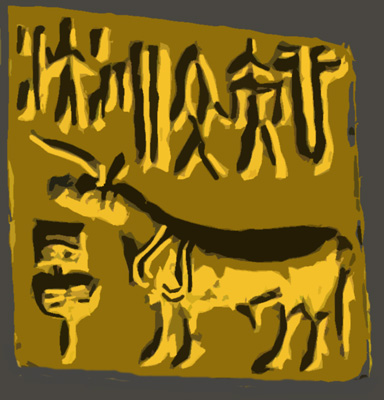
Seal M-130 with inscription: CAGED MAN HOLDING POST / BI-QUOTES // TWO POSTS / FISH / TABLE BELTED MAN / POT (a six-symbol series containing the elements of prefix, medial section, and terminal; one unit of info).

Sometimes an anthropomorphic element is caged, as in CAGED MAN HOLDING POST (XI 5), elsewhere KP32 and W54.  As Wells notes, it is a singleton from Mohenjo daro (M-130).  While representations of humans holding sticks or other implements are common around the world, the combination of this motif and the four dots of caging seems to be confined to the Indus Valley.
Inscription from seal K-60: THREE POSTS / MAN ON BASE HOLDING TWO POSTS / TRI-FORK.

The following symbol is problematic: MAN ON BASE BETWEEN POSTS (XI 6), which appears only as KP18.  I do not see the precise sign included in Koskenniemi and Parpola’s list.  The closest thing to it appears to be a singleton from Kalibangan (K-60).  To my eyes, this is a MAN ON BASE HOLDING TWO POSTS.  I am inclined to change the designation on this basis.
Detail of broken seal M-863 with inscription: GRAIN EAR BETWEEN POSTS / POTTED ONE / CUPPED POST / PRAWN / POT (a single unit of information with the elements of medial section and terminal).

Another singleton is GRAIN EAR BETWEEN POSTS (XI 7), also known as KP102 (only nine strokes) and W273.  It occurs at Mohenjo daro, like so many other singletons (M-863).
Proto-cuneiform sign SZAM2, "to buy, sell, barter," analogous to Indus XI 7.

As a comparison, we may note the proto-cuneiform SZAM2.  This symbol includes a horizontal ear of grain between two bent lines that resemble a bottle.  It came to mean “purchase; sale price; to buy, sell, barter.”  Originally, it may have depicted grain in a standardized container, a commodity commonly used for barter in the ancient world.
Seal M-752 with partially legible inscription: QUINT-FORK ON DOWN COMB / POT (?) / FOOTED STOOL / PINWHEEL (the POT has a chip missing at the top, so it may actually be a POTTED ONE or another similar sign -- seal very abraded).

The eighth symbol for this post is QUINT-FORK ON DOWN COMB (XI 8), shown only in Wells’ list (W286).  It appears once at Mohenjo daro (M-752).  It may be a variant of a simpler sign, a trident on the same “comb” with tines turned downward (KP88 and W275).  Another variation on this theme places a “Y” shape (or “bi-fork” in my terminology) on the same “comb” (Dlp-3).
Proto-cuneiform sign NIN, "queen, mistress, lady."

Besides being rare, this symbol has almost no parallels, though the two elements of which it is composed are quite frequent.  The best analog I find is the proto-cuneiform sign NIN, “queen, mistress, lady.”  It, too, is a ligature of two elements.  But here, one part is a triangle that is not quite bisected (representing the female aspect of the meaning).  The other is not a “comb” but a thin rectangle crossed by two horizontal lines (indicating high rank).
Seal M-67 with inscription: BATTERY / MAN HOLDING CUP / PINCH // CEE / PACMAN / POT //
SPACESHIP WITH ATTACHED TRI-FORK (probably two units of information: prefix, medial / terminal / 2nd medial).

As the largest Indus site, Mohenjo daro provides the greatest number of seals, tablets, and other artifacts bearing inscriptions.  Not surprisingly, there are more singletons from this site than any other also.  Yet another example is SPACESHIP WITH ATTACHED TRI-FORK (XI 9).  It appears in other lists as well: KP223 and W426.  Fairservis only notes the elements of which it is composed (N-1 SPACESHIP, “mountains” + F-13 trident affix, “fire”).  Perhaps he considers the ligature a volcano?
Seal M-842 with single-sign inscription: FOOTED STOOL WITH HAIRY LEGS
& ATTACHED TRI-FORK (12-stroke version).

The final sign for this post is FOOTED STOOL WITH HAIRY LEGS AND ATTACHED TRI-FORK (XI 10).  Since I include this in the eleven-stroke group, only those variations with two “hairs” per “leg” appear here.  More commonly, this type of symbol includes three such “hairs” per “leg” (W461).  Although Wells carefully distinguishes the two types, I am not convinced that there is a two-hair version.  If it does occur, it is probably a single instance from Mohenjo daro (M-127).
Ghanaian goldweight with repeated "bowtie" motif, the closest element to the Indus "stool" (Phillips 2010: 82, fig. 120).

If Wells is correct, there are six occurrences of the 11-stroke version, one of them from Harappa; plus a single instance of a 12- or 13-stroke version from Mohenjo daro (M-107).  He observes only instances with the “tri-fork” on the right, the “feet” of the “stool” on the left.  But I think one case is reversed (H-99, not included in his listing).  In any case, this uncommon Indus sign appears to have no parallels elsewhere.

REFERENCES

Fairservis, Walter A. 1992. The Harappan Civilization and Its Writing: A Model for the Decipherment of the Indus Script. Leiden: E.J. Brill.
Faulkner, Raymond O. 1994. The Egyptian Book of the Dead: The Book of Going Forth by Day. San Francisco: Chronicle Books.
Phillips, Tom. 2010. African Goldweights: Miniature Sculptures from Ghana 1400-1900. London: Thames & Hudson.

Saturday, July 30, 2011

A Leaf, an Egg, and a Bird in the Indus Script

Tablet H289A and B with inscriptions: STRIPED LEAF (B); FOUR QUOTES / LOOP TOPPED DUBYA / POT (A).


Today’s first sign for discussion is a ten-stroke version of the STRIPED LEAF (X 45), enumerated elsewhere as KP112, W254, and Fs E-6a.  Fairservis identifies it as a pipal leaf, with the definition “head/high superior as in Chief or God” (1992: 161).  As Wells notes, there are many variants, this one occurring twice at Harappa (H289B and H290B, which are duplicates).
Plant motif (right) from proto-Elamite pot shard, with gazelle or goat on left
(this fringed look is far more common than leaf-like elements in most early art)
(Potts 2001: 188, fig. 7.7).

Many plants appear in the scripts of other lands, including the M series in Egyptian hieroglyphs (e.g., M2 is the determinative for a plant or flower; M9 the determinative for a specific species, the lotus).  Plant-like signs also appear in proto-cuneiform: GI, “reed”; GI4, “to return”; GIBIL, “renewal”; GISZIMMAR, “date palm”; and NAGA, “saltwort,” are examples.  Although these all look like plants at the early proto-writing stage, they may not all signify such things.  And none of these examples bears much resemblance to the Indus LEAF sign.
Adinkra sign sankofa: doubled on right, variants of single form on left (Willis 1998: 188).

Plant-like motifs also occur in the artwork and/or symbol systems around the world (hardly surprising since plants themselves are widespread).  But a leaf resembling the Indus X 45 remains quite rare, regardless of where one looks.  Among the Adinkra symbols of West Africa, one includes an element shaped like a Valentine heart, as well as a “stem.”  This is sankofa, “go back to fetch it” (Willis 1998: 188-189).  This symbol actually represents two birds rather than a plant, conveying the message that one must learn from the past in order to build for the future.  It has many variants, many of which do not resemble the Indus LEAF in the least.
Seal K-28 with inscription: HORN / EGG ON NEST / BI-QUOTES // VEST / POT // GRAIN EAR /
TABLE (note that "trident" on the second sign angles toward the right and its oval sits on three prongs).

The second Indus sign for today’s post is EGG ON NEST (X 46), a symbol with a trident on top of an oval that sits on three or four prongs.  It appears in other published lists as KP84, as well as W179 and W180.  Wells distinguishes two versions, seen as independent signs, where W180 is the mirror image of W179 (and vice versa).  If we combine these as variants of a single sign, following Koskenniemi and Parpola, there are five occurrences in all, all but one from Mohenjo daro.
Broken seal M-976 with (complete) inscription: CIRCLED VEE /
STRIPED FAT LEG LAMBDA / SINGLE QUOTE // EX / EGG ON NEST
(note angle of "trident" on last sign, which sits on four prongs). 

Again, there is nothing quite like this symbol elsewhere, so far as I can tell.  In proto-cuneiform, there is a sign based on a diamond shape, with a prong attached to each corner.  In this symbol, IM~b, which may be either the sign that came to mean “clay” or the one for “storm,” the angles of the attached prongs vary, so that the whole lacks symmetry.  It is really only this feature that is shared with the Indus sign.
Adinkra wawa aba symbol, which represents toughness and perseverance (Willis 1998: 196).

Among the Adinkra signs, asymmetry is quite rare.  There is one symbol containing a circle sitting on three prongs, namely wawa aba, “seeds of the wawa tree” (Willis 1998: 196).  It has the same three prongs on top, though, not a forked element.  This symbol symbolizes hardiness, toughness, and perseverance.
"Shield" motif from American Southwest (Heizer and Baumhoff 1984: 166, fig. 103a).

In the American Southwest, the occasional representation of a warrior’s shield bears some resemblance to the Indus sign.  In one case, a circle appears to sit on three prongs, with a “skewered chevron” on top (Heizer and Baumhoff 1984: 126, fig. 63a).  In another instance, there is a trident protruding from the circle at an angle, as well as a number of attached prongs (1984: 166, fig. 103a).  Once more, none is a close match for the Indus X 46.
Indus sign X47, BARBELL UNDER FOOTED TABLE.

Today’s third sign derives from the list of Koskenniemi and Parpola (KP81).  It appears nowhere else in the literature and I have not seen it in the Corpus.  Nevertheless, I include it here as BARBELL UNDER FOOTED TABLE (X 47).  As noted in a previous post, the “barbell” motif is widespread around the world, but a combination of these two elements, “barbell” and “table,” is vanishingly rare.
Bar seal L-88 with inscription: BIRD WITH BENT NECK / GRID / DOWN BI-FORK / SINGLE QUOTE //
FIVE QUOTES / QUAD-FORK (note the oval near the distal end of the bird's neck indicates it is the head, not a feather).

We come to today’s fourth sign now, also rare but occasionally paralleled outside the Indus Valley.  I term this one BIRD WITH BENT NECK (X 48), known elsewhere only as KP69.  Fairservis apparently took the curved line arising from the central element as a feather on the head (B-3, identified as a peacock).  Wells does note a bird with its head turned toward the tail, but he gives it stripes (W105).  This increases the stroke count, so I include it in a later section.  As far as I can tell, this sign appears once, at Lothal (L-88).  Other birds in the script have short necks and look straight ahead.
Ghanaian goldweights in the form of the Sankofa bird (Phillips 2010: 104, Pl. 158).

The West African Sankofa bird is a prime analog, as it characteristically turns its head toward its tail.  It appears among the Adinkra signs, as noted previously in this post.  Such a bird is also found in three-dimensional versions among the goldweights of this region (Phillips 2010: 104, Pl. 158).
Ornate bird (eagle or dove) at Christ's shoulder from the Irish Book of Kells (Mitchell 1978: 140, Pl. 37/38b).

In the West, the four evangelists credited with writing the Christian gospels are often represented in non-human form.  Matthew is an angel, Mark a lion, Luke a bull, and John an eagle.  In the medieval Irish Book of Kells, there are two birds, one at each shoulder of Christ, perhaps representing John’s eagle, perhaps the dove of the Holy Ghost (Mitchell 1978: 139-140, Pl. 37/38b).  In each case, the bird turns its head backward toward its wing, in this 8th century book.
The DUCK IN POND as depicted in seal Marshall No. 93.

Another rare Indus sign is a more straightforward bird surrounded by an oval that lacks points.  Following Fairservis, I term this DUCK IN POND (X 49), also known as KP68, W111, and Fs B-5.  While Fairservis identifies this as a depiction of a duck, he defines the sign as a “token of an unknown but certain value” (1992: 158).
Detail from the Egyptian Book of the Dead, with various birds highlighted, including three of the chick (G43), two of the owl (G17), and one instance of the sacred ibis on a standard (G26), none enclosed (Faulkner 1994).

Although birds of various types occur in other scripts as well as in the art of many places, I see no close parallels where a bird is enclosed by a round line.  Its occurrence in the Indus script is as a singleton, identified by Wells as Marshall No. 93.  It does not appear in the Corpus.

REFERENCES

Fairservis, Walter A. 1992. The Harappan Civilization and Its Writing: A Model for the Decipherment of the Indus Script. Leiden: E.J. Brill.
Faulkner, Raymond O. 1994. The Egyptian Book of the Dead: The Book of Going Forth by Day. San Francisco: Chronicle Books.
Koskenniemi, Kimmo and Asko Parpola. 1982. A Concordance to the Texts in the Indus Script. Helsinki: Department of Asian and African Studies, University of Helsinki.
Mitchell, G. Frank. 1978. Treasures of Early Irish Art 1500 BC to 1500 AD. New York: Metropolitan Museum of Art.
Phillips, Tom. 2010. African Goldweights: Miniature Sculptures from Ghana 1400-1900. London: Edition Hansjorg Mayer.
Potts, D.T. 2001. "Context BW.69.T5.5-7" in Excavations at Tepe Yahya, Iran 1967-1975: The Third Millennium, C.C. Lamberg-Karlovsky ed. Cambridge: Harvard University Peabody Museum of Archaeology and Ethnology.
Wells, Bryan. 1998. An Introduction to Indus Writing: A Thesis. University of Calgary (see previous post for online availability).
Willis, W. Bruce. 1998. The Adinkra Dictionary: A Visual Primer on the Language of Adinkra. Washington DC: The Pyramid Complex.

Friday, July 29, 2011

Fancy Circles in the Indus Script: When Is a Wheel Not a Wheel?

Tablet H-787B with inscription (reading right to left): SHISH KEBAB / DEE-SLASH / CIRCLED FAT EX.

I begin this post by considering an apparent variation on the simpler CIRCLED CROSS.  Since we are examining ten-stroke signs, today’s first symbol is CIRCLED FAT EX (X 42).  It does not appear either in Fairservis’ list of Indus signs or among those prepared by Koskenniemi and Parpola.  However, Wells notes eleven occurrences of his W350, five of them from Mohenjo daro and six from Harappa.  There may be an additional instance from each of those sites and another from Lothal, according to my own database.  In any case, this is not a common sign.

Replica of pre-cuneiform token which may have developed
into the sign SIG2,"hair; wool; fur, hide" (made by author).

Egyptian glyph O49 is another “fat ex” (or four “V” shapes) in a circle, a determinative for a place, typically a village or town.  It occurs quite frequently even in apparently non-geographic texts, such as the Book of the Dead (it appears seven times on one page of Chapter 17 in the Faulkner facsimile edition 1994: pl. 8).  As previously noted, there is also a five-pointed star in a circle among the glyphs (N15).  It is part of the word dw3t, “netherworld.”  Since many of the Egyptian texts concern the afterlife, this is not a rare glyph.
Egyptian O49, determinative for a town or village.

Proto-cuneiform includes an “X” shape of doubled lines inside a circle in the sign SIG2~a3, which came to mean “hair; wool; fur, hide.”  This sign may have originated as a copy of a round token with incised double “X” before the stage of proto-writing (Schmandt-Besserat 1992: 18 from Uruk, Iraq and 22-23 from Susa, Iran; see also artifact list p. 210, four perpendicular lines on a disk-shaped token 3:55 and 3:56).  Tokens are small objects of clay, made into various shapes – spheres, cones, disks, tetrahedrons, and iconic shapes – that were used in the earliest accounting system in the Near East.  Such a system preceded writing by thousands of years.  Although such tokens have been excavated from as far east as Shahr-i-Sokhta and Bampur, they do not seem to have been in general use in the Indus Valley civilization.
A bronze hairpin with "cartwheel" design as the head from Tepe Yahya, Iran
 (note the incised circled cross or "X" in the center) (Potts 2001: 64).

Among the Indus signs there is another oval with internal additions: BACKSLASH IN DONUT WITH COMB (X 43), a sign I base on the form published as KP370.  Wells provides a slightly different version of this symbol, in which the bisected circle inside the larger circle is a small bisected rectangle (W379).  I think that, in this instance, Wells is correct.  He also notes it to be a singleton from Harappa (H-558).  I find no parallels to this unusual symbol.
Bas-relief tablet H-176A with inscription on right (reading right to left): DOUBLE
CARTWHEELS / POT (bovine, standing man, plus man seated in building are the icon, not signs).

The next Indus sign in my list follows Wells: DOUBLE CARTWHEELS (X 44).  Koskenniemi and Parpola classify each occurrence as an instance of their KP378 (the individual CARTWHEEL), and Fairservis also views the sign this way (F-2 is the single CARTWHEEL).  Faiservis defines the single sign as “full moon.”  This suggests that he might consider the doubling of the symbol to mean “two moons” (or “two months”).  Not all signs appear in doubled form, so Wells takes this to indicate an independent symbol.  He finds six occurrences, three from Mohenjo daro, one apiece from Harappa, Lothal, and Banawali. 
Replica of a pre-cuneiform token, a disk with a five-pointed "star"
(essentially the same symbol as Egyptian N15, "star," though without that meaning).

In Egyptian hieroglyphs, the doubling of a sign can be significant in the sense that Wells suggests.  The single reed (Gardiner’s M17) typically indicates the phonetic element transcribed i (actually a type of glottal stop, not a vowel).  When doubled, the sound changes to y (Gardiner 1976: 27).  This apparently derives from the phonetic form of the dual case ending in ancient Egyptian.  I doubt that the Indus signs had phonetic values in the same way, for reasons that will become clear later on, in another post.
Symbols commonly found on kudurru, the star of Inanna/Ishtar (left) and the sun of Utu/Shamash (right).

At any rate, proto-cuneiform provides a number of possible parallels to the Indus CARTWHEEL, though these are usually not doubled.  Among the early tokens found in Iraq and Iran, one disk contains five “spokes” and another eight, reminiscent of a star-in-circle motif (Schmandt-Besserat 1992: 210, disks 3:53 and 3:60).  In the later proto-cuneiform, besides the “X” of double lines (or “tic tac toe” marking) in a circle cited earlier in this post, there is |LAGAB~a x UB|, wherein a circle contains an inverted five-point star.  This may represent a type of livestock, but the individual signs mean “slab (of stone), block (of wood” and “angle; one of the four directions.” 
Clay model of a cart from Altyn Depe, showing solid wheels (Masson 1988: Pl. XLIII).

Still later, during the period of the Kassite Dynasty in Babylonia, land deeds or grants were carved onto conical stone stelae called kudurru.  At the top the emblems of various Mesopotamian gods appear.  Among these emblems, two of the most common often appear as star-like elements enclosed in a circle.  The sun god, Sumerian Utu or Akkadian Shamash, is represented by a four-pointed star in a circle, with wavy lines interspersed between the points.  Sumerian Inanna, the goddess of love and of war, known as Ishtar to the Akkadians, is represented by an eight-pointed star which is also sometimes in a circle.
Detail of cart with wheel from the Standard of Ur -- not a spoked wheel, but solid (Aruz 2003: 98).

Before continuing with the enumeration of wheel-like symbols, I want to point out that these early signs cannot represent spoked wheels.  That is because the people of the Early Bronze Age did not yet have these.  They did have carts or wagons and these did have wheels.  But the wheels were solid, as shown on the famous Standard of Ur from Mesopotamia (Aruz 2003: 97-99).  That this was true in Eurasia generally is indicated by small models of carts with solid wheels (Indus Valley: Kenoyer 1998: 89-90; Altyn Depe in Turkmenistan: Masson 1981: Pl. XLIII, nos. 1-4; Budakalász in Hungary: Gimbutas 1991: 374-5).  Despite this fact, a cartwheel-like symbol is extremely common.  It is found adorning Elamite objects of the third millennium, including as the design of a stamp seal and on the head of a hairpin (Potts 2001: 53 and 64).
An elaborated decorated circled cross from Mycenae, Greece.

The Mycenaean Greeks of the Middle and Late Bronze Age often decorated pottery and other objects with an elaborate circled cross or rosettes.  In the earlier Cretan hieroglyphs, an “asterisk” in a circle appears on at least two seals (Evans 1901).  A figurine from Enkomi, Cyprus, dating to roughly the same period bears a simple circled cross with a dot between every two arms.  More ornate versions of the circled cross appear on much later Celtic artifacts (Mitchell 1978: 25 and text 49 on gold disk, dating to Early Bronze Age, 2000-1800 B.C.; Irish cross 1978: 103, fig. 27). 
Circled cross in gold from Bronze Age Ireland, County Monaghan (Mitchell 1978: 25).

A cross or asterisk in a circle also appears in Africa.  It is a Christian symbol in the area of Nubia, where it adorns ceramic window grills and door lintels of churches, as well as appearing on stone finger rings (Welsby 2002: 196, 219-220).  But it also occurs in rock art, where it has no such connotation.  The second variety appears alongside a depiction of an animal of the “bedside rug” type at Chaingo in Zambia (LeQuellec 2004: 103).  Both the simpler circled cross and the circle with eight internal “spokes” appear in engravings on stone and in tattoos on the people themselves in Lunda territory in Angola (2004: 88-89).
Pictograph from Chaingo in Zambia showing animal of "bedside rug" type
and circled "asterisk" (lower right) (LeQuellec 2004: 104).

The circled cross is just as frequent in America, where it becomes the shield of Quetzelcoatl as the Wind God of pre-Columbian Mexico (Van Dinter 2006: 171 and 213).  A number of variations on this theme serve to represent various Mayan month and day names (2006: 198 and 199).  A number of spindle whorls from Jalisco in ancient West Mexico also show such a motif (Butterwick 2004: 29).  Less elaborate versions appear carved into stone in the American Southwest (Heizer and Baumhoff 1984: 74-75)  The authors cite 11 instances of a “spoked circle” in Nevada, along with 17 instances of the more elaborate “spoked concentric circles.”  The latter also appear frequently in California in the territory of the now-extinct Chumash people (Grant 1993: Pl. 1-7, 9-12, 19, 22-25, 30-31).  These are particularly colorful and elaborate.
Spindle whorls from Jalisco in West Mexico, dating
to pre-Columbian period, some showing circled cross motif
(Butterwick 2004: 29).

In modern times, the Presbyterian Church sometimes uses a circled cross, and the Irish or Pictish cross is similar.  A circled asterisk forms a quilt pattern and variations occur in cross-stitched place mats and a crocheted wallet (personal items, all hand-made in the 20th century).
Mayan day signs: note eznab in the bottom row, center, essentially a circled cross
(Van Dinter 2006: 199).

As a final note on the Indus CARTWHEEL, a large “signboard” was discovered at the site of Dholavira with the remains of an inscription that contained no less than four CARTWHEELS (reading right to left): CARTWHEEL / HAMMER / BUGS ON STRIPED LEAF / CARTWHEEL / DIAMOND / CHEVRON / SINGLE QUOTE // DOUBLE CARTWHEELS / CRAB (Wells 2011: 152). 

Replica of the Dholavira inscriptions according to an online source (read left to right here):
CARTWHEEL / HAMMER / LEAF (?) / CARTWHEEL / DIAMOND / CHEVRON / (?) /
DOUBLE CARTWHEELS / CRAB (note quite the same as Wells' version, but his is probably more accurate).
Wells suggests that some part of this inscription gives the name of the site.  He notes that five of the signs in the sequence occurring at Dholavira also appear in five inscriptions from Mohenjo daro (2011: 153).  From this, Wells concludes that the most likely “spelling” of the name of ancient Dholavira is that portion appearing elsewhere: DIAMOND / CHEVRON / SINGLE QUOTE / DOUBLE CARTWHEELS.
Anthropomorphic figure on a Neolithic Chinese vessel of the Majiayao culture (c. 3000 B.C.)
-- note the circled cross motif above the right arm and possibly (restored) at the right foot (Yang 1999: 77).

I wonder about such a quick and easy solution to the knotty problems of decipherment.  If Michael Korvink is correct about SINGLE QUOTE functioning as the (final) constant in the prefix, then the elements before this sign are probably not closely related to the elements that come after it.  That is, it would be unnatural to divided the Dholavira sequence into pre-prefix (CARTWHEEL / HAMMER / BUGS ON STRIPED LEAF), place name (CARTWHEEL / DIAMOND / CHEVRON / SINGLE QUOTE), constant ending the prefix (SINGLE QUOTE), more of the place name (DOUBLE CARTWHEELS), plus something else tagged on (CRAB).  I should point out that Korvink brings the preponderance of data from the Indus inscriptions to bear when he develops his hypothesis describing prefixes and terminals.  Wells, in contrast, has this one “locative” (really a place name) and very few partially parallel inscriptions from another city, with no evidence that the latter have anything to do with naming locations.  For all we know, the repeated segment may signify a person’s epithet or title, a relationship (such as “son of X”), or a group of good luck charms.
Nubian circled cross (left) and spiral (right) on a door lintel of an Ethiopian church
(Welsby 2002: 196).

Another researcher, Iravatham Mahadevan, notes the existence of the CIRCLED FAT EX and FAT EX IN DIAMOND (XII 7) and equates the two (2009: 5).  He then compares these “variants,” along with the CIRCLED VEE and VEE IN DIAMOND (also to be considered variants of one sign in his view), with the Egyptian glyph O49.  Since the Egyptian glyph represents a place, so must these Indus signs, Mahadevan reasons.  Just as Egyptian title of pharaoh derives from the words “great house,” so must the title of the Harappan ruler derive from the parallel expression, “high house,” he decides.  Thus, the Egyptian house glyph O1 (a wide rectangle open at the bottom), pr, explains the Indus SQUARE/RECTANGLE and DIAMOND (and CIRCLE, for that matter), as (Proto?) Dravidian akam, “house, place, inside” (2009: 6).  Then VEE IN DIAMOND (and VEE IN RECTANGLE and CIRCLED VEE) must be mēl-akam, “High House (citadel)” or “fortified house.”  Finally, FAT EX IN DIAMOND (and CIRCLED FAT EX and even the elaborated crosses on some of the square seals lacking inscriptions) can only be pāli “city, town.”
Crowned eagle atop a circled cross, as photographed on the cathedral in Barcelona, Spain.

Mahadevan admits that there is no evidence of contact between the Indus Valley civilization and the Nile Valley, to support these hypotheses (2009: 6).  Still, he thinks it “not unlikely that the two great contemporary civilisations had at least indirect contact through the intermediary Sumerian-Akkadian city states in West Asia” (ibid.).  I would be far more hesitant to draw parallels of meaning in this way, since the Harappans may have had only indirect contact with Mesopotamia itself – via the islands of Dilmun (modern Bahrain) and the land of Magan (east of Elam).  As we can readily see, the cross or ex appears inside a circle on most of the world’s continents.  In each place where its meaning is known, it differs in its significance from all other occurrences.  Thus, the Egyptian O49 is a town, the Old Chinese circled cross represents a cultivated field, the proto-cuneiform version is a sheep, and in Mexico it is Quetzalcoatl’s shield.  None of these meanings has anything to do with the modern Presbyterian circled cross or the Navaho equivalent which represents a basket with its contents or a fire in a hearth (as noted in the previous post on circled crosses).
Star in a circle (though a bit angular) as a decorative motif on a wallet handmade by the author's grandmother.

REFERENCES

Aruz, Joan. 2003. Art of the First Cities: The Third Millennium B.C. from the Mediterranean to the Indus. New Haven: Yale University Press and The Metropolitan Museum of Art, New York.

Butterwick, Kristi. 2004. Heritage of Power: Ancient Sculpture from West Mexico; The Andrall E. Pearson Family Collection. New York: Metropolitan Museum of Art and Yale University Press, New Haven.

Evans, Arthur J. 1901. Scripta Minoa: The Written Documents of Minoan Crete with Special Reference to the Archives of Knossos. London: University of Oxford. Available at the Internet Archive:


Fairservis, Walter A. 1992. The Harappan Civilization and Its Writing: A Model for the Decipherment of the Indus Script. Leiden: E.J. Brill.

Faulkner, Raymond O. 1994. The Egyptian Book of the Dead: The Book of Going Forth by Day. San Francisco: Chronicle Books.

Gardiner, Sir Alan. 1976 (orig. 1927). Egyptian Grammar: Being an Introduction to the Study of Hieroglyphs (Third ed.). Oxford: Griffith Institute and Ashmolean Museum.

Grant, Campbell. 1993. The Rock Paintings of the Chumash: A Study of a California Indian Culture. Santa Barbara, California: Santa Barbara Museum of Natural History.

Heizer, Robert F. and Martin A. Baumhoff. 1984. Prehistoric Rock Art of Nevada and Eastern California. Berkeley: University of California.

Joshi, Jagat Pati and Asko Parpola. 1987. Corpus of Indus Seals and Inscriptions. 1. Collections in India. Helsinki: Suomalainen Tiedeakatemia.

Kenoyer, Jonathan M. 1998 and 2008. Ancient Cities of the Indus Valley Civilization. Oxford: University Press.

Koskenniemi, Kimmo and Asko Parpola. 1982. A Concordance to the Texts in the Indus Script. Helsinki: Department of Asian and African Studies, University of Helsinki.

LeQuellec, Jean-Loic. 2004. Rock Art in Africa: Mythology and Legend. Paris: Flammarion.

Mahadevan, Iravatham. 2009. “Meluhha and Agastya: Alpha and Omega of the Indus Script,” available at www.harappa.com/arrow/meluhha_and_agastya_2009.pdf .

Masson, V.M. 1988. Altyn-Depe. Transl. Henry H. Michael. Philadelphia: University Museum of University of Pennsylvania.

Mitchell, G. Frank. 1978. Treasures of Early Irish Art 1500 B.C. to 1500 A.D. New York: Metropolitan Museum of Art.

Potts, D.T. 2001. “Phase IVC2” and “Phase IVC1,” in Excavations at Tepe Yahya, Iran 1967-1975: The Third Millennium. C.C. Lamberg-Karlovsky, ed. Cambridge: Harvard University Peabody Museum of Archaeology and Ethnology. Pp. 1-78.

Schmandt-Besserat, Denise. 1992. Before Writing. Vol. I. From Counting to Cuneiform. Austin: University of Texas Press.

Shah, Sayid Ghulam Mustafa and Asko Parpola. 1991. Corpus of Indus Seals and Inscriptions. 2. Collections in Pakistan. Helsinki: Suomalainen Tiedeakatemia.

Van Dinter, Maarten Hesselt. 2006. Tribal Tattoo Designs from the Americas. Amsterdam: Mundurucu.

Wells, Bryan. 1998. An Introduction to Indus Writing: A Thesis.  Available at:


_____. 2011. Epigraphic Approaches to Indus Writing. Oxford: Oxbow Books.
Welsby, Derek A. 2002. The Medieval Kingdoms of Nubia: Pagans, Christians and Muslims along the Middle Nile. London: British Museum Press.

Yang, Xiaoneng, ed. 1999. The Golden Age of Chinese Archaeology: Celebrated Discoveries from the People's Republic of China. London and New Haven: Yale University Press.