Saturday, January 14, 2012

A Comparison of Indus Script and Mycenaean Linear B

Linear B tablet Ce 162 from Knossos: tall sign left of center is OVIS, "sheep,"
and the dotted, rayed circle represents 10,000 (Chadwick et al 1986: 79).
The other marks are numerals: 9,000 (rayed circles), 700 (circles), perhaps
90 (horizontal strokes), and 4 (verticals) = 9,794.


Linear B is a logo-syllabic script of Bronze Age Greece, deciphered in 1953 largely by Michael Ventris (Robinson2009: 95-103).  The basic syllabary portion contains 60 common signs, with an additional 27 occurring less frequently.  There are also four basic symbols used for writing numerals: a vertical stroke for each unit, a horizontal stroke for each ten, a circle for each hundred, and for each thousand a circle with a vertical stroke above and below as well as a horizontal stroke on either side.  In addition, there are a number of logograms, which tend to occur less frequently than the syllabic or numerical signs.  If one assumes about a hundred logograms, this would make a total of 191 signs.  Thus, the overall sign list is considerably shorter than what one finds in Mesopotamian cuneiform, in Egyptian hieroglyphs, or in Indus script, each of which has several hundred symbols.  But an examination of Linear B may still prove informative for the student of Indus symbols, if only as a contrast.

The following table indicates the syllabic signs that appear in Linear B (all either vowels or combinations of consonant plus vowel), with the frequency of each one.  The numbers in the table represent my count of occurrences in the first 100 pages of Corpus of Mycenaean Inscriptions from Knossos (Chadwick et al 1986, Vol. I).  The most frequent sign represents the vowel a, occurring 69 times or 4.6% of the total.  The least frequent syllables (of those that actually occur in this sample) appear less than 1% of the time.  This is not a large frequency range.  Compare the frequencies of signs in the Indus script, where most symbols appear fewer than 10 times and comprise less than 1% of the whole, versus a small core of commonly occurring symbols that, together, comprise nearly half the whole.

Vowel/
Consonant
a
e
i
o
u
(pure vowels)
69 (4.6%)
36 (2.4%)
40 (2.7%)
46 (3.1%)
32 (2.1%)
d
42 (2.8%)
22 (1.5%)
17 (1.1%)
10 (0.7%)
3 (0.2%)
j
42 (2.8%)
9 (0.6%)
--
62 (4.1%)
0
k
45 (3.0%)
25 (1.7%)
16 (1.1%)
41 (2.7%)
20 (4.0%)
m
14 (0.9%)
31 (2.1%)
14 (0.9%)
23 (1.5%)
0
n
19 (1.3%)
21 (1.4%)
30 (2.0%)
36 (2.4%)
9 (0.6%)
p
48 (3.2%)
19 (1.3%)
15 (1.0%)
13 (0.9%)
5 (0.3%)
q
8 (0.5%)
18 (1.2%)
5 (0.3%)
12 (0.1%)
--
r
44 (2.9%)
41 (2.7%)
48 (3.2%)
38 (2.5%)
16 (1.1%)
s
13 (0.9%)
6 (0.4%)
35 (2.3%)
22 (1.5%)
4 (0.3%)
t
62 (4.1%)
32 (2.1%)
22 (1.5%)
53 (3.5%)
8 (0.5%)
w
33 (2.2%)
28 (1.9%)
15 (1.0%)
43 (2.9%)
--
z
4 (0.3%)
10 (0.7%)
--
2 (0.1%)
--

Table 1.  Frequency of syllabic signs in a sample of Linear B texts from Knossos.


In this same sample, logographs also occur, but they are generally less frequent than the syllabic signs.  Logographs for people and animals are fairly common, as are commodities associated with them:

Sign
Meaning
Frequency
BOS
ox, cow, bull
18 (8.8%)
CAP
goat
6 (2.9%)
EQU
horse
11 (5.4%)
OVIS
sheep
27 (13.5%)
SUS
pig
3 (1.5%)
VIR
man
19 (9.3%)
MUL
woman
5 (2.5%)
BIG
chariot
9 (4.4%)
LANA
wool
1 (0.5%)

Table 2.  Frequency of some logographs in sample of Linear B texts from Knossos.

Other commodities include domesticated plants, four different types of vessels containing other products (each occurring once in this sample), and the occasional manufactured object.

Sign
Meaning
Frequency
AES
bronze
1 (0.5%)
CROC
saffron
1 (0.5%)
CYP
copper
3 (1.5%)
FAR
flour/meal
13 (6.4%)
GRA
grain/seed
7 (3.4%)
HORD
barley
21 (10.3%)
OLE
oil
28 (13.7%)
OLIV
olives
2 (1.0%)
TELA
cloth
3 (1.5%)
TUN
tunic (armor)
12 (5.9%)
VIN
wine
14 (6.8%)

Table 3.  Frequency of additional logographs in a sample of Linear B texts from Knossos.

Percentages shown only tell part of the story, though, since I have separated syllabic signs from logographs.  If I combine them, the percentages all decrease, with the most frequent sign comprising 4.1% of the total and the least frequent about 0.1%.  In this sample, there are three singletons, all of them logographs.  There are actually three other symbols not shown in these tables, which are also singletons or quite rare.  Their meaning remains uncertain, so they are transliterated with numerical designators, shown in italics, with an asterisk preceding (nine such singletons).  Some could be logographs.  But at least one is probably a syllabic sign because it apparently occurs as part of a word, between two other syllabic signs (designated *22 with 6 occurrences).  Adding these in with the others reduces the percentages of frequency slightly.
Linear B tablet Dl(1) 947 + 7626: e-se-re-e-jo OVIS 80 ki OVIS 10  LANA 11
si-da-jo / ma-ri  o ki OVIS 70   o LANA 5 (recording numbers of sheep and
amounts of wool) (Chadwick et al 1986: 946).  Note the "11," on far right, top row,
a number which never appears in Indus inscriptions.

As noted, syllabic signs tend to occur more often than logographs, but there are plenty of exceptions.  Two of the most common logographs, OLE and HORD,  each occur more than 20 times, so that each comprises more than 10% of the whole sample.  And while the rare signs are more likely to be logographs, this is not always the case, either.  There are also a few rare syllabic signs, especially those ending with –u (du, nu, pu, su, and tu each appear fewer than 10 times and neither ju nor mu shows up at all in this sample).  With this amount of overlap in frequency between the two categories of signs, clearly the frequency of a sign alone cannot tell you whether it is a phonetic or a logographic symbol. 

The two categories of signs are not entirely separate, either, since several syllabic signs also function as logograms.  For example, the syllable ni commonly functions as a logograph for figs.  Context distinguishes the two categories in Linear B.  Logographs occur most often next to numerals.  Syllabic signs, on the other hand, generally occur in small groups, as they spell out words.
Linear B tablet fragment V(2) 159 + fr. (Chadwick et al 1986: 159) with
four rows of text: 83 ru-ki-to 157 (top complete row); 55 ti-ri-to 45 (2nd
row); -so 34 pu2-te-re / wa-si-ro 18 (3rd row); 10 ra-pte-re 20 (bottom row).
Note the distinct appearance of tens (horizontal strokes) & ones (verticals).

A similar pattern has been noted before in connection with Egyptian hieroglyphs: the most frequent symbols tend to be those providing phonetic information, with the logographs occurring less often.  But a few specific logographs are actually quite common (e.g., the sign ntr, “god” in the Book of the Dead).  And some of the phonetic symbols are rare (especially certain triliterals).

The study of one writing system is not necessarily informative concerning details of an unrelated writing system (especially true of proto-writing).  Still, such an examination can induce caution in studying Indus symbols, especially for those who see this as a logo-syllabic script (the position of a number of researchers).  Specifically, one can determine which Indus signs are most common and which are rare, simply by counting.  But having done this, one cannot automatically assume that common signs indicate phonetic information (whether syllabic or otherwise).  Nor can one automatically assume that rare symbols are always logographs.  In fact, the two categories of signs – phonetic symbols versus logographs – overlap in Linear B and in Egyptian hieroglyphs, since a given symbol may have both functions.  This characteristic – where one sign has more than one function – is also found in cuneiform.

Beyond these general observations, note that the frequency data from Linear B is quite different from that of Indus signs.  There are some singletons in my sample of Linear B, but these form a small proportion of the total.  And among the frequently occurring signs, there is no individual symbol that appears much more often than all the others.  In Indus script, in contrast, the proportion of singletons is quite large – well over half of the signs are either singletons or quite rare.  The proportion of frequently occurring Indus signs is quite small and one sign – the POT – occurs considerably more often than any other sign.  These differences in the patterns of frequency provide a strong indication that Indus signs do not function as a logo-syllabic writing system.

The frequency of Linear B numerals is also interesting:

Numeral
Occurrences
Percent
ONE
693
42.9
TWO
261
16.2
THREE
119
7.4
FOUR
93
5.8
FIVE
87
5.4
SIX
71
4.4
SEVEN
43
2.7
EIGHT
35
2.2
NINE
30
1.9
TEN
144
8.9
ELEVEN
10
0.1
TWELVE
29
1.8
TOTAL
1,615
100%*

Table 4.  Frequency of numerals in Linear B texts from Knossos

(*total percentages actually add up to 99.7% due to rounding).

The pattern shown here is clearly that demonstrated by Dehaene and Mehler’s (1992: 1-29) study of number frequency in modern languages: “In all languages, the frequency with which number words are printed or uttered decreases with magnitude, aside from local increases for the round numbers 10, 12, 15, 20, 50, and 100.”  In other words, the smaller the number the higher its frequency and, conversely, the larger the number the lower its frequency.  Note that in this selection of Linear B tablets, the local increases cited by Dehaene and Mehler for 15, 20, and 50 do not appear (numerical data on Linear B includes all texts in volume I).

Had I included ten and its multiples in this table, it would have shown a similar pattern, with ten showing the highest frequency (144 occurrences) and ninety the lowest (11 occurrences).  Similarly, a table of the hundreds would show 100 with the highest frequency (81 occurrences) versus the very low 900 (4 occurrences).  In the case of the Linear B tablets from Knossos, though, 800 does not occur and 600 only appears once, no doubt due to chance.  There are also 3 occurrences of the number 1,000 and 2 of 10,000, but other thousands are essentially lacking.
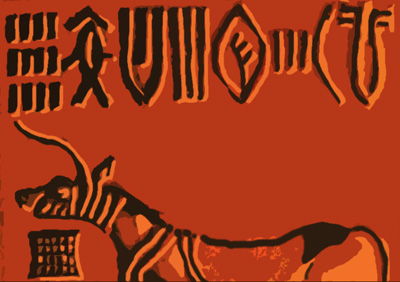
Indus seal B-10 with an apparent numeral at the top, SEVEN QUOTES,
and perhaps an enumerated item before the iconic animal, TRI-FORK.

Now, the Linear B tablets are basically accounting documents, so the appearance of more than one number on a single tablet is quite common.  In fact, this is the case on nearly all the complete tablets.  The numerals indicate quantities, preceded by logographs indicating the commodities, which are preceded in turn by phonetic signs.  The phonetically spelled words are sometimes recognizable as place names, at other times clearly the names of persons, at still other times the names of deities.  There are also some symbols, sometimes occurring in between the logographs and the numerals, that represent measures.  For example, if we were to write the English phrase “10 gallons of milk” in the Linear B manner, we would begin with a symbol representing milk (let us say “M”), follow this with a sign for the gallon measure (“g”), and conclude with a symbol for the numeral ten (“X”):  M g X.

A document from Knossos in Linear B concerning cloth is KN Ld 571 (Hooker 1980: 96).  In large signs on the left is the three-syllable word pa-we-a (resembling a shish kebab, backward “S,” and capital “T” with serifs).  This represents an archaic Greek word pharwea (φÎħρFεÎħ) meaning “pieces of cloth.”  To the right are two rows of smaller symbols.  The upper row is transliterated pe-ne-we-ta a-ro2-a *158 1; the lower row e-qe-si-ja re-u-ko-nu-ka TELA 25.  The first word, pe-ne-we-ta, remains uninterpreted, but a-ro2-a is the Mycenaean version of areion (ÎħρεÎıων), “better, of superior quality.”  The next symbol is enigmatic.  Since its definition has not been established, it is transcribed with a numerical designator with an asterisk before it.  It may indicate a standard container of some kind (1980: 97).  The “1” which follows is a numeral indicating the quantity of such containers, namely one.  In the lower row, e-qe-si-ja that shows the following object is intended for a person entitled the epetas (επετÎħς).  The word after this is re-u-ko-nu-ka (ÎğÎµÏ…ÎşÎżÎ½Ï…Ï‡Îħ) which means “(decorated with) white ÎżÎ½Ï…Ï‡Î·Ï‚,” probably decorated with a white pattern resembling claws or hooves.  Capital letters indicate a logograph, TELA, meaning “cloth,” followed by the numeral 25.  Thus, there are 25 cloths for the epetas with a decorative pattern of hooves or claws, as well as one container of superior quality, perhaps for someone entitled pe-ne-we-ta.  This is the typical format of Linear B documents – several syllabic signs, a logograph, and a numeral in each line.  A single clay tablet may contain only one line of text like this, or many such lines.
Can a study of the Linear B texts provide useful information for interpreting Indus inscriptions?  I doubt it.  The basic format is quite different.  Indus seals lack apparent numerals more often than not.  When “numerals” do occur, they may be at the beginning of an inscription, in the middle, or at the end.  Usually when a “numeral” appears, there is only one.  Even when there seem to be two or more “numerals,” they do not line up the way numerals do in Linear B.  That is, there is no standard format in the Indus inscriptions comparable to this one just described for Linear B.

REFERENCES

Chadwick, J., L. Godart, J.T. Killen, J.-P. Olivier, A. Sacconi, I.A. Sakellarakis. 1986. Corpus of Mycenaean Inscriptions from Knossos. Vol. I (1-1063).  Cambridge: Cambridge University Press.

Dehaene, S. and J. Mehler. 1992. "Cross-linguistic regularities in the frequency of number words," in Cognition (43): 1-29.

Hooker, J.T. 1980. Linear B: An Introduction. London: Bristol Classical Press.

Monday, January 2, 2012

More on Indus Fish Signs

Detail from seal M-38 with inscription containing 3 "fish":
TWO POSTS / BLANKET / MAN HOLDING DEE-SLASH / TRI-FORK / BI-QUOTES //
FISH UNDER CHEVRON / WHISKERED FISH / TWO POSTS / FISH //
PRAWN / ZEE / CROSSROADS EX // POT (consisting of 5-sign prefix, 4-sign "fish"
section and 3-sign combination in medial segment, plus terminal sign).


In previous posts concerning the FISH symbol (and such variations on it as DOT IN FISH, FISH UNDER CHEVRON, and MARKED FISH), I mentioned Asko Parpola’s proposed interpretations (1994: 275-277 summarized).  He reads the basic FISH as the (proto-)Dravidian word mÄĞn, a homonym or near homonym of which means “star.”  In Mesopotamia, a star was the symbol of the god of heaven, An, later becoming a determinative (or non-pronounced symbol) placed before the name of any deity.  On this basis, Parpola concludes that the FISH usually represents a deity (1994: 275).  Certain combinations of the FISH and another symbol then represent stars, planets, or other asterisms, in Parpola’s view.  For example, STACKED SIX + FISH represents the Pleiades, the name of which means “six stars” in Tamil, presumably derived from Proto-Dravidian.  THREE QUOTES + FISH also follows a Tamil pattern, indicating an asterism called MrigaĊ›iras.

Variations on the basic symbol include FISH UNDER CHEVRON (mey/may “roof” + mÄĞn, or “black star”) for Saturn and DOT IN FISH (poáı­áı­u “dot, drop” + mÄĞn, or “carp fish,” the third eye of the Heavenly Bull, known in the West as alpha Tauri.  Parpola also proposes reading STACKED SEVEN + FISH as Ursa Major, the “Seven Sages” in India, and interprets the MARKED FISH (a combination of those I originally termed BELTED FISH and SLASH IN FISH) as Mercury.  TWO POSTS + FISH becomes Venus, while variously topped DUBYA + FISH is seen as the North Star.  In most cases, Parpola considers these to be examples of the rebus principle, where a picture of an object signifies a homophonous word.
Seal K-15 with inscription containing FISH + BUD TOPPED DUBYA,
perhaps representing the North Star (following Parpola 1994).

Iravatham Mahadevan more recently published a new interpretation of the various fish-like signs (2011).  He notes the following signs and sign combinations, also providing their frequency in the inscriptions:

Sign (combination)
Occurrences
FISH
381
FISH UNDER CHEVRON
216
WHISKERED FISH
279
DOT IN FISH
73
MARKED FISH
188
RAKE + FISH
76
TWO POSTS + FISH
67

Table 1.  Frequency of FISH signs alone and in combination (Mahadevan 2011: 12).

In large part because such signs and sign combinations are so frequent, Mahadevan considers it most likely that they are ideographs, depicting what they represent, rather than syllabic (or other phonetic) symbols.  Thus, he does not see them as examples of the rebus principle, in contrast with Parpola's view.

In assessing Parpola’s interpretation, Mahadevan notes that Indus symbols occur almost exclusively on small objects where space is often cramped.  This would lead one to expect a small and compact symbol such as the Mesopotamian asterisk to represent “star,” rather than the relatively broad FISH.  Mahadevan also observes combinations of an apparent numeral with a symbol other than the FISH.  For example, while indeed there are combinations such as THREE QUOTES + FISH, FOUR QUOTES + FISH, STACKED SIX + FISH, and STACKED SEVEN + FISH, equally frequent are other combinations, including THREE QUOTES + FORK (whether TRI-FORK, QUAD-FORK, or QUINT-FORK), FOUR QUOTES + FORK, FIVE QUOTES + FORK, STACKED SIX + FORK, STACKED SEVEN + FORK, STACKED EIGHT + FORK, and STACKED NINE + FORK. 

Detail from seal H-25 with inscription: STACKED TWELVE / FISH UNDER CHEVRON /
CUPPED POST / 3 POSTS / CIRCLED FORK / 3 QUOTES / CEE / POT (consisting of a
medial segment with apparent numeral and "fish" plus other elements, and a terminal).

The terminal sign POT HATTED BEARER also appears in multiple inscriptions preceded by THREE QUOTES, FOUR QUOTES, FIVE QUOTES, or STACKED NINE.  Less commonly, CEE occurs with a preceding “numeral” as well (THREE QUOTES, FOUR QUOTES, FIVE QUOTES).  From this comparison, Mahadevan concludes, “It seems most unlikely that among the many NUMBER + SIGN sequences in the Indus texts, the FISH group alone represents constellations in the sky, while all other sequences refer to various entities on earth” (2011: 5). 

More telling is the fact that Parpola does not (as yet) have an explanation for some of the other combinations that include one of the FISH.  Among these unexplained signs are CAGED FISH, CAGED FISH UNDER CHEVRON, CAGED WHISKERED FISH, and CAGED MARKED FISH.  The term “caged” here follows Wells, describing four small marks placed around a sign, in the upper right, lower right, upper left, and lower left corners of an imaginary rectangle.  Mahadevan adds his observation that the CAGED FISH and its variations tend to shift from the middle to the end of an inscription.  Thus, the common terminals, POT and SPEAR, do not occur after CAGED FISH while both do occur after the simple, non-caged forms.  Mahadevan then chooses to interpret the caging as a plural marker (of humans only), following Heras (2011: 6).  The SPEAR, he then decides, must be the non-masculine (feminine and neuter) suffix, while the POT must be the masculine suffix.
Tablet H-346A and B with inscriptions:
RAKE / FISH / SPEAR (A side, top)
and MAN HOLDING CUP (B side, bottom).

This leads to the rather surprising discovery that “fish-women” (FISH + SPEAR) outnumber “fish-men” (FISH + POT) rather substantially.  Mahadevan thinks that the FISH and its variations indicate one or more categories of people, perhaps an occupational group or status, with women of this status outnumbering men (2011: 13).  Now, more than one archeologist has noted the apparent reverence for water in the ancient Indus Valley, an attitude sometimes termed wasserluxus (literally, “water luxury”; see Possehl 2002: 55, following M. Jansen).  At Mohenjo daro, for example, there are many wells, an advanced drainage system, apparent bathing facilities in the houses, and a structure called the Great Bath (2002: 57).  To this, Mahadevan adds his suggestion that the human category represented by the FISH signs formed a class of religious practitioners, ancestors of the apsaras and gandharva of the Rig Veda and of the Old Tamil ara-makaÄĵir.  The Indus category would include dancing girls who served as hierodules (sacred prostitutes, as posited for contemporary Mesopotamia) – mortal equivalents of the apasaras – and the male consorts of these women – the gandharva.

Recalling Parpola’s reading of the Indus FISH as mÄĞn, Mahadevan reconstructs the Proto-Dravidian reading as min- / minuk- / meĊ†ak- which he proposes for the generic name of the Indus water nymph (later apsaras).  Where an apparent numeral precedes the FISH, he interprets the “numeral” as an ordinal number.  So, THREE QUOTES + FISH + SPEAR is an apsara of the Third (Group) while FOUR QUOTES + FISH + SPEAR is a water nymph of the Fourth (Group) (2011: 32). 
Seal B-3 with (nonlinear) inscription:
STACKED FOUR / FISH / SPEAR.

According to Mahadevan’s presentation, there would seem to be no “First Group” and no “Fifth Group,” but third, fourth, sixth, and seventh groups do occur.  That is, THREE QUOTES, FOUR QUOTES, STACKED SIX, and STACKED SEVEN appear before FISH, but other apparent numerals do not.  My own examination of the possibilities indicates that a “First Group” might be indicated by the occasional appearance of SINGLE POST preceding FISH (one occurrence, M-65) and WHISKERED FISH (possibly as many as six occurrences: M-941, H-301, H-440, and H-988, and two others shown in the Koskenniemi and Parpola concordance).  Similarly, although Mahadevan does not include TWO POSTS + FISH with his numerical combinations, I see 62 instances of this possible “Second Group.”  As he notes, there is no evidence of a “Fifth Group,” oddly enough.  But beyond the “Seventh Group,” there might even be a “Twelfth Group” (STACKED TWELVE + FISH in KP 6178A or L-125-129, L-189A4, L-191; STACKED TWELVE + MARKED FISH in KP 1003 or BM VS 823; and STACKED TWELVE + FISH UNDER CHEVRON in KP 3081 or H25).  It would be problematic, though, to give this definition in the total absence of groups eight through eleven.

A few Indus signs can be doubled; even fewer can be tripled.  The FISH appears doubled in such a fashion perhaps half a dozen times (KP 2592, 3324 or H-230 and H-815, 2436, 3232 or H-85, 2875 or M-868, 588).  Mahadevan considers the pair TWO POSTS + FISH to be the equivalent of FISH + FISH (or DOUBLE FISHES) (2011: 33), a reasonable guess, but still fails to mention a possible interpretation as “water nymph of the Second Group.”  He notes the existence of occasional tripled fishes, but cites no inscriptions (and I do not find any in either the KP concordance or the corpus).  None of the variations appears doubled – no DOUBLE FISHES UNDER CHEVRONS, no DOUBLE WHISKERED FISHES, etc.
Tablet H-230A with inscription: DOUBLE FISHES / ANKH / SPEAR.

Other than doubling, though, there are many other occurrences of multiple FISH signs; in these, one type sits beside another type.  For example, H-593 reads: SPACESHIP / FISH / BI-QUOTES // WHISKERED FISH / FISH UNDER CHEVRON / TRI-FORK TOPPED POT/ POT.  Here there are three different types of FISH sign, the plain one in the prefix, followed by two modified variations, WHISKERED FISH and FISH UNDER CHEVRON, in the medial segment of the inscription.  These two are followed in turn by a two-sign terminal, one which would seem to spoil Mahadevan’s neat division into masculine (POT) and non-masculine (SPEAR) – does the TRI-FORK TOPPED POT modify the ordinary POT or does it qualify the preceding FISH UNDER CHEVRON?

There should be 20 non-repeating pairs, Mahadevan says, if each type can occur alongside every other type (2011: 33):

Remarkably enough, 16 of the 20 possible pairs are actually attested in the Indus texts (ASI Concordance 1977).  If seems therefore reasonable to infer that the absence of the other 4 pairs is merely due to the incomplete nature of the record.  The general pattern seems to be that the FISH signs can occur in any non-repeating combination.


FISH
DOT IN FISH
MARKED FISH
WHISKERED FISH
FISH UNDER CHEVRON
FISH
6
2 (Mh 4)
7
10 (Mh 11)
5 (Mh 4)
DOT IN FISH
--
--
5 (Mh 7)
--
--
MARKED FISH
--
1
--
4
4
WHISKERED FISH
--(Mh 5)
6 (Mh 8)
24 (Mh 28)
--
4 (Mh 4)
FISH UNDER CHEVRON
7 (Mh 14)
6 (Mh 6)
12 (24)
30 (Mh 44)
--

Table 2.  Frequencies of FISH pairs, with the sign in the column at left preceding and those in the columns to the right following (based on my database; numbers in parentheses from Korvink, based on Mahadevan).

I have plotted the frequencies of occurrences in the table above (based on my own database, with corrections from the KP concordance).  Thus, we can see that there is no DOT IN FISH + FISH although the reverse does occur (2 times); there is no DOUBLE DOT IN FISH; there is no DOT IN FISH + WHISKERED FISH although the reverse does occur (6 times); there is no DOT IN FISH + FISH UNDER CHEVRON although the reverse does occur (6 times).  More succinctly, we may conclude that DOT IN FISH can only precede MARKED FISH.  It must follow all the others.  MARKED FISH, in turn, may precede DOT IN FISH (but only once, so perhaps I misread this one), WHISKERED FISH, or FISH UNDER CHEVRON, but it may not be doubled and it can only follow FISH.  Similarly, WHISKERED FISH can precede DOT IN FISH (6 occurrences), MARKED FISH (24 times!), and FISH UNDER CHEVRON (4 times), but cannot be doubled and can only follow FISH.  Finally, FISH UNDER CHEVRON precedes each type of FISH except itself – it cannot be doubled.  It may be tempting to discount the places in the grid that contain no occurrences, as Mahadevan does, but since the data are all we have, it is better to recognize the patterns that occur.
Seal L-51 with inscription: FISH UNDER CHEVRON / DOT IN FISH /
FOOTED STOOL WITH TICK / PINWHEEL (perhaps beneath a
trough such as is usually shown before an animal).

From this same data, M. Korvink suggests that there is a standard sequence that the various types follow: (1) FISH UNDER CHEVRON, (2) FISH, (3) WHISKERED FISH, (4) DOT IN FISH, (5) MARKED FISH (2008: 37).  He notes that this “rule” accounts for 94% of occurrences, even when there are three (or more) types of FISH in an inscription.  In the remaining 6%, the appearance of a FISH preceding FISH UNDER CHEVRON – instead of following it, as the above “rule” would have it – is due to the presence of the pair TWO POSTS + FISH.  Even with the proviso that this pair does not follow the “rule,” there are a few exceptions (WHISKERED FISH + FISH in a handful of cases and WHISKERED FISH + FISH UNDER CHEVRON in another small group).

Mahadevan’s interpretation of the pairs is that each apsaras had a name or title, these containing between one and three FISH types (2011: 34).  More specifically, he sees the basic FISH as the symbol for the water nymphs in general, functioning rather like a determinative in Egyptian.  That is, it would not have been pronounced, but gave some indication of the meaning of those signs that were pronounced (although determinatives as such do not occur alone, as the FISH does on K-34 and K-37).  WHISKERED FISH, Mahadevan suggests, was the same sign modified by the addition of rays of light, giving it the meaning “twinkling” (water nymph who shines or twinkles, i.e., celestial water nymph).  In combination with the basic FISH, it would have meant “celestial” (2011: 35).  Similarly, the FISH UNDER CHEVRON has a modification, the chevron, which he terms a “roof.”  It means “sky,” he supposes, giving the symbol the same meaning as the previous sign (water nymph of the sky, i.e., celestial nymph). 
Seal H-76 with inscription: MAN HOLDING FORK / HUNCHBACK / POTTED ONE /
FISH UNDER CHEVRON / WHISKERED FISH / WINGED MAN / POT
(note the presence of two "celestial water nymph" signs according to Mahadevan).

The other modified pair of FISH includes DOT IN FISH and MARKED FISH.  The first, Mahadevan proposes, represents the rising of the sun and the latter, the setting of the same.

A different pair that often occurs is RAKE + FISH, which Mahadevan sees as a combination of the Mesopotamian “rake” meaning “great,” and the FISH, “water nymph,” yielding “Great Water Nymph.”  The pair TWO POSTS + FISH (or, presumably, the DOUBLE FISHES) indicate “twin water nymphs” (and not the Second Group that would seem to be necessary for his earlier proposal of 3rd through 7th groups).  An expansion of the meaning for this sign pair becomes “nymph of heaven and earth” (2011: 49).  Where there are seven anthropomorphs in a row on an Indus seal, Mahadevan believes they can only be Seven Water Nymphs, or the “Seven Virgins” of Tamil tradition, or the “Seven Mothers.”
Are these the Seven Water Nymphs -- six standing in a row, above,
while the seventh kneels beside a goat, with a tree lower right (M-442)?

As I see it, Parpola’s interpretation of the various FISH has two problems.  The first is the most fundamental: if the FISH does not represent “star” and/or “deity,” then none of the other proposals can stand (3 QUOTES + FISH = MrigaĊ›iras; STACKED 6 + FISH = Pleiades; STACKED 7 + FISH = Ursa Major; CHEVRON FISH = Saturn; MARKED FISH = Mercury; DOT IN FISH = alpha Tauri; 2 POSTS + FISH = Venus; DUBYA + FISH = North Star).  It seems to me that the CARTWHEEL sign might be reasonably interpreted as a straightforward depiction of a star, since spoked wheels do not appear in the archeological record until the end of the Indus Civilization.  If CARTWHEEL = “star,” then FISH must mean something else.  Of course, I cannot prove that CARTWHEEL represents a star any more than Parpola can prove that FISH has that meaning.  Other evidence must be brought forward to support or negate either interpretation.

The second weakness of Parpola’s interpretation is that each type of FISH or two-sign combination with FISH is treated individually.  But in many inscriptions, there are two or more types of FISH beside one another.  If the stars and planets are associated with gods – as was certainly the case in Bronze Age Mesopotamia – and if the seals contain names and titles, it seems unlikely that two or more stars/gods are listed this frequently.  For example, I find 66 different inscriptions containing the basic FISH and at least one other type of FISH (not counting the DOUBLED FISHES).  And if the Mesopotamian cylinder seal inscriptions do sometimes include the names of two deities (e.g., Shamash and Aya, the sun god and his consort), three divine names would seem to strain credulity. 
Seal M-129 with inscription: SQUARE AY / POTTED ONE /
FISH UNDER CHEVRON / WHISKERED FISH / MARKED FISH /
SPEAR (3 different water nymphs with the singular suffix of the feminine?).

But the inscription of M-572 contains three types of FISH: FISH UNDER CHEVRON / MARKED FISH / FISH BETWEEN PARENTHESES WITH EAR / POT.  Can this really represent Saturn and Mercury and some unidentified asterism?  This is not an isolated instance either, as demonstrated by the inscription on M-314: CARTWHEEL / BI-QUOTES // FISH UNDER CHEVRON / WHISKERED FISH / DOT IN FISH / SPEAR (as well as additional signs).  Here, by Parpola’s interpretation, we seem to have Saturn, an unidentified asterism, and alpha Tauri.  There seems to be no explanation for the sequencing rule identified by Korvink, either.  If Saturn and Mercury do go together for some unknown mythological reason, why does Saturn regularly precede Mercury?  Why are combinations of WHISKERED FISH (still unidentified with a particular asterism) so much more common than other types?  Too much remains unexplained.

Mahadevan’s proposals suggest a reason for including both the basic FISH sign alongside another type, making the FISH a determinative and the modified variation the name of a specific water nymph.  But again, the appearance of three different types in a single inscription is problematic.  TWO POSTS + FISH should be “twin water nymphs of heaven and earth,” the male twin when followed by POT and the female twin when followed by SPEAR.  But then, why should one of these occur alongside another water nymph?  This is the question posed by KP inscription 2614: COW LEG / FISH / EX ON POST WITH ATTACHED TRIANGLE / POTTED ONE / CIRCLED FORK / WHISKERED FISH / TWO POSTS / FISH / ANKH / SPEAR.  In this inscription, the basic FISH is not alongside the pair (TWO POSTS + FISH) or the modified variation (WHISKERED FISH).  In both Mesopotamian cuneiform and Egyptian hieroglyphs, a determinative must fall within the word, either at the beginning or at the end.  The FISH here does not seem to behave like known determinatives. 
Detail from impression L-219 with inscription (right to left):
BATTERY / FISH / PINCH (?) / TWO POSTS / CAGED FISH /
MARKED FISH (if the first FISH is in the prefix, it is unlikely
to be a determinative for the other two types that appear in the medial segment).

Or again, if DOT IN FISH is the goddess of the dawn, why does her symbol follow that of the twin?  This combination occurs in C-10: CIRCLED VEE / BI-QUOTES // TWO POSTS / FISH / DOT IN FISH / POT.  It also appears in M-1159: TWO POSTS / EARPHONES ON BI-FORK / BI-QUOTES // TWO POSTS / FISH / CAGED DOT IN FISH.  In the latter example, the goddess of the dawn seems to be pluralized as well as standing alongside one (or both?) twin water nymphs, following an unusual prefix.  Worse still, there would have to be three such watery deities in M-38: TWO POSTS / BLANKET WITH TICKS / MAN HOLDING DEE-SLASH / TRI-FORK / BI-QUOTES // FISH UNDER CHEVRON / WHISKERED FISH / TWO POSTS / FISH / PRAWN / ZEE / CROSSROADS EX / POT (illustrated at the beginning of this post).  In this case there are three fish-like elements, the FISH UNDER CHEVRON (water nymph of the sky), WHISKERED FISH (shining water nymph), and TWO POSTS + FISH (twin nymph).  The last might be the male version, since the inscription ends with POT.  But, if so, why does a three-sign sequence intervene between the last nymph’s symbols and the suffix?  PRAWN + ZEE + CROSSROADS EX often appear together, not always following “fishes.”  So perhaps it is this group that is male, as the POT supposedly indicates, rather than one of the FISH.
Tablet H-794A and B with inscriptions (right to left):
FISH UNDER CHEVRON / CAGED DOT IN FISH / COMB (A);
CUP / TWO POSTS (B).  The COMB commonly appears after
caged FISH types, as well as occasionally after POT or another terminal.

Further, while the caged varieties do not take the SPEAR or POT terminals, as Mahadevan notes, a caged sign does not inevitably appear in final position.  Note M-726: CARTWHEEL / BI-QUOTES // CIRCLED FORK / TWO POSTS / FISH / CAGED FISH UNDER CHEVRON / LOOP MAN HOLDING SLASH / DIAMOND / SINGLE POST.  There are three signs after the caged element.  We might attempt to explain this as the addition of name(s) or title(s) after the designations of the nymphs.  But sometimes it is a terminal sign that follows the caged symbol: Rpr-1 reads RAKE / CAGED FISH / COMB; M-1438 includes both types of signs, reading TWO POSTS / CAGED FISH / FAT CEE / POT / COMB.  Another type of terminal follows two fish-like symbols in L-51: FISH UNDER CHEVRON / MARKED FISH / FOOTED STOOL WITH TICK / PINWHEEL.  Korvink analyzes the last two signs as a paired terminal.  So, to demonstrate that POT is a masculine suffix and SPEAR is feminine, one really needs to go further and explain the other “suffixes” (i.e., terminals, including COMB, PINWHEEL, BEARER, etc.).  Thus, there remain a number of difficulties with both Mahadevan’s and Parpola’s interpretations.
Terra cotta object K-79 with incised symbols, a possible combination
of FISH, BEARER, RAKE, and POT (side A), as well as a
FOOTED ASTERISK (side B, oriented oddly).

Finally, Mahadevan suggests that his anthropomorphic interpretation of the FISH signs is supported by a unique item from Kalibangan (K-79).  One side depicts a symbol resembling one of the BEARER signs, with an apparent shoulder yoke and rounded objects hanging from it.  The body of this unusual anthropomorph is render with two curved lines, though, so that it seems to be part fish.  It may be topped with the POT.  But unlike the POT HATTED BEARER, it also has something round above, possibly the head of this odd individual.  There is also an attached RAKE angling from one end of the shoulder yoke.  Mahadevan describes all this as “a compound of five basic signs in which the ‘standing man’ of the BEARER sign is replaced by the ‘standing’ FISH” (2011: 18).  I see the BEARER, the FISH, the POT, and the RAKE.  What is the fifth sign combined here?  The other side of the terra cotta object bears a version of the ASTERISK (III 19), with a rounded element on the end of each prong.  Does this juxtaposition indicate that the ASTERISK is the same as this odd BEARER?  As usual, more questions are raised by every attempt at an answer.

REFERENCES

Korvink, Michael. 2008. The Indus Script: A Positional Statistical Approach. Gilund Press.

Koskenniemi, Kimmo and Asko Parpola. 1982. A Concordance to the Texts in the Indus Script. Helsinki: University of Helsinki, Dept. of Asian and African Studies.

Mahadevan, Iravatham. 2011. “The Indus Fish Swam in the Great Bath: A New Solution to an Old Riddle,” in Bulletin of the Indus Research Centre (No. 2, August 2011), pp. 1-73 (available online at www. harappa.com).

Parpola, Asko. 1994 and 2009. Deciphering the Indus Script. Cambridge: University Press.
Possehl, Gregory. 2002. The Indus Civilization: A Contemporary Perspective. Lanham, MD: AltaMira.