Thursday, December 16, 2010

An Indus Rake and Comb

This post discusses four signs in the Indus script, each comprised of six strokes.  The first of these contains two tall vertical lines in the center.  On the right of these and on the left are two short vertical strokes, one over the other.  Thus, the two posts in the center are surrounded by four short strokes, similar to the keyboard sequence : | | : although not identical.  Wells does not list this particular sign, but he uses the term “caged” as a description of this type of modification of a basic symbol by surrounding it with four short strokes.  Following his example, I call this sign CAGED DOUBLE POSTS and enumerate it V17.  It appears elsewhere only in the list of Koskenniemi and Parpola (KP146). 
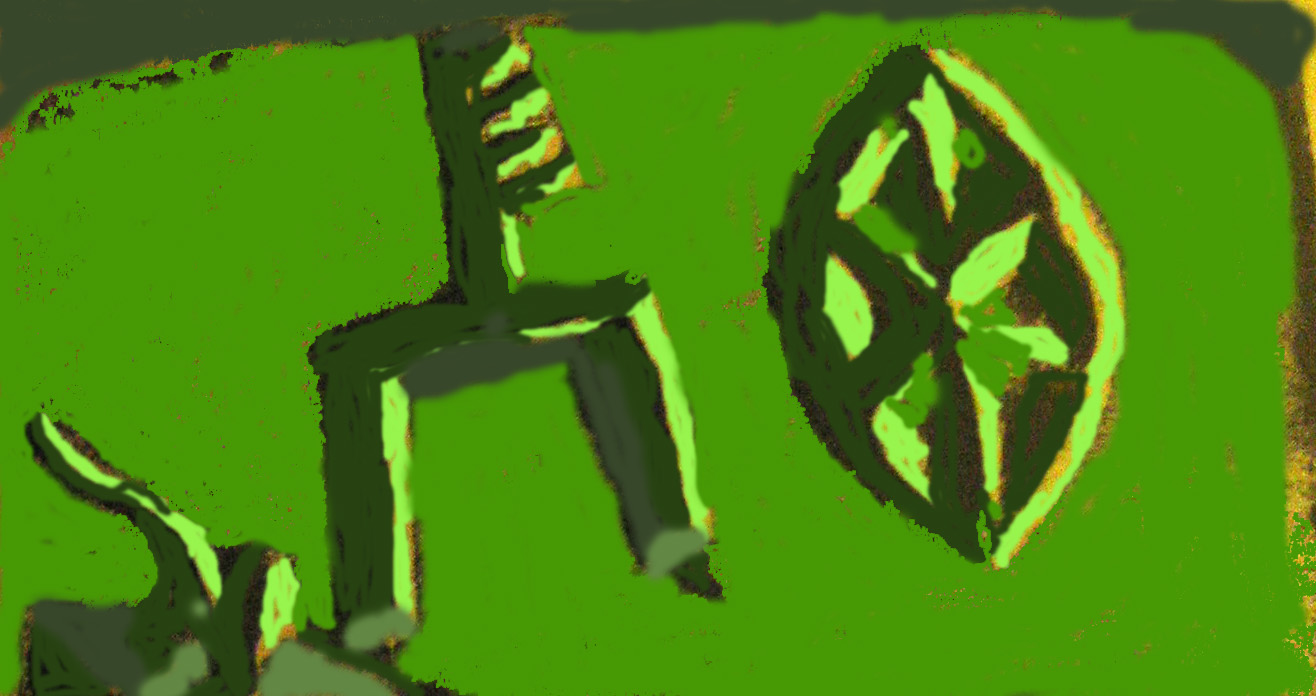
Inscription M-880: STRIPE BELTED AITCH / CUPPED POST / POTTED ONE / FAT EX IN DIAMOND / VEE IN DIAMOND / POT  (detail, over head of unicorn bull; smoothing of image and false color added by author).

Sign V17 does not appear in my own database of inscriptions any more than in the sign lists of Wells and of Fairservis.  The KP sign may have been derived by inference from M-1201F, an inscription on the short side (not the face) of a broken seal.  To the right of the break in the upper part of the seal's face (looking at the side edge) there is an abraded post, then a clearly preserved post, hence DOUBLE POSTS.  This is followed by the two short strokes stacked one over the other that is typical of caging.  In my database, I coded this DOUBLE POSTS / STACKED TWO, because that was all that I saw.  Apparently, Koskenniemi and Parpola proceeded from such an observation to the inference that originally there must have been another “stacked two” on the other side of the DOUBLE POSTS.  This is quite possible.  However, since the first “post” is marred by the break, we cannot tell whether there was also another post (or more, or even another symbol) before this hypothetical, reconstructed “stacked two.”  
In addition, the STACKED TWO occurs at least once by itself, not part of a “caging” pair.  Thus, it is also possible that there was no other symbol on the other side of the DOUBLE POSTS.  In any case, this seems to be the only occurrence of this combination.  On a different seal from the same city, M-137, there is a sequence "stacked two" plus CARTWHEEL / DOUBLE POSTS and another "stacked two."  Thus, I term this whole sequence CAGED CARTWHEEL & DOUBLE POSTS.  It is certainly possible that the unbroken inscription on M-1201F was originally a duplicate of that on M-137.
Although it is a very simple combination of elements, I have not observed this exact symbol (CAGED DOUBLE POSTS) elsewhere.  Among Egyptian hieroglyphs, there are two that include four dots or short strokes, U9 and U10.  In both of these, the main part of the sign resembles a barrel turned on its side.  Extending from one end come four dots in a diagonal arrangement, seemingly pouring out of the overturned barrel.  This is the form of U9, representing a grain measure with grain pouring out.  This glyph occurs at the end of the word “grain” as a determinative.  In U10, the same symbol also has three small diagonal strokes above the “barrel” section.  This is a combination of glyph M33 (three grains above) plus U9, which together serve as an ideograph in “barley” and/or determinative “emmer (wheat).”  Thus, four short strokes do appear in Egyptian as part of a glyph, but not “caging” another glyph.
In proto-cuneiform, one sign is made up of two long horizontal strokes above and below two shorter strokes (ZATU772).  This is essentially the reverse of the Indus sign, using long strokes to bracket short ones.  A similar situation occurs in proto-Elamite, where two long horizontal strokes form one sign (M009).  A second sign, which may be a variant of the first, has these same long strokes above and below a set of short strokes (M009~h).  In this case, there are five internal shorts, two in a stack on the left, three in a stack on the right.  Once again, the double posts of the Indus sign are replicated.  But these are not bracketed by the stacked short strokes.  Instead, the long strokes bracket the short ones.
The second sign considered here is the STRIPE BELTED AITCH (VI18, the eighteenth of the six-stroke signs).  It resembles our capital letter “H” but with two horizontals instead of one, and there are additional short strokes between the two horizontals, joining them.  This sign does not appear in Fairservis but is KP298(b) and W185.  Wells shows it with three short strokes between the horizontals while the KP form has just two.  Wells notes VI18 to be a singleton, appearing only on M-880.  The Corpus indeed shows three short strokes between the two “belts,” revealing VI18 to be a seven-stroke sign in reality.
There are two hieroglyphs in the Egyptian list with some resemblance to the Indus sign.  The first of these represents a coffin (Q6).  It is wide and low, with no lines joining the two central horizontals.  In addition, over the top horizontal is a curved line, indicating the curved top of the coffin.  Since this glyph is a representation of a coffin, the horizontal elements are wide apart, a feature not seen in the Indus sign.  The second Egyptian glyph represents the mast of a ship (P6).  This is a tall and thin “H” shape (more or less) with four crossing horizontals, perched on top of a “Y” shape.  Again, the similarity to the Indus sign is remote.
Old Chinese provides a better parallel with dan1, “cinnabar....The crucible or stove of the alchimists [sic], with cinnabar in it” (Wieger 1965: 270).  The basic shape is again much like an “H,” and there are two horizontal strokes.  However, instead of two or three short verticals joining the two horizontals, there is a single dot between them (the cinnabar in the crucible).
In proto-cuneiform, two signs somewhat resemble Indus VI18, but rotated 90 degrees.  There is ISZ~a, two horizontals joined by two verticals, with a shorter horizontal to the right of the right-most vertical and another to the left of the left-most vertical.  It seems to be the letter "H" fallen on its side, with an additional post down the middle, the center of which is hidden by the belt formed by the crossing strokes.  The second sign, U2~c, is identical except that the shorter horizontals in the center join, making a single long horizontal.  The first symbol came to mean “mountain,” and the second, “plant.”
Proto-Elamite contains three signs with some resemblance to this.  There is an “H” shape on its side with two “belts” (M026).  A possible variant of this adds an “X” between the two “belts” (M026~h).  A third moves the two “belts” to the left end, adding three short strokes to join them (M032~b).

Inscription M-1295: (POTTED ?) / CRAB / RAKE ("a") / SLASHES IN OVERLAPPING CIRCLES / QUINT-FORK (bar seal, with smoothing and false color added by author).

Our third Indus sign, VI19, has been called a “rake” elsewhere and I repeat this term.  The RAKE appears elsewhere as KP92, W264, and Fs Q-11.  Fairservis relates it to the COMB, which it resembles, turned horizontally and given the affix P-1 (i.e., the SINGLE QUOTE, which he previously defined as the genitive/possessive).  The COMB, according to this author, means “write, scratch; dative of person, belongs to; women’s cloth.”  Nevertheless, when put together, a horizontal COMB on top of a SINGLE QUOTE (which looks more like a SINGLE POST to me), the meaning becomes “of below, downriver, south.”
Wells notes 70 occurrences of VI19 in three variants.  There are 54 occurrences from Mohenjo daro, 10 from Harappa, three from Lothal, and one apiece from Kalibangan, Pabumath, and Rupar.  Wells distinguishes the versions based on the number of prongs on top, his "a" having five of these, "b" four, and "c" six.  I find more than three variants, five based on the number of prongs (4-8), and possibly an additional variant to account for those of a smaller size.  If we ignore the size distinction for the moment, we can still call the most common variant with five prongs “a,” the second most common variant with four prongs “b,” a relatively rare variant with six prongs “c,” a very rare variant with seven prongs “d,” and a singleton variant with eight prongs “e.” 
Mohenjo daro provides examples of all five variants (rare variants: M-163 the “c” type, M-279 the “d” type, and M-406 the “e” type).  The last two are smaller than the other signs in the inscription, fitting partially or completely underneath BI-QUOTES, a sign I type to be intended as preceding.  Harappa yields “a” variants mostly on seals, “b” variants mostly on tablets, and one instance of a “c” variant (H-103).  All three instances from Lothal are of the “a” variant while the single occurrence from Kalibangan is “b” (L-18, L-98, L-145; K-54).  Those from Pabumath and Rupar are the “b” as well, and I add to these an instance from Banawali, also “b” (Pbm-1, Rpr-1, B-11).
Proto-cuneiform provides two partial parallels to the RAKE.  GAL is a horizontally positioned “rake” with six long prongs and GAL~b a three-pronged variant.  This sign came to have various meanings including “big, great.”  The six-pronged variety appears as part of the word SZANDANA, which came to mean “gardener.”  Proto-Elamite has three rake-like symbols with four, five, and seven prongs (M038~a, M0138~b, M038~d).  All are horizontal like the proto-cuneiform type, a feature unlike the Indus sign.

Inscription M-1390A on round tablet, reading from right to left: STOOL / PINWHEEL / COMB (false color and smoothing added by author).

The COMB with five “teeth” is sign VI20 in my list (twentieth of the six-stroke signs).  Printed with six “teeth,” it appears as KP98.  Shown with five “teeth,” it is W287 (prongs on the left side of the vertical stroke) and W282 (prongs on the right side of the vertical).  It is also Fs L-9, where it is said to represent a comb (hence my term for it).  Fairservis gives his suggestion for the meaning as “write ‘this mark’; scratch; dative of person, as terminal in texts ‘belongs to’; women’s cloth.”  These disparate definitions are lumped together as being semi-homophonous in Dravidian languages.
Wells divides the COMB into two different signs based on the direction of the “teeth.”  In his listing, W287 has the prongs on the left side of the vertical, in a singleton from Kalibangan (K-77).  The other sign, W282, is quite common, occurring 143 times in all.  Mohenjo daro provides 40 of these, Harappa 97, Kalibangan three, and one apiece from Chanhujo daro and Nindowari damb.  Wells divides these among six four-, five-, and six-pronged variants of two prong types, horizontal and diagonal. 
Unusual bird motif on M-1390B, the back of the round tablet.  This resembles bird motifs found in the art of Central Asia, e.g., Altyn Depe in Turkmenistan).

In my own database, I did not distinguish by prong type originally.  I had the impression that the diagonal forms occur only on tablets while the horizontal forms occur on both seals and tablets.  Thus, I considered the distinction to be based more on the style of signs on the whole artifact.  I did distinguish among the numbers of “teeth.”  In going back over these, I find my general “rule” to be wrong.  At Mohenjo daro, both seals and tablets show diagonal and horizontal prongs, numbering four, five, six, seven, and eight.  Those at Harappa also show a highly mixed pattern of diagonal- and straight-pronged variants, numbering three, four, five, six, seven, and eight. 
But there are also more variants just counting the number of "teeth" in the comb.  From Kalibangan come both diagonal and straight types again, the prongs numbering five, six, seven, and thirteen.  Lothal provides only two instances, one with four long horizontal prongs (L-96) and a more enigmatic version with two or three (L-97), both rather crudely executed.  Chanhujo daro yields three instances by my count rather than just one (Wells' count).  One has five diagonal prongs (C-14) and two have horizontal, numbering five and six (C-15, C-32).  There may be one from Rahman dheri with seven prongs (Rhd-267), a very faint sign on a pot shard (which Wells did not mention).  One is on a seal from Nindowari damb with six horizontal prongs (Nd-2), another on a seal from Rupar with five (Rpr-1).
Besides seeing more variety in prong number than Wells, I note the presence of instances with longer prongs than typical (M-874, M-1305, M-1311, H-226, H-227, H-228, and L-96).  The greatest difference between our observations is in the distinction between the COMB with prongs on the right side of the vertical and the REVERSED COMB with prongs on the left.  It seems to me that generally prongs point toward the beginning of the inscription.  Since many tablets show a sign order that is the reverse of that on most seals, a great many instances of the COMB (in my database) are in the reversed position and this is particularly common on tablets.  If all instances can be explained in this way, then it would be best to consider the COMB and REVERSED COMB as variants of a single sign rather than two different signs.
Korvink includes the COMB among the signs he calls "terminals" (2007: 28-34).  In discussing the "harrow," as he terms it, he notes that VI20 occurs both before and after two other terminal signs in some inscriptions (before or after the SPEAR and the POT).  The COMB follows one of these other terminals 232 times, preceding one of them only 19 times.  He does not attempt to explain the significant minority of occurrences preceding other terminals, only stating that this cannot be explained by “scribal error.” 
It is not clear to me whether or not his analysis accounts for the reversal of inscriptions on tablets, i.e., the fact that sign order is from right to left on typical tablets but from left to right on most seals.  Despite this generally tendency, I note that a few seals appear to reverse the usual sequence and read from right to left like tablets.  At the same time, some tablets appear to reverse their usual sequence and read from left to right.  If one assumes that the appearance of a common prefix (such as CIRCLED VEE / BI-QUOTES) indicates the beginning and the common terminal indicates the end of an inscription, many such apparent anomalies can be accounted for.  That is, one can simply choose to read a given inscription by starting with the prefix -- whichever side it occurs on -- and procede toward the terminal. 
However, this is circular reasoning, interpreting certain signs as prefixes and others as terminals and, in effect, insisting on a consistency in the corpus which will suit the hypothesis.  We need some other evidence one way or the other, before confidently assigning reading direction.
As far as parallels to the COMB go, Egyptian hieroglyphs do not provide much to choose from.  There is only a rough similarity between the Indus COMB and the harpoon-head (T19).  The glyph is comprised of a tall vertical from which two short horizontals extend near the top and two diagonals near the bottom.  The higher of the diagonals ends in a coil.  The Old Kingdom form of the same glyph has a single upper horizontal and neither of the two lower diagonals is coiled (T20).
Luwian hieroglyphs include a slightly curved, comb-like sign for the syllable mu.  This may be a schematic bovine horn since another symbol for the same syllable represents a bovine head.  Then again, these could simply be two unrelated ways of writing a single syllable.  It is interesting that mu is what English speakers tell their toddlers the cow says, spelling it "moo."  In linguistics, this "word" is termed echoic because it echoes a sound in the environment.
Proto-cuneiform has a much better parallel, a comb sign with nine long “teeth” (ZATU753).  In addition to this difference in the number of prongs, it has a horizontal line extending from between the 4th and 5th “teeth” on the left out beyond the rest of the sign on the right.  This additional line has no counterpart in the Indus sign.  Proto-Elamite also contains a few comb-like elements, all of which have their prongs descending from a horizontal line.  One has three prongs, another four, and a third variety five (M041, M041~c, M041~d respectively).  The meanings of these and of the previous proto-cuneiform sign are unknown.
Old Chinese does not have a precise parallel, at least not among the forms discussed by Wieger.  But among the inscriptions shown in his appendix, one variant of a character does appear, resembling a horizontal comb with prongs upward (Wieger 1965: 374).  This is a representation of mountains, a variant of shan1.  The character is now considerably more comb-like, written with a horizontal stroke and three verticals.  The ancient variant shown in this particular inscription has a the slightly curved base typical of the ancient form and five “teeth” (an atypical number of mountain peaks).
Motifs resembling the COMB commonly occur in the rock art of North America while the RAKE typically does not.  There are 306 occurrences of a “comb” in Nevada spread fairly evenly across all regions of the state where petroglyphs occur (Heizer and Baumhoff 1984: 83-84).  These are most often horizontally positioned, with prongs hanging down.  A few, though, have upward-pointing prongs.  Others have a diagonal base. 
There is also an element similar to the “comb” but with an additional line attached to the horizontal at one end and curving back over it.  This may be rain symbol; it occurs just twice and only in southeastern Nevada.  Instead of symbolizing rain, it may be a schematic representation of a mountain sheep, an animal otherwise commonly depicted in a less angular manner.  A third motif is something the authors term a “convoluted rake.”  This has the same appearance as the basic “comb” but one (or more) of the descending “teeth” curves back on itself.  Such an element appears 11 times, mostly in western Nevada and in one location in the east. 
Examples of “combs” with both upward and downward prongs are easily observed in this collection (1984: 126, fig. 63e and f).  The motif with upward prongs has seven of these while there are six downward prongs in the second example.  A third example on the same page has nine “teeth” protruding from a diagonal long line (1984: 126, fig. 63d).  The possible “rain” motif appears  nearby (1984: 128, fig. 65h).  It has five downward “teeth” and an upper curve that is indeed quite like representations of the horn on a sheep.  The fifth “leg” may indicate the animal’s tail or the male sexual organ.  A possible “convoluted rake” occurs at the Mouse’s Tank site (1984: 136, fig. 73e).  Five “teeth” descend from a horizontal in this case, with two prongs joining a circle below on the left and three joining a circle on the right.
Similar motifs appear in the rock art of Texas.  One panel alone contains four different “combs,” two with five “teeth,” one with six, and one with perhaps ten (Newcomb 1996: 74, Pl. 37, no. 1).  Historical tribes in this area participated in a mescal bean cult that may be referred to for explanations of many elements in rock art.  For example, Wichita and Pawnee peoples held initiation ceremonies for medicine societies during which new members were tested by scraping toothed jaws of garfish over their bodies (1996: 75).  It may follow from this that the "combs" here are representations of the ritually significant garfish jaw. 
However, as the author notes, there is a huge gap in time between the date of the petroglyphs and that of the modern tribes.  Connecting the two is a hypothesis, not a proven fact.  In addition, other “combs” may not fit this hypothesis.  One instance, for example, has over 50 “teeth” (1996: 85, Pl. 46, no. 4).  A single panel at Bee Cave has a horizontal, curved version with four upward prongs, two straight vertical versions with five “teeth” each, and a diagonal version with six “teeth” (1996: 97, Pl. 55, no. 1).  In another instance, a possible “rain” element occurs with four upward prongs, a short curve at the left end of the long stroke, plus two prongs extend beyond the others and then join. Hence, this may be a “rain” motif plus a “convoluted rake” combined.  This much variation (especially in one relatively small area) would be rather astonishing for a single symbol.
Before leaving the COMB, I will note in passing the ligatures in which it appears in the Indus script.  There is a COMB ON BATTERY, discussed previously in connection with the TRI-FORK TOPPED BATTERY (M-649), as well as a MAN HOLDING COMB symbol which appears at the same city (M-16, M-494, M-704).  The CIRCLED DIAMOND AND COMB occurs at Mohenjo daro, while a similar CIRCLED BISECTED RECTANGLE AND COMB occurs at Harappa (M-481, H-558).  The rather odd AY ON COMB seems to have a horizontal comb under one “leg” (M-357, M-470, H-158, H-189, H-190, H-208).  Possibly related, the BI-FORK ON COMB also has a horizontal comb as its base element in a seal impression from Desalpur (Dlp-3).  Kalibangan yields an example of CIRCLE WITH ATTACHED COMB (K-104) and CIRCLE-HEADED BEARER WITH ATTACHED COMB (K-79).  Another ligature with a horizontal comb, this time across the middle, is from Mohenjo daro: COMB BELTED ASTERISK (M-391).  The same is true of COMB BELTED MAN (M-142, M-488, M-831, M-1160, M-1162, M-1611, M-1612).
Inscription on tablet H-897A, from left to right: STRIPED DOOR WITH KNOB / BI-FORK TOPPED POT / POT / COMB ("a2") (smoothed and false color added by author).

*Note: two bird-shaped "seals" were found at Altyn Depe, one in excavation 7, priest's tomb, room 10, burial 235 (Plate XVII, no. 9) and another in excavation 9 from 1981, locality 254 (Plate XXXVII, no. 4).  Both are made of metal, the second more specifically bronze (Masson, V.M. 1988. Altyn-Depe. Transl. Henry N. Michael. Philadelphia: The University Museum, University of Pennsylvania).


Thursday, December 2, 2010

Vee in Diamond and Vest: Two Common Indus Signs

The VEE IN DIAMOND (VI14) is one of the core signs of the Indus script.  As such, it occurs more than a hundred times, a frequency that is not matched by the great majority of signs.  This sign (VI14) appears elsewhere as KP385(a), W370, and in Fairservis as both N-7 and N-5.  In addition, Mahadevan numbers it Mh267 in his concordance.  Faiservis is alone in thinking that there are three different signs with a small “V” shape just inside the top.  He considers the true diamond with that extra piece to represent a settlement (village or town).  The little “V” shape itself, he suggests, may be an unpronounced classifier or an indicator of the locative case.  By this criterion, VEE IN DIAMOND should mean, not just town but “in town.”  He sees the CIRCLED VEE (my IV40 and his N-11) as a seal imprint or sealing; or as a variant of the ordinary CIRCLE, meaning “sun.”  Finally, he finds a third variant which is essentially diamond-shaped but more rounded on the sides (N-7).  He defines this last symbol as meaning “open area (assembly area).” 
Inscription from H-139: STRIPED TRIANGLE / VEE IN DIAMOND / STRIPED FAT LAMBDA
(false color and smoothing of image by author).

Wells usually finds more variants than the other scholars, but here he notes only a single form, one which is distinct from the CIRCLED VEE.  As for the VEE IN DIAMOND, he sees a total of 105 occurrences, 65 of them from Mohenjo daro, 21 from Harappa, 12 from Lothal, five from Kalibangan, and one apiece from Dholavira and Allahdino.  Koskenniemi and Parpola see the VEE IN DIAMOND and CIRCLED VEE as variants of a single sign, as does Mahadevan.  I am generally skeptical of conflating rounded and angular signs, as I noted in the earlier post on the CIRCLE.  Some signs have only a rounded form (e.g., the CIRCLED TRI-FORK), others have only an angular form (e.g., DOTTED WINDOW and DOTTED VEE IN DIAMOND), and only a subset seem to have both forms (e.g., VEE IN DIAMOND / CIRCLED VEE).  In addition to this evidence, there is the fact that both rounded and angular signs occur in the same inscription.  Thus, I think we should be wary of ignoring this distinction at this point.
I find other types of variation among the many occurrences of the VEE IN DIAMOND, however.  There are small (M-91 and M-100) and large variants (Ad-8 and L60), wide (M-1 and H-135) and narrow variants (M-240 and L-46), some that lean to the right or left (L-29, M-72, M-1658) while others are bilaterally symmetrical (M-880 and H-129).  In some cases, the internal “V” is a bit curved, hence better described as a “U” (M-79, H-55).

Inscription M-72: VEE IN DIAMOND / BI-QUOTES // BELTED FISH / WHISKERED FISH / HORNED MAN / POT // ASTERISK BETWEEN BACK PARENTHESES (false color and smoothing added by author; note presence of VEE IN DIAMOND in prefix, initially, as opposed to the medial position of the previous illustration).

It is interesting to note that this sign has relatively few parallels outside the Indus Valley.  The closest Egyptian analog is a rectangular enclosure with a smaller rectangle in the lower right corner (O6).  This is the same glyph I cited in connection with the Indus VEE IN SQUARE, which resembles it more closely.  Diamond shapes just do not appear in Egyptian, generally speaking.  There is a Luwian hieroglyph that is a diamond, the syllable ku.  It has two “V” shapes or curves, not just one, and these are at the sides rather than the top.  In addition to these differences from the Indus sign, the Luwian syllablic sign also has two verticals bisecting it.
A closer parallel appears among the early proto-cuneiform signs that may derive from still earlier tokens.  The symbol is a diamond with a smaller central diamond inside (Schmandt-Besserat 1996: 73).  It seems to indicate a commodity that is sweet tasting, perhaps honey.  But the closest analog occurs in proto-Elamite, in a sign identical to the Indus sign but rotated 90 degrees (M226~c).  Unfortunately, the meaning is not clear.  In later times, when the cuneiform script had long been in use in ancient Iraq, boundary stones sometimes show a diamond inside a larger diamond as well.  In this context this is a symbol of the goddess Ishtar, patroness of both love and war (Black and Green 1992: 152-153).
Diamonds shapes are relatively rare in the rock art of North America, at least in Texas and Nevada.  The most common occurrence is this shape is in a grid, where the whole thing appears tilted, thus creating multiple diamond shapes (e.g. Newcomb 1996: 201, Pl. 149).  In this case, there is a diamond within a diamond within each diamond in the grid.  In Nevada, there is an occurrence of two diamonds that are not in grids and which have inserts.  One sits over the over, touching it, with a single long vertical bisecting both diamonds (Heizer and Baumhoff 1984: 196, fig. 133d). 
The second sign I discuss here is the VEST, enumerated V15 in my list, also found as KP308, W497, and Fs L-2.  This symbol is a small square with two triangles on top configured so that the tops form a shape like the letter “M.”  Fairservis proposes to interpret this as cloth, meaning “heap, pile, large quantity.”  Wells finds 14 occurrences in three variants.  This symbol is not all that common in Indus inscriptions, then, but has surprisingly common parallels in other areas. 
Inscription K-28: HORN (SINGLE STRIPE) / TRI-FORK ON EGG ON NEXT / BI-QUOTES //
VEST ("b" variant) / POT // GRAIN EAR / JAY (false color and smoothing of image by author).
Wells' “a” variant differs from “b” only in the shape of the “M” at the top.  In the former, the descending lines in the center do not touch the top of the square below.  In the latter, these descending lines do touch the square.  His “c” variant is more distinct.  In this one, the line descends from the upper right all the way across to the lower left of the upper triangular area.  The other descending line crosses this, making an “X” shape between the two sides of the upper triangles.  There are four occurrences from Mohenjo daro, one of these “a,” two of them “b,” and one a “c.”  There are six occurrences from Harappa, four of them “a,” and one apiece “b” and “c” according to Wells (I see this supposed “c” as a fourth variant which is striped).  There are also occurrences from other sites: one from Lothal (“b”); two from Kalibangan (both “b”); and one from Rakhigarhi (“a”).

Inscription M-1115: VEE IN DIAMOND / BI-QUOTES // FISH / VEST ("c" variant) / POT
(smoothing of image and false color added by author; note horns of zebu bull on left).

Although Fairservis thinks that this sign represents cloth, it closely resembles the shape of an Egyptian glyph representing a column with a tenon at the top (O28).  The Indus sign lacks the tenon, but the rest is much the same.  There is also a Luwian glyph, the syllable tu4, which is virtually identical to the Indus VEST.  In proto-cuneiform, a similar form without internal lines is GUM~b @n, which came to mean “mortar; to crush.”  Almost the same shape flipped horizontally is TUM~b, “work, action; quiver (for arrows).”  If the square element at the bottom of the Indus sign were a circle, still surmounted by the triangular elements, this would make a fair representation of the proto-cuneiform UD5~c, “nanny goat.”  Additing two bisecting lines to the circle portion makes ESZGAR, “goat doe, young nanny goat.”
Proto-Elamite also contains more than one apparent variant of the VEST.  Like the symbols in proto-cuneiform, these are oriented horizontally rather than vertically.  One proto-Elamite sign has a single stripe or line separating the square portion from the triangles (M288~f).  A second has two separating lines (M288).  A third has three such lines as well as a fourth, at a perpendicular angle to the first three, bisecting the whole thing (M206~g).  The first two variants appear in proto-cuneiform also, at an early period, where they represent a large container for grain (Damerow and Englund 1989: 43-46).  For this reason, and because the proto-Elamite sign occurs alongside numerical measures of grain, the sign in proto-Elamite is also most likely a grain measure.
There is also a syllabic sign in Linear B that resembles the VEST somewhat.  It stands for the syllable ma and may derive from a depiction of a cat’s face.  There is a “Y” shape in the center, with straight verticals descending from either end of this element.  At the bottom of each vertical, the line bends outward.  A more pictographic element resembles this sign, in turn, in the earlier hieroglyphic symbols of pre-Mycenaean Crete.  In the earlier glyph, there are also two dots on either side, thus making the symbol indeed resemble an animal’s face.

"Cat face" glyph as it appears on a Cretan gem, surmounted by plant-like motif (image colored and clarified by author from Scripta Minoa).
In the rock art of North America, an element similar to the VEST appears but upside-down (Newcomb 1996: 214, Pl. 159, No. 1).  This Texan motif also has a small circle above it in another location, near the first occurrence (1996: 214, Pl. 159, No. 13).  In the latter case, the grouped elements (upside-down “vest” plus circle above) probably represent an anthropomorphic figure.  The figure which may be incomplete.  The triangular peaks, being at the bottom, are probably the figure’s legs.  The square from which the triangles project is probably the figure’s body.  A third instance of the motif is upright, this one without a circle (1996: 105, Pl. 65, No. 1).
Finally, two schematized representations occur in Native American art outside those found on stone.  In the artwork of the Arapaho people, the lizard resembles the Indus VEST in having a rectangular bottom segment with two prongs above.  However, the lizard also has diagonals descending on either side and a circle beneath the rectangle.  This identification suggests one possible interpretation of the (possibly incomplete) figures from Nevada.  These, too, may be lizards rather than anthropomorphs.  The second motif is a squared version of the three-clawed bear's paw mentioned in previous posts.  This squarish Arapaho representation is similar to the Indus VEST in having a square base and prongs above, but of course the number of upper elements (and their shape) differs.  Thus, while the Indus sign might possibly represent an animal's foot (or print), it is most unlikely to be a bear's.

Images from Arapaho (Native American) beadwork and quillwork: lizard (at top) and bear paw (at bottom).

ADDITIONAL REFERENCES:

Appleton, Le Roy H. 1971. American Indian Design and Decoration. New York: Dover (originally published as Indian Art of the Americas, 1950, by Charles Scribner's Sons).

Black, Jeremy and Anthony Green. 1992. Gods, Demons and Symbols of Ancient Mesopotamia: An Illustrated Dictionary.  Austin: University of Texas Press.

Evans, Arthur. 1901 and 1909. Scripta Minoa: The Written Documents of Minoan Crete with Special Reference to the Archives of Knossos (Vol. I and II). Oxford: At the Clarendon Press.

Saturday, November 27, 2010

A Bed, a Table, and a Square in a Square: Three Rare Indus Signs

Inscription K-122A from Kalibangan: CIRCLED VEE / TRIPLE ZIGZAGS & VEE IN SQUARE / DOUBLE LAMBDAS (?).


This post includes a discussion of three rare Indus signs of six strokes each.  The first is basically an “H” shape with two horizontal lines in the middle, beneath which two extra “legs” descend.  I term this the BED (VI10).  It is also known as KP303, W173, and Fs I-17.  Faiservis thinks it represents a harrow, meaning “many; the number 10.”  Wells notes 23 occurrences, 12 from Mohenjo daro, 10 from Harappa, and one from Desalpur.  He divides these among four variants, “a” being the most common.  The “b” variant extends the two central “legs” to the upper horizontal line (i.e., through the “mattress” of this “bed”).  The “c” variant adds an additional short “leg” below, making three (and changing this to a seven-stroke sign).  The “d” variant has four short “legs” (changing this to an eight-stroke sign).  There should be an additional “e” variant with three short “legs” and four diagonal stripes between the horizontals (making this an 11-stroke sign).  All variants occur at Mohenjo daro (a-e), just one at Harappa (a), and just one at Desalpur (b).  Seven of the Harappan occurrences are duplicates.

Bar seal Dlp-1 from Desalpur with inscription showing BED, variant "b," third from right end
 (smoothed and colored by author to enhance clarity).

There is an Egyptian hieroglyph that is only somewhat similar to the Indus BED (O33).  The glyph represents the facade of a palace or tomb, used as a determinative in a word meaning “banner.”  This glyph is made up of four tall verticals, two parallel horizontals both joining and separating these.  Between the verticals and beneath the lower horizontal, there is another shorter vertical in each segment.  This makes three short verticals in all.  Over the whole thing there are two parallel horizontals that do not touch the tall verticals below.  It is intended to represent an exterior once common in royal tombs that had pillar-like extensions on the outside with indentations between, i.e., cornices and niches. 
Detail of Egyptian pectoral showing goddess Nephthys, wearing hieroglyphs spelling her name on her head: nb (basket) on top of hwt (temple, with phonetic glyph "t" inside), i.e., Nb-hwt "Lady of the Temple."

It is possible that the Indus sign, too, represents an architectural motif.  One of the icons found alone on a seal is something like this, with two tall elements on either side and boxy elements in between (M-1187).  On top of the left vertical, there is a motif something like a small “m.”  It may originally have been duplicated on top of the right vertical, but this is broken off, so it is hard to tell for sure.  I think a hint of the right end of this element is still there.  The lower portion of the icon differs from the BED sign, though.  The icon seems to be two squares, side by side, rather than something thin that is held up by posts.  A rather different architectural element appears on a tablet (H-176).  It is considerably more complex, apparently with an anthropoid figure sitting inside on the left.
On the other hand, in proto-cuneiform there is the sign termed U2.  One of its “b” variants is made up of three verticals joined by three horizontals.  Another is 4 x 4, still another seven verticals with four horizontals.  All appear to have long “legs” beneath the horizontals, although these “legs” also cross the horizontals and match the outer verticals in height.  This sign came to mean “plant; vegetation; firewood.”
There is also a horizontally positioned variant of the previous sign (U2~c), which has a parallel in proto-Elamite (M026~d).  In this case, the proto-Elamite sign has a short central “leg” making it more like the Indus sign.  Another sign resembles this, with two short “legs” (M207~f).  This last is the closest analog of the Indus sign yet.  But the “mattress” portion of this “bed” is much thicker than in the Indus symbol.
In Old Chinese, three verticals joined by two central horizontals also occur as a character.  This is zhung1, “the centre...To hit the centre, to attain.  It represents a square target, pierced in its centre by an arrow.  Later on, the target was contracted” (Wieger 1965: 260).  This character is now a smaller rectangle pierced (or skewered, in my terms) by a tall vertical and appears in the name of China, zhung-guo.  Literally, this means “middle kingdom.”
In Old Europe, a similar design occurs with sides that are not vertical but bent.  The left side is “>” and the right side “<” with a horizontal joining them in the center.  Below this single horizontal there are three short verticals (DS192).  A possible variant is the same basic shape but with eight short legs very close together (DS193).  In Linear B, another European symbol set, there is a syllabic sign closely resembling the Indus BED, but with a single short “leg.”  It represents the wa sound.  Four “legs,” three short and only one end long, occur in the syllable ju.  In the latter sign, there is only one horizontal as well. 
I mention the latter Linear B sign mainly because it resembles some of the schematic quadrupeds found in the rock art of North America (e.g., Heizer and Baumhoff 1984: 188, fig. 125k).  In these, three of the four verticals do seem to represent legs, and the single long vertical is the fourth leg (below) and the head (above).  Other instances appear both in Nevada and Texas (1984: 195, fig. 132e with two long verticals; Newcomb 1996: 67, Pl. 27, no. 1; 69, Pl. 31, no. 2; 94, Pl. 53, no. 2). 
Schematic quadrupeds as depicted in rock art from Nevada.

The rock art of North America also contains less zoomorphic motifs that resemble the Indus BED.  One such motif appears in Texas near Glenn Spring, an occurrence similar to “H” with a smaller “H” below the horizontal (Newcomb 1996: 128, Pl. 85).  Another is much like the Indus BED but with two short verticals both above and below the two horizontals (1996: 151, Pl. 103, no. 1).  Three of these motifs appear inside one long rectangle in this case.
One final note concerning the Indus BED is its appearance in one ligature.  One of the eight-stroke signs is the BED with an attached POST.  It will be discussed later.
Our next sign is FAT TABLE (or SQUARE AY WITH DOUBLE LEGS), enumerated VI11.  It is much like the previous sign except that the second horizontal joins the tops of the two outer verticals.  It only appears elsewhere as KP295, not in Wells’ or Fairservis’ lists.  In my database, it appears only on one tablet from Harappa, although it is on both sides (H-180 A and B).  Whether it is truly an independent sign or a variant of the BED is difficult to determine from this single appearance.  It is the second sign of six signs in the inscription. 
Symbol from Arapaho design repertoire resembling Indus FAT TABLE and Hopi bear track.

Note that some of the supposed occurrences of the BED from Harappa, also appearing on tablets, could be interpreted as this sign (H-278 through H-284).  These are hard to discern, showing two long verticals on either side, a single horizontal near the center, and two short legs.  Since these are cylindrical, I cannot be certain that there is no horizontal at the tops of the verticals, though there is certainly no second horizontal close to the center as there should be in the BED.
This rare sign is reminiscent of quite a few symbols found outside the Indus Valley.  Among Egyptian hieroglyphs, the same tomb facade glyph mentioned in connection with the BED is one possibility (O33).  Another analog is the glyph of the sky with four verticals beneath it, representing moisture falling from the sky (N4).  This one is a determinative or ideograph in words for dew and rain.  Another rectangle with three descending verticals is an Old Kingdom form representing a pectoral (S17).  This chest ornament also has a small semi-circle on top that the Indus sign lacks, but jewelry of some sort might also be the intended object depicted by the Indus FAT TABLE.
Old Chinese returns to the theme of moisture from the sky with yu3, “rain” (Wieger 1965: 288 and 26).  One version of the character is a “roof” element with six short horizontals inside, three on the left and three on the right.  Beneath these are four short verticals.  Another version begins with a horizontal across the top and a single vertical attached below, making a “T” shape.  Overlapping the vertical stroke, said to represent the concept of falling from heaven, there is a “roof” element with four dots underneath, two stacked on either side of vertical.  The dots are the raindrops.  This second version has been squared off to form the modern character.
In proto-cuneiform, the FAT TABLE finds an almost identical analog, but one which is less “fat.”  This is E~e, positioned horizontally, which came to mean “speaking, prayer; to say, do.”  A closer analog appears in proto-Elamite but with only one short “leg” (M030~a).  Another has four short “legs” joined by a longer line perpendicular to them, but this “comb” element is slightly separated from the square “A” shape (M207~e).
The first of the proto-Elamite signs is identical in form to the Linear B ideograph for “cloth.”  But the Linear B sign is vertical like the Indus sign, rather than horizontal like the proto-Elamite symbol.  Presumably, the “legs” of the cloth represent fringe.
The rock art of North America presents another possible interpretation for such a sign.  In a way, the FAT TABLE is reminiscent of some of the schematic quadrupeds mentioned in the discussion of the previous sign (e.g., Heizer and Baumhoff 1984: 188, fig. 125k).  These may represent actual quadrupeds, such as mountain sheep or dogs.  But they may also be somewhat metaphorical, representing rain.  Another possibility is a schematized footprint, perhaps of a vear, perhaps of some other animal (1984: 160, fig. 97j).  The cited instance is identical to a Hopi representation of a bear’s track except there are three claws shown in Nevada.  A bear actually has five just as humans have five toes.  But the nine-banded armadillo has just three obvious toes in its track, with two smaller indentations toward the back.  The beaver also has three (webbed) toes that appear more prominently in its track than the outer two.  Thus, the Indus sign could be a schematic footprint.
The FAT TABLE also bears some resemblance to the body and legs of an elephant symbol on some punch-marked coins from India.  This symbol appears on Vidarbha coins.

Native American signs representing clouds (complete one on left resembles Indus TOP)
and moon (upside-down "L").

The third Indus sign discussed in this post is the TOP, a square with a short post attached on top and another on the bottom (VI12).  Elsewhere, it is known as KP275(a), W486, and Fs G-10.  Fairservis thinks it represents an enclosure with two pillars or poles on either side.  He says that it means “cowpen or fold.”  Wells finds just four instances, two from Mohenjo daro, one each from Harappa and Allahdino (M-281, M-723, H-162, and Ad-5).  He states that there are two variants but does not show more than a single form.  The relative prominence of the posts versus the square does vary a bit, but the distinctions among instances are not great.
Proto-cuneiform has more than one sign with this basic shape, but most are further elaborated.  The first of these is AK~a, AK~b.  The “a” variant is horizontal and there are six short marks inside the square, three stacked backslashes on the left and three stacked slashes on the right.  Variant “b” is vertical like the Indus sign and contains six “<” signs, three stacked on the left and three stacked on the right.  This sign came to mean “to do, act, make.”  A longer horizontal type has two crossing vertical stripes, one near each end, BANSZUR~b2.  This came to mean “table; container.”  A third is identical to the Indus sign.  Unfortunately, this is ZATU837~b, a sign whose meaning is unknown.
The same shape appears in the rock art of Texas, although the “square” is thinner and rectangular (Newcomb 1996: 136, Pl. 91, no. 1).  Such an element only occurs in Nevada as part of a larger grouping.  Circles connected by short lines, reminiscent of beads on a string, are a common motif in this area.  Squares connected in such a way are rare, but do occurs (Heizer and Baumhoff 1984: 146, fig. 83h).
The fourth and last symbol under consideration is VEE IN SQUARE, VI13.  It is a square with what appears to be a smaller square inside, in one corner.  This symbol does not occur in any of the three lists that I have full access to, so it has no enumeration other than mine.  However, I. Mahadevan mentions it in one of his articles, as a variant of the very common VEE IN DIAMOND (VI14).  It may be that Koskenniemi and Parpola, Wells, and Fairservis all saw the few occurrences of the VEE IN SQUARE as variants also and did not think it worth mentioning.

Cloud symbol as it appears in Navaho sand paintings, drawn from design on modern wallpaper.  Where this symbol is halved on the wallpaper, it resembles an "altar" symbol also found on an Indus seal.

It is an interesting sign, though, because it has good analogs outside of India, whereas the VEE IN DIAMOND form is extremely rare outside the Indus script.  In assigning a meaning to the VEE IN DIAMOND (and CIRCLED VEE and VEE IN SQUARE), Mahadevan cites an Egyptian glyph (O6).  This glyph represents a rectangular enclosure, supposedly seen from above.  It is ideographic in hwt, “castle, mansion, temple, tomb” (with a dot below the “h”).  Because this glyph means something like “citadel,” Mahadevan posits that the Indus sign in all its variants must mean “citadel” as well.  As noted, the glyph is not exactly a citadel, though.  Nor is the Egyptian glyph the only analog to the Indus sign.  Luwian hieroglyphs include a square with a central circle, its meaning as yet unknown. 
Proto-cuneiform includes a square with a central diamond, transcribed |LAGAB~b x HI|.  The first part, LAGAB, also appears as a circle in other combinations, where it may have its later meaning, “slab (of stone), block (of wood)” or it may refer to a type of livestock.  The internal element, HI, came to mean “mixed,” so the combination may actually indicate a flock of sheep and goats.  A rectangle with a stripe near the right side is GA2, a sign that also occurs with a small square inside (|GA2~a1 x LAGAB~b|) or with an internal diamond (|GA2~a1 x HI|).  In later cuneiform, GA2 means “box, basket; house; stable; shrine.”  The first combination may represent a shrine made of stone, the second a house made of mixed materials, say, wood and reeds.  These are only guesses of mine based on the meanings of the signs when not in combination.  But |GA2~a1 x GISZ@t|, which contains a small rectangle, might indicate a mixed pair for drawing a plow, i.e., a team of oxen consisting of two different types (different colors? belonging to different owners?).  In proto-Elamite, another example is a rectangle with a small central rectangle inside (M146~d).  As with Luwian, its meaning is unknown.

Broken seal B-18 from Banawali, showing VEE IN SQUARE below other signs.

There may be four occurrences of this sign, although one of these is certainly a more elaborate element.  The clearest instance is on a broken seal from Banawali, where it seems to appear beneath TWO POSTS / THREE QUOTES.  But this may be the VEE IN DIAMOND tilted severely.  There are other clearer cases where the VEE IN DIAMOND is indeed tilted off center (K-40, L-29, M-72, M-142, M-1152).  We will examine these and others in the next post.
A second possible occurrence of VEE IN SQUARE appears on a very obscure tablet from Mohenjo daro (M-1428).  None of the signs on this object are entirely clear, however.  In this case, if it is a VEE IN SQUARE, the “V” is in the upper right corner, whereas this element is in the upper left corner on B-18.  That is what we would expect, since tablets normally reverse the order and shape of the signs on the seals.  One instance occurs in an impression from Kalibangan (K-85).  This is damaged, the signs faint, and the photograph unclear.  But the VEE IN SQUARE appears to be first sign on the right, with the internal “V” in the upper right again.  The fourth occurrence is on a copper ingot from Kalibangan between CIRCLED VEE and possibly DOUBLED LAMBDAS.  It appears to have its “V” in the upper left, assuming that the CIRCLED VEE is positioned with the pointed ends at the top and bottom.  Inside the square are three parallel zigzags of five segments each.  The right side of the sign is obscured.
In Egypt, the glyph representing a rectangular enclosure has its “V” or the smaller rectangle in the lower right corner.  The internal element thus resembles a little door in a tall building.  In the Indus sign, it would have to be a window just under the roof-line.  The Egyptian glyph also appears in the headdress of the goddess Nephthys (more accurately Nebkhut), with a large semi-circular basket on top (see illustration above).

Squares and Rectangles with Enclosures

The first of the squarish signs in the Indus script that I consider here is the WINDOW, or BOXED CROSS, VI4.  It also appears as KP268(b) but is not shown in Wells' or Fairservis' lists.  This sign is hard to find and, if it truly exists, vanishingly rare.  One rectangular seal of Post-Harappan Period IB from Pirak has a pattern on it resembling the WINDOW, an embossed rectangle with a cross inside, and rounded knobs at the corners of the rectangle (Pk-20).  This is not really a sign, though, just a seal with a decorated design. 
Seal Pk-20 from Pirak, resembling a possible WINDOW sign.
One broken pot shard seems to have a square or box shape etched on it, with an “X” inside rather than a cross (M-1620).  But that is the next sign, not this one.  Here, the breaks occur in such a way that one side of the square is missing, so the viewer cannot be certain the "boxed ex" actually exists, anyway.  Another pot shard with similar markings is a little more complete and there is no line to close this “square” (M-1593).  Thus, both examples on pot shards may be the bottom part of the STAR (a five-stroke sign) or the top of the VEST (a six-stroke sign not yet discussed).  Another pot, this one from Lothal, seems to have a a very faint incised boxed cross (L-244).  But there are three deeper posts across it in such a way that the half-hidden symbol seems, instead, to be a diamond enclosing an “X.” 
A broken seal from Mohenjo daro may have the WINDOW (M-1140), but the central line rises a little above the square.  This raises the possibility that the sign is, instead, a STRIPED BISECTED MALLET.  None of the photos is very clear, all are small, and it is very difficult to make out the precise signs on this seal.  Another equally doubtful case is M-1186, the sign on the left above the first of the seven people standing at the bottom of the seal.  This appears to be a WINDOW in just one of the five photos of this seal in the Corpus.  In all the other photos, the sign seems, instead, to be the TRIPLE BRICK, in which the horizontal line only crosses half the square. 
Seal M-1140 with inscription: SINGLE POST / CUP (VEE) / DEE / WINDOW (?)
(detail smoothed and colored by author, showing top of iconic animal, a rhino).

The last possibility is the best candidate, a tablet in bas-relief from Harappa (H-729).  The last sign on the left appears to be a WINDOW.  My best calculation, then, is that this sign is a singleton occurring only at Harappa.
This shape is more popular outside the Indus Valley.  It is the form that the character tien2 takes in calligraphic Chinese, meaning “field, country[side].  It represents a furrowed field” (Wieger 1965: 316).  There is another Chinese character that is almost the same, but the central vertical line extends above the square: yu2, “It represents the germination of a fruit-stone, of a large grain....By extension, beginning, principle, origin, starting point, cause, to produce” (1965: 318).

Tablet H-729A inscription (from right): PRICKLY CORN HOLDER / TRIPLE TRIANGLES /
OVERLAPPING CIRCLES (? CRAB?) / WINDOW.

This “window” shape is a variant of the circled cross in proto-cuneiform, UDU~c meaning “sheep.”  A similar boxed cross but of double lines is a variant form of another sign, SIG2~a3, which came to mean “hair, wool, fur.”  Proto-Elamite also contains a boxed cross sign (M145), along with one in which both the vertical and the horizontal lines extend beyond the box in each direction (M197).  Meanings are unknown.
The rock art of North America also contains a boxed cross motif.  It appears in Texas more than once (Newcomb 1996: 179, pl. 128 no. 3-A; 184, pl. 132 no. 10-A).  And it occurs in Nevada, where it is often near anthropomorphic or zoomorphic figures (Heizer and Baumhoff 1984: 125, fig. 62a; 133, fig. 70a; 160, fig. 97n). 
The Indus TRIPLE BRICK is similar to the previous sign except that the horizontal line crosses only half the square, as far as the central vertical.  Thus, one "brick" is large and the two beside it are small.  This sign, VI5 in my list, appears in both possible forms, with the horizontal on the right (my variant “A”) and with the horizontal on the left (my variant “B”).  This sign is also found as KP265 (“B” variant only), W517 (variant “B”) and 521 (variant “A”), and Fs I-10 (variant “B”).  Fairservis says it represents a winnowing tray, meaning “master; measure; (mother) father; wise, judge, ‘The Wise’; an exclamation; honorific ending for elders.”  These are all semi-homophonous terms in Dravidian languages.  Parpola suggests that it represents a grouping of three bricks (the reason for my term), one upon which women in India give birth.  Wells notes 18 occurrences of his W517, 16 at Mohenjo daro and two at Harappa.  He cites two occurrences of W521, with just one each at Mohenjo daro and Kalibangan (M-747, K-6). 
Detail from K-6 with inscription: CRAB / CARTWHEEL / VEE IN DIAMOND / STRIPED FAT LAMBDA //
TRIPLE BRICK / POT / FOUR-TOED FOOT.

Besides the variation in the side with the horizontal line, the instances of the TRIPLE BRICK vary in size.  Some are tall and rectangular, the same height as other signs in the inscription.  Others are smaller than the other signs in the inscription and square in overall shape.  The instance from Kalibangan actually has the horizontal on the left (variant “B”), indicating that Wells has reversed the actual appearance of the sign.  This occurrence is as the first sign in the second row of signs, where it is full sized.  One instance on a tablet from Harappa also has its horizontal on the left (H-206).  This one is a little misshapen, not quite square in shape, and appears on a tablet (where one expects it to be the reverse of signs on seals).  One last instance has the horizontal on the left, this one from Mohenjo daro (M-973).  However, it is abraded enough that distinguishing the location of the horizontal is a bit difficult.

M-882 with inscription: FOOTED STOOL WITH EARS (?reconstructed) / CRAB (? reconstructed) /
POTTED ONE / MALLET / TRI-FORK / TRI-FORK TOPPED POT // TRIPLE BRICK (small).

All the others have the horizontal on the right (H-60; M-782, M-851, M-882, M-898, M-1139, M-1141, M-1150, and M-1186).  Three are small and square rather than rectangular (M-882, alone in the second row; M-1139, below the BI-QUOTES; and M-1186, alone on the left side beside the tree holding the “god”).  The change in size and shape is due to crowding, it seems.  One final instance is tilted so that it is almost a diamond, as well as being smaller than other signs, and alone in the second row (M-747).
This symbol does not appear outside the Indus script.  In Old Chinese inscriptions on bronze objects, sometimes the presence of the ancestor in the temple is indicated with a triangle.  In some of these inscriptions, this triangle has a horizontal line crossing it and a short vertical bisecting the segment below the horizontal.  In at least one instance, the striped and bisected triangle I have just described has a rounded top.  In this instance, it somewhat resembles a semi-rounded version of the Indus TRIPLE BRICK (Wieger 1965: 372).
There is a proto-cuneiform sign similar to the rounded, striped, and bisected triangle of the Old Chinese inscriptions.  The bisecting line of the proto-cuneiform sign goes all the way, though, crossing both the base (making two small "bricks") and the upper part (which should be undivided, if it is follow the Indus sign).  Additionally, there are two round impressions in the upper part, one on either side of the central bisecting line (ZATU691).  Thus, the similarity to the original Indus sign is quite remote.
In the rock art of Texas I note a single instance also resembling the rounded Chinese triangle, with its crossing horizontal and bisected bottom portion.  The Texan motif also has six short lines projecting from the right side, as if it were fringed (Newcomb 1996: 149, Pl. 99 no. 2).  This is a most unusual motif, not found again.

Inscription L-280 on pot shard showing ENVELOPE (enhanced, with false color).
Another rectangular sign of rare occurrence is the Indus ENVELOPE (or BOXED EX), VI6.  It is a square or rectangle with an internal “X” shape, shown elsewhere only as KP273, not in Wells and Fairservis.  At Pirak, again, there are a few square seals with deeply incised “X” shapes, most further adorned with more lines (Pk-18 from Post Harappan Period IA, rounded Pk-44 from Period II, or more oval Pk-43).  There is also a single Harappan tablet of rectangular shape with a deeply incised “X” (H-351C).  Other tablets of similar shape have three dotted circles on the “C” side.  This makes it seem as if the large "X" fills the single instance as a means of indicating that there is no inscription or possible numeral intended to go here.  If that is the case, this "X" is not a sign here, whether or not it should be viewed as being contained in the rectangle (which, in turn, is only hinted at by the shape of the tablet).
There are the same two pot shards mentioned previously from Mohenjo daro (M-1593 and M-1620), both of which may show an incised ENVELOPE.  Or these may be part of the STAR or VEST.  A third shard clearly bears an ENVELOPE, with all four sides of the enclosing square appearing (L-280).  This sign is best classified as another singleton, then, one which occurs only at Lothal.
Proto-cuneiform has a tall and thin boxed “X” symbol, DARA4~b.  It came to mean “blood; red.”  Such a sign appears also in proto-Elamite (M143 horizontally positioned and M140~a vertically positioned).  The meaning is unknown.  Modern Chinese has a square containing an “X” shape, with another stroke between every two arms.  It thus resembles an asterisk in a box.  This is wei4, “the stomach which incloses the food” (Wieger 1965: 285).  This derives from an Old Chinese circle enclosing an "X" with dots between the arms.
In Old Europe, there is an “X” motif (OE113) and a simple cross (OE130), as well as a combination of the two, an "X" overlapping a cross at an angle, with some additional “v” shapes between the arms.  The whole thing makes an elaborate, asterisk-like pattern (OE143).  But there is neither a cross nor an “ex” in a box.  This is no elaborate asterisk in a boxed either.  Still, the elaborate asterisk itself is interesting because it is so similar to the markings on the (Post-Harappan) seals from Pirak.
Seals from Pirak with "X" designs: Pk-16 and Pk-18.

On the punch-marked coins of later India, the Magadha type sometimes bear a square with five dots inside.  If these dots were joined by lines, they could be thought of as indicating an “ex” shape.  That is, the dots are arranged in the same way as on our dice and dominoes, four dots in the corners and one in the center.  This is admittedly not much like the ENVELOPE.  But it, too, is interesting since there is at least Indus seal with five dotted circles or dotted donuts in the same dice-like pattern. 
In this regard, it may be worth noting that two other patterns appear on seals or pot shards in the Indus Corpus, on one hand, and outside the Indus as well.  An Old European motif, OE142, is a cross with three lines seemingly rising from each arm, the whole making a pattern reminiscent of a swastika.  An Indus seal has the same pattern, but with four lines instead of three.
Another Indus sign that is basically rectangular is the DOUBLE BELTED RECTANGLE, VI7.  It also occurs as KP264 and W518, but not in Fairservis.  Wells notes two occurrences, both at Mohenjo daro (M-240 and M-1273).  There appears to be another one on Ns-9 just above the break in the lower corner.  But this is most likely the tail of the tiger body in the icon below.

Seal M-240 with inscription: DOUBLE BELTED RECTANGLE / VEE IN DIAMOND / BI-QUOTES //
TWO POSTS / DOTTED FISH / WHISKERED FISH / SPEAR (smoothed and colored by author to improve clarity).

In Egyptian hieroglyphs, there is a rectangle with two crossing horizontals near the center (O11).  But this glyph also has a third horizontal near its top, a diagonal descending from that top horizontal to the first in the middle.  On top of the whole rectangle several prongs rise a short distance.  The glyph represents a palace with battlements, functioning as an ideograph in a word meaning “palace.”
Further, Luwian hieroglyphs contain PORTA, meaning “gate.”  This example is exactly like the Indus sign, a tall rectangle with two central crossing horizontals.  Likewise modern Chinese has this same symbol, which here is mu4, “eye” (e.g., see Wieger 1965: 322).  In the Old Seal writing, this is an oval with two crossing lines. 
In proto-cuneiform a rectangle with two crossing lines can be either vertical, as the Indus sign is, or horizontal (NAM2 and NAM2 @ t respectively).  Either way, it came to mean “destiny; prince, noble.”  In proto-Elamite there are three horizontal rectangles with two crossing lines (now vertical due to the repositioning of the enclosing form).  In the first, the crossing lines occur in the center of the rectangle (M151~c).  In the second, the crossing lines are closer to the right end (M151~e).  In the third, the two crossing lines are wide apart, one close to the right end and one close to the left end of the rectangle (M152~d).  Meanings are unknown.
Old European motifs also include a vertical rectangle with two crossing horizontals (OE202).  Linear B made use of a similar sign, but with the crossing horizontals close to the ends and far from each other.  This represents the syllable transcribed ja (pronounced yah).
American rock art also includes such a symbol, in North America more often in Nevada than Texas (Heizer and Baumhoff 1984: 104, fig. 41x; 148, fig. 85f; 165, fig. 102b; 177, fig. 114c; 182, fig. 119i).  Only the first and last instances cited have two crossing lines.  Two instances have three stripes and one has five.  In all cases, the rectangle is extended horizontally, rather than in the vertical position of the Indus sign.  A rare instance in Texas stands in the vertical position (Newcomb 1996: 96, Pl. 54, no. 1).  To the right of it is a more common motif resembling a ladder with multiple rungs.

Impression L-219 showing BATTERY in first position on right.

A sign that is more common in the Indus script is one I term the BATTERY, VI8.  It comprises an incomplete rectangle (with an open bottom), with a smaller rectangle set on top.  It resembles the icon found on or in many modern appliances showing the position for batteries, hence my term for it (but of course, the Indus sign cannot actually represent a battery).  This sign occurs elsewhere as KP289, W475, and Fs G-1.  Fairservis focuses on the smaller rectangle’s placement atop the incomplete rectangle, positing the meaning “platform (upper room, upper story).”  Wells observes 27 occurrences, with 14 at Mohenjo daro, eight at Harappa, four at Lothal, and one at Khirsara.  I add to these an additional instance from Kalibangan (K-24), several more from Mohenjo daro and Harappa (13M, 5H), and a possible occurrence from Rahman-deri (Rhd-269B).
The Indus sign somewhat resembles the Egyptian hieroglyph representing an obelisk (O25).  The glyph is a tall and thin rectangle with a small triangle on top.  It stands on a very thin rectangle representing the obelisk’s base.  Not surprisingly, this glyph is an ideograph or determinative in the word for obelisk.  Another glyph is essentially a tall and thin rectangle but with a different top (O28).  The top is indented, with a short vertical stroke added.  The glyph represents a column with a tenon on top, an ideograph in the word “column.”  Obviously, neither of these hieroglyphs quite matches the Indus BATTERY sign.
A modern Chinese character is more similar to the Indus sign.  This is gua3, “a skeleton, skull and bones without flesh, roughly shaped.  By extension, to strip the flesh off, to bone, to disarticulate, article, broken, etc.” (Wieger 1965: 274).  In Old Seal writing, this character is a circle or half-circle joined to a “roof” element below, and thus not rectangular at all.  But the modern form includes the incomplete rectangle at the bottom with a smaller such element on top.  Inside this upper element are two sides of an even smaller rectangle, attached to the right side of the basic upper rectangle.
There is another character in Chinese, a radical invented under the Tang Dynasty, which has the same outline as the Indus sign, but no internal lines.  Thus, it is a complete (though short) rectangle, bottom line included, but with a short rectangular projection on top.  This is ga3, “convex” (1965: 340).
In proto-cuneiform, another complete rectangular form with an added projection occurs.  This sign is positioned horizontally, termed DUB~d, and includes two horizontal lines internally.  Its eventual meaning was “tablet; to store.”  Another symbol is virtually identical but without the internal lines, URUDU~a, “copper; metal.”
Proto-Elamite includes four symbols that resemble various signs thus far described.  One sign is almost identical to the second Chinese character meaning "convex," but rotated 90 degrees (M203~d).  Another is a horizontal rectangle with a triangle attached to the left side, reminiscent of the Egyptian obelisk, but much thicker (M175).  A third sign is virtually identical to the proto-cuneiform “copper” (M157~a).  Finally, there is also a proto-Elamite sign of the same shape as the Indus symbol, though rotated 90 degrees (M037~a).  Unfortunately, the meanings of these various symbols are unknown.

Possible kachina motif from Nevada (Heizer and Baumhoff 1984: 193, fig. 130 l).

Interestingly enough, there are also rock art motifs that resemble the Indus BATTERY, especially in Nevada (Heizer and Baumhoff 1984: 193, fig. 130d; e, c, and l; 125, fig. 62b).  These are essentially anthropomorphic figures, being incomplete versions of an anthropomorphic figure thought to be a shaman (human) or a kachina (divine).  In the complete versions, the figure’s head is a small rectangle (or a triangle, apex down) on top.  The larger, partial rectangle beneath this represents the shoulders and body.  The complete versions either close the lower rectangle or taper to the point of a second, large triangle.  Lines (or doubled lines) sometimes give the figure arms and there may or may not be legs beneath.  In some instances, he arms are holding various objects.  The head is also adorned with further lines in some cases and the body filled with dots, striping, or other embellishment.  There are about 60 kachinas in this corpus, counting both complete and incomplete types.
A very similar outline appears in Texas (Newcomb 1996: 207, Pl. 152, no. 7).  There are two short strokes rising from the “head” which may represent feathers on the shaman/kachina.  On the other hand, as this type of motif is considerably less common in this corpus, the resemblance to the kachinas in the Nevada collection may be a coincidence.  Modern kachinas, as found among the Hopi, still tend to have heads with flat tops, but lack the broad shoulders that make this painted or carved motif resemble the BATTERY.
Returning to the Indus sign, the BATTERY occurs both full sized and small.  This type of variation is quite common among Indus signs, apparently due to the need to fit signs into small spaces.  Where the BATTERY must fit into the confined space above the horn of the unicorn bull, it is often smaller than the other signs in the same inscription.  The same is true when it occurs in the second row.  In other cases, the reason for this sign being small and the others larger is not entirely clear, though.  On some of the tablets, for example, the BATTERY appears in the middle of a single line of symbols and there is no icon.
Among the other characteristics that vary among occurrences of this sign, there is also the relative size of the upper and lower elements.  Some instances from Harappa have relatively tall upper elements (H-1, H-592).  Some from Mohenjo daro have much shorter upper elements (M-65, M-67).  In some cases, the right and left sides of the lower portion are not completely equal, either (M-318A, left side longer; M-393, left side longer; M-1052, left side much longer; H-774B, left side longer; H-296A, right side longer). 
In one instance from Lothal, the upper element is reduced to a single short line (L-115).  This gives the symbol a close resemblance to another sign, the MALLET.  I thought perhaps the two might be variants of a single sign.  This appears unlikely, though, because the STRIPED MALLET appears immediately after the BATTERY on two seals (M-72 and H-1).  Although this is not the same as the simple five-stroke MALLET, having three additional lines inside the bottom portion of the sign, it is the top element that we are considering.  The simple straight line above the STRIPED MALLET is clearly not a rectangle.  And the rectangle above the bottom portion of the BATTERY is clearly not a simple line, on these two seals.  Hence, MALLET and BATTERY probably should not be equated.

Inscription from seal M-649, showing E TRI-FORK (QUAD-FORK) TOPPED BATTERY / CARTWHEEL (by horn of unicorn bull; smoothing and false color by author).

The next sign resembles the previous one in that the base is an incomplete rectangle with an open bottom.  The top element in TRI-FORK TOPPED BATTERY (VI9) is actually the same as the DUBYA, in some instances, but an E shape on others.  I think these two types probably represent the same sign, as there are typically three types of FORKS: those with prongs all rising from the same point, those with prongs angled outward from one side of a “Y” shape, and those with prongs angling out from a straight stem.
Both types appear with the same identifying number in the list of Koskenniemi and Parpola, KP292(a) being the “E” TRI-FORK TOPPED BATTERY (my variant “B”), and KP292(b) being the TRI-FORK TOPPED BATTERY (my variant “A,” resembling the DUBYA).  Wells enumerates these separately, with W480 being my “A” variant and W481 my “B” variant.  Fairservis also enumerates them separately, G-3 being my “B” variant and G-4 being my “A” variant.  Fairservis sees G-4 as a platform or building with the symbol for grain on top, defining it as “granary.”  He sees G-3 as a platform or building with the symbol for fire on top, defining it tentatively as “watch fire.”  Wells finds both to be singletons, both from Mohenjo daro (“A” variant M-1263; “B” variant M-649).
On the seals, the “A” variant occurs on a highly abraded example which is quite difficult to make out.  The top and right side of the symbol’s base is clear but the left side is not.  The top element seems to be a short distance above the base, not resting on it as shown in all three published lists.  This is another reason that I consider it a TRI-FORK rather than a DUBYA.  But if there was originally a “stem” to this little FORK connecting it to the base, it does not seem to be there now.  The other occurrence, M-649, is clear, the bottom of the BATTERY being tilted so that the right “leg” is higher than the left.  On top, the “E” shape actually has four prongs rather than three, so strictly speaking I should term it a QUAD-FORK.
A third possible variant is KP279, TRI-FORK TOPPED SQUARE.  I do not see another occurrence that could be this element, so perhaps this list gives the same symbol – the unclear sign on M-1263 – in two different forms.
There is a slight resemblance between my “A” variant of this sign and the Egyptian hieroglyph representing a column, mentioned in connection with the previous sign (O28).  The top of the column is "V" shaped, with the central tenon making the center of a "dubya" -- though the sides of the column rise all the way to the tops of the central "V." 
My other variant, “B,” resembles the Old Chinese zhuan1.  “It represents a plant that develops itself above and under the ground....By extension, stalks and roots” (Wieger 1965: 330).  The Chinese form has a tilted “E” shape above a horizontal line, recalling the top of the four-pronged "E" shape on the Indus sign.  However, beneath the horizontal of the Chinese sign is a rounded “roof” element with another smaller “roof” inside.  Both “roofs” are joined to the horizontal above by a single central vertical.  Thus, the Chinese character bears only a slightly resemblance to the Indus sign.
In proto-cuneiform, DUB~f is also slightly similar.  It is a horizontally positioned rectangle with an internal stripe close to the left side.  From this crossing stripe two parallel strokes extend to the left, ending beyond the outside of the rectangle.  This symbol, like the variant mentioned in connection with the BATTERY, came to mean “tablet; to store.”  Almost the same symbol appears in proto-Elamite also, but without the internal stripe (M157).  An even closer resemblance to the Indus sign appears in proto-Elamite (M424).  This is the same as the published versions of Indus variant “A” but with a central bisecting stripe added.  In addition, as is typical in proto-Elamite, M424 is rotated 90 degrees compared to the Indus sign.
Almost the same motif occurs in the rock art of Nevada, the Indus variant “A” turned on its side (Heizer and Baumhoff 1984: 195, fig. 132e).  Here, though, the rectangle is complete and contains a stripe, while the prongs of the "dubya" are four in number rather than three.  In contrast, the closest motif in the Texas collection appears to be a representation of a church with three crosses rising from the top (Newcomb 1996: 207, Pl. 152, no. 5).  It is not close to the original Indus sign at all.
As a final note on these “BATTERIES,” I mention ligatures.  There is a BATTERY BETWEEN POSTS (M-957), a CAGED BATTERY AND FISH (M—280), and, where the basic element is striped (STRIPED BATTERY), has an attachment of the LOOP (or FINLESS FISH, which itself may be striped).  These ligatures require more strokes to draw, so they will be covered in greater detail in later posts.