Wednesday, June 1, 2011

From a Yoke Bearer to a Fat Zee: Ten Indus Signs

Seal K-49 with inscription: THREE QUOTES / STACKED SEVEN / MAN CARRYING SHOULDER YOKE (over a tiger looking back at a person in a tree, a rare iconic motif that may represent a Harappan myth or legend).

Today’s first sign is MAN CARRYING SHOULDER YOKE (or BIG SHOULDERED MAN), which is the twenty-seventh of the eight-stroke signs (VIII 27).  It is found elsewhere as KP1(b), W21, and Fs A-6.  The name comes from Fairservis’ identification of it as a depiction of a man with a carrying pole or yoke.  He defines it as “guard, guardian.”  Wells notes four occurrences, all from Mohenjo daro, but I see a variation from Kalibangan as well (K-49).

Variants of Old Chinese di4, "the emperor" (a man with long robes, not a man with sticks).

The sole parallel for this sign that I observe outside the Indus Valley is an Old Chinese character, di4, “the Emperor, the man who rules over the Empire..., clad in long robes” (Wieger 1965: 281).  In other words, the “carrying pole” and the strings which seem to dangle from it are not these things at all, here.  Instead, the horizontal and vertical strokes in this character represent the outline and folds of a long robe or cloak.
Indus sign VIII 28 (left) and an Old Chinese representation of a pious son making offerings to the ancestors (right).
Note the similarity in the TRI-FORK on the left and the man's hands on the right.

The second sign for this post is MAN HOLDING TRI-FORK (VIII 28), also known as KP25 and Fs A-26.  Fairservis sees this symbol as a man holding a stalk of grain, meaning “farmer (of grain?), one who keeps order (in farming).”  Both Fairservis and the team of Koskenniemi and Parpola depict the sign as a stick figure with a neatly formed trident on one side.  However, in keeping with Wells’ silence on this, I find no such symbol among the Indus inscriptions of the first two volumes of the Corpus.  I do see such a “man” bearing what appears to be a backward letter “E,” an element that often varies with tridents, but which does not seem to do so here.
Seal H-76 with inscription: MAN HOLDING E TRI-FORK / HUNCHBACK / POTTED ONE / FISH UNDER CHEVRON / WHISKERED FISH / HORNED MAN / POT (note the difference in the first sign and that shown above as VIII 28).

In any case, Old Chinese presents an interesting possibility that differs from Faiservis’ interpretation.  Rather than a grain stalk, the trident, “E” shaped or not, may represent a hand (Wieger 1965: 363).  The Indus sign only has this element on one side, a point that might indicate something held rather than the hand itself.  Still, anthropomorphic figures also appear in North American rock art with just one arm (and hand) represented, even though people mostly have two.
Egyptian glyph and depiction of a god-king bearing the flagellum, emblem of power and rank (from the Book of the Dead).

Egyptian hieroglyphs provide another possibility with glyph A46, a king holding the flagellum (glyph S45).  This flagellum or flail is an emblem of the rank of king, as is the crown that the same figure usually wears (but not shown in the example).  So, the Indus sign may depict a person (or deity) holding a stalk of grain, as Fairservis suggests, or a person whose hand is emphasized, or a person holding an emblem of rank.
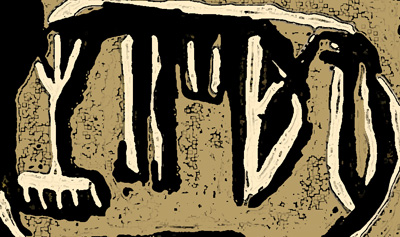
Seal impression Dlp-3 with inscription: TRI-FORK ON COMB / TWO POSTS / BI-QUOTES // DEE-SLASH / POT.

The following sign is TRI-FORK ON COMB (VIII 29), which appears elsewhere as KP88(a) and W275.  Wells notes only one occurrence from Desalpur (Dlp-3).  I find only one parallel, a comb with an ornate handle which is an Adinkra symbol representing feminine qualities, duafe.
Detail from seal M-79 with inscription: VEE IN DIAMOND / BI-QUOTES // BELTED FISH / WHISKERED FISH / WINGED MAN / POT // ASTERISK BETWEEN BACK CEE AND CEE.

Third, we find ASTERISK BETWEEN BACK CEE AND CEE (VIII 30).  It appears in other lists as KP247 and W557, in the latter case cited as another singleton, this time from Mohenjo daro (M-79).  The “asterisk” is a previously observed sign, one made with an “X” shape with two short strokes between the arms of the upper segment and two more below.  Strictly speaking, then, it is not an asterisk shape at all.  With the backward parentheses (BACK CEE AND CEE) bracketing it, the symbol takes on a vague resemblance to the Egyptian glyph of a headrest (Q4).  This glyph is the determinative in wrs, “headrest,” not surprisingly.  The “asterisk” portion slightly resembles wheat as seen in an Old Chinese inscription (Wieger 1965: 373).
Analogs of Indus sign VIII 30, Egyptian glyph Q4, a headrest (above), and
Old Chinese bunches of wheat offered to the ancestors (below).

I have mentioned a HAIRY HUNCHBACK previously (VIII 31).  This eight-stroke variation possesses four prongs, where the previous version had only three.  There is also a five-pronged version.  This variation occurs as KP194, W78, and Fs Q-8.  Faiservis considers the “head” portion to be one sign (E-5, “bud”) to which a chevron is attached (P-4, “head”), and four additional strokes denoting the plural.  The ligature, as he sees it, means “cotton, crops, cotton in general.”
Detail from seal H-23 with inscription: STACKED NINE / QUAD-FORK / HAIRY HUNCHBACK / WINGED MAN / POT (note that the "hunchback" has four prongs rather than three here).

However, as noted in the post concerning the three-pronged version, I see this as possibly representing an animal.  Thus, I find parallels – though distant – in Egyptian E21 and E33, the recumbent Seth animal, and a monkey.  The first serves as determinative in words denoting turmoil, such as nšni, “to storm, rage.”  The second is the determinative in the word for monkey, gf, gif.  These animals, like the rest of the Egyptian animal series, sit horizontally on an invisible ground line, as one might expect.  However, Old Chinese provides a parallel for an animal placed vertically, with the legs to the side, in an inscription (Wieger 1965: 374).  Here, the animal is imaginary, a dragon, which is entreated for rain.
Inscription from Indus tablet H-787 at top: HAIRY HUNCHBACK / POT / COMB.
Below are analogous quadrupeds: Old Chinese horse and two pigs (center), an unidentified proto-cuneiform ZATU resembling a dog (below left), and an ithyphallic North American hunchback (below right).
Additional quadrupeds, including Egyptian E21, the Seth animal (above),
Old Chinese dragon (below left), and Egyptian E33, a monkey (below right).

Our next sign is difficult to name, being temporarily called TRIPLE LASHES ON CIRCLE UNDER TABLE (VIII 32).  It looks something like an eye with three eyelashes, but without an iris or pupil.  It sits beneath an element rather like our numeral “7,” which appears elsewhere as a variation of the “table” with a single long leg.  This singleton appears only in the list prepared by Wells, as W377 (M-83).  It recalls the Egyptian wd3t eye, the eye of Horus, which occurs as a glyph in Egyptian writing, as a symbol of the deity in pictorial scenes, and as a magical amulet of sorts (A10).
Detail of impression of seal M-83 with inscription (right to left): TRIPLE LASHES ON CIRCLE UNDER TABLE / STACKED EIGHT / TRI-FORK (compare the sign on the right with an eye).

Detail from panel of deities in Egyptian Book of the Dead, showing Horus (wearing the pharaoh's double crown and perching on the facade of the old palace), with the Wedjat eye behind him.

The following sign is also difficult, resembling the CARTWHEEL discussed earlier, but with additional strokes added to the sides and underneath.  I am originally called it ROOF ON CARTWHEEL OVER BI-QUOTES (VIII 33), a very clumsy appellation. But since it looks something like the “cartwheel” with drops falling off, I may change this to RAINY CARTWHEEL, in the interest of brevity.  It appears elsewhere as KP339(a) and W569.  Wells notes four occurrences in two variants, one of them a nine-stroke symbol.  Both variants occur at Mohenjo daro, a single one at Harappa.
Copper object H-380 with inscription: ROOF ON CARTWHEEL OVER BI-QUOTES / BLANKET / BOAT.

Although a rare and unusual sign, VIII 33 has a few analogs, if one does not press the analogy too far.  Proto-cuneiform AMA~a is something close to a diamond shape with a true asterisk inside.  It came to mean “mother.”  If this can be considered a parallel to the “cartwheel” element, the addition of a grid inside the “diamond” makes |AMA~a x E2~a|.  This combines signs for “mother” and “temple, house.”
Analogs to the RAINY CARTWHEEL: Old Chinese hui4, "meeting, reunion," and dian1, "offer libations" (top row);
proto-cuneiform AMA~a, "mother" (below left), and Adinkra symbol sepo, "executioner's knife" (below right). 

In Old Chinese, a depiction of a vessel with a lid, placed upon a table, is similar.  This is dian1, “spirits [i.e., fermented drink] for the libations, placed upon a small table...; to offer libations” (Wieger 1965: 118).  Here, this is a circular element with lines inside paralleling the “cartwheel” element of the Indus sign, two additional strokes on top depicting a lid to parallel the Indus “roof,” and the horizontal line with two short verticals below recalls the “bi-quotes” at the base of the Indus sign.  If one is willing to stretch things quite a bit, the Adinkra symbol sepo, “executioner’s knife” is another analogy (Willis 1998: 190).  This represents justice, law, and punishment.
Detail of broken seal M-1005 with inscription: WHISKERED FISH / BLETED FISH / WINGED MAN / POT // RAINY CARTWHEEL (Wells' variant "b").

There is also a CIRCLED QUINT-FORK (VIII 34), also known as KP364 and W343c.  Wells lumps together the variations on a circled fork, noting 67 occurrences overall, in five variants.  I remain uncertain as to where this version occurs, though.
In proto-cuneiform, something along the same lines occurs in the symbol transcribed |LAGAB~a x SIG7|.  The circular portion came to mean “block (of stone), trunk (of tree),” but also denoted a lamb early on.  Inside this circle is what appears to be a rake or broom, SIG7, “to let live, to garden; green, yellow, pale.”  Old Chinese also contains characters with circled elements.  One of these is kun4, a circled tree, meaning “weariness, exhaustion....a camping...under a tree” (Wieger 1965: 276).  Another is a circle with a symbol something like the letter “Y” inside, han2, “the tongue drawn...into the mouth” (1965: 247).

Among the Adinkra symbols of West Africa, damedame is a circle with an internal square surrounded by four small rectangles.  It is a representation of a gameboard which symbolizes “craftiness, intelligence, strategy” (Willis 1998: 88).
Analogs to the HAIRY LOLLIPOP: Egyptian glyphs R21, V25, and Aa (top row), proto-cuneiform MASZ2 @ g (below).

Koskenniemi and Parpola are the only ones who note the following symbol, HAIRY LOLLIPOP (VIII 35, their KP360), a sign I have not seen.  Still, Egyptian provides three examples of a small circle atop a post, with additional strokes.  The first of these is an Old Kingdom glyph representing a stylized flower surmounted by the horns of an ox, the emblem of the goddess of writing, Seshat (R21).  There is a simpler glyph that seems to be a cord wound on a stick (V25).  In its 18th Dynasty form, it is a small oval on top of a vertical line, with a short diagonal on top, a biliteral or phonetic symbol for two consonants, wd.  Third, there is another combination on a post with three “flanges” attached to a central circle.  This unidentified object is another biliteral, used for the consonants nd.
Old Chinese zi3, "child," (above) and fu2, "to hatch" (below).

Proto-cuneiform provides a similar sign, though composed of a horizontal line with a diamond rather than a circle attached on one side.  The line is crossed by a shorter perpendicular stroke and there are six or so diagonal prongs rising from the diamond.  The symbol is MASZ2@g, “he-goat, buck; rent profit, produce, yield.” 

Old Chinese, too, contains a character recalling this Indus sign in zi3, “a newborn child, swathed up” (Wieger 1965: 233).  The simpler version of this is now the 39th radical, but in some ancient inscriptions, the baby has three wavy hairs.  There is also fu2, in which the same “baby” element is surmounted by a bird’s foot.  This represents “a hen-bird covering with her legs her little ones; to hatch” (1965: 234).  In both of these Chinese characters, the portion representing a child or chick has arms/wings.  But there is another character which seems to be the same infant without arms, liao3.   It is now used for a particle la which sometimes indicates something akin to past tense (but many other uses as well).
Detail from broken seal M-843 with inscription: FATT ZEE / POTTED ONE / BIRD / CUP (?) / (?).

Finally, there is an outlined “Z” shape, FAT ZEE (VIII 36), also known as W586.  Wells lists it as yet another singleton from Mohenjo daro (M-843).  A very similar shape oriented differently occurs in proto-cuneiform as BAN~a, “bow” (the noun).  Luwian glyphs contain two such symbols though with open ends.  The first is SOLIUM, “seat,” two parallel zigzagging lines, each of which resembles a sideways “Z.”  There is also FLUMEN (AQUA), “river (water),” rotated 90 degrees and given an addition zag.  It may be of interest to note that in Cretan hieroglyphs, a simpler “Z” shape appears as a phrase termination rather like our comma or period (O61).  However, given the extreme brevity of all known Indus inscriptions, it seems unlikely that a phrase terminator should have been needed.

Analogs to Indus FAT ZEE: proto-cuneiform BAN~a, "a bow" (top), Luwian SOLIUM, "seat" (below left) and FLUMEN (AQUA), "river (water)" (below right).

Tuesday, May 31, 2011

Eight More Eight-Stroke Signs

Seal B-17 from Banawali with inscription: MAN ON BASE / PANTS (VIII 19b) /
BI-QUOTES // CAGED FISH UNDER CHEVRON (over composite animal, part tiger, part bovine).

There are a number of variations on a motif made up of bent lines, among the Indus signs.  Two versions contain eight strokes each, for which reason I enumerate both VIII 19, distinguishing them as variants “A” and “B.”  Koskenniemi and Parpola only show the “B” variant in their list of signs (KP205), while Fairservis fails to include any variation on the PANTS motif.  Wells enumerates each version separately, giving the "B" variation the number W163 (three occurrences, two from Mohenjo daro, one from Chanhujo daro), the "A" variation the number W160 (seven occurrences, six from Mohenjo daro and one from Banawali).  Other variations include five, six, seven, and nine strokes (see posts on V 19, VI 40-41, VII 39, and IX 61).  If all of these variations on the bent-line motif are seen as a single sign – which is by no means proven – then there are 24 occurrences in all, divided among 11 variants.  They appear at Mohenjo daro (19 instances in 8 variants), Harappa (2 instances in 2 variants), Banawali (1 instance), Chanhujo daro (1 instance), Kalibangan (1 instance), and Khirsara (1 instance).  Since there are so few of each “variant,” it is probably better to assume that there is more than one sign here, at least for now.
Two variants of PANTS ("A" above left and "B" below left), and analogs
 Old Chinese yong3 (upper right), "duration," and proto-Elamite M059~d (below right).

Old Chinese includes two characters that are similar, although more curvilinear.  The first of these is yong3, “the unceasing flow of water veins in the earth....Abstracted meaning, duration, perpetuity” (Wieger 1965: 289).  Reversing the character produces pai4, “ramification of a stream” (1965: 289).  In this script, directionality is significant, then.  If this is also true of Indus symbols, then there must be at least two different signs among those that I have labeled PANTS.

Tablet K-61 from Kalibangan with inscription (right to left): CROSSROADS EX / POT.

The second element for today is CROSSROADS EX (VIII 20).  It appears in two variations, one of which apparently includes nine strokes.  The sign appears elsewhere as KP255, W542, and Fs K-16.  Fairservis sees it as a division of two or four units, meaning “share, division.”  Wells observes the two variations, grouping them under one number and distinguishing them as “a” and “b.”  He notes 40 occurrences, 20 from Mohenjo daro, 19 from Harappa, and one from Kalibangan.  I count more than that, all told, but in some cases it is difficult to distinguish this sign from another where the ends of the crossed “roads” are closed.  So I do not consider my own count more certain than that of Wells.
Inscription on bas-relief tablet H-279 (right to left): DEE / SINGLE POST / FISH / BED / BOAT / PRAWN / ZEE / CROSSROADS EX (?) / MALLET / TRI-FORK / POT (it is less clear than shown, but there may be a simple EX).
There is a crossroads inside a circle in Egyptian, a glyph that serves as an ideograph in the word for “village,” and a determinative in names of villages, towns, and inhabited regions (O49).  This is a better parallel for another Indus sign, however, one in which this “crossroads” is also encircled – a sign I will discuss in a later post. 

Analogs to CROSSROADS EX: Egyptian O49 (upper left), proto-cuneiform KIB, "object made of gold" (lower left), Old Chinese temple of the ancestors (upper right), proto-cuneiform KASKAL, "expedition, journey" (lower right).

A type of crossroads symbol appears in proto-cuneiform, as KASKAL, “expedition; road; journey.”  This sign is made up of two “X” shapes slightly offset.  Thus, the center becomes a diamond due to the crossing of the long lines.  In the Indus symbol, either the center is completely open (“a” variant), or there is only a short vertical in that space (“b” variant).  Another proto-cuneiform sign resembles the crossed roads with closed ends, turned to formed a “plus” sign.  This is KIB, which came to mean an object that could be made of gold.

In Old Chinese also there is a symbol closely resembling crossed roads, but in the shape of a “plus” sign rather than an “X.”  The meaning is quite different, as this is not a character in the script but a representation of the ancestral temple with its four pillars, seen in various inscriptions (Wieger 1965: 369).
Proto-cuneiform ZATU 730 (left) and similar Indus sign VIII 21 (right), as depicted by Koskenniemi and Parpola (KP345b).

The third Indus sign for today is SPOONS ON TEE (VIII 21), known only as KP345(b) elsewhere.  It has a single parallel, ZATU 730 in proto-cuneiform, which is more angular and more complex.  I do not see this precise symbol in the first two volumes of the Corpus, although there is an unusual seal in the shape of a “T,” on which multiple “T” shapes are interlaced (H-165).  Wells does note a very similar nine-stroke sign (my IX 24, his W76).  It is a singleton from Harappa (H-455), probably the same instance that KP345(b) indicates.  There does seem to be an extra stroke on the seal, as shown in Wells' list.  But there also seems to be a bit of a mark joining this symbol to the DOUBLE POSTS before it.  So, perhaps both of these differences from the idealized KP345 are inadvertent, slips of the seal-carver’s knife?

Seal H-165 which contains interlocking "T" shapes and is itself "T" shaped, perhaps akin to sign VIII 21.

Our fourth sign is a grouping of three triangles, one on one side, two on the other side stacked one over the other.  All three touch, forming a shape reminiscent of spaceships drawn by certain small children.  For this reason, I have termed it SPACESHIP (VIII 22), although it may be a representation of mountains, as Fairservis suggests (Fs N-1).  It also appears as KP221 and W416.  Wells finds 17 occurrences, 11 from Mohenjo daro, four from Harappa, one each from Lothal and Kalibangan.

Detail from seal M-29 with inscription over unicorn: STRIPED TRIANGLE / SPACESHIP / FISH / BI-QUOTES //
CIRCLED TRI-FORK / FISH UNDER CHEVRON / WHISKERED FISH / STACKED 12 / POT.

Faiservis considers this sign to be a representation of mountains.  Not only that, but he declares this to be a universal sign.  It does indeed resemble the collection of three triangles – or three wedges – found in proto-cuneiform as KUR, which came to mean “mountain; (foreign) land; netherworld.”  In Egyptian, as previously noted, a representation of three humps bears a similar meaning (N25, an ideograph or determinative in h3st, “foreign land,” and determinative for “desert”).  But these mountains or hills are depicted in a row, unlike the stacked arrangement of proto-cuneiform and the Indus SPACESHIP.  Then, in Old Chinese, a “U” shape with an upside-down “Y” inside is shan1, “mountain” (now the 46th radical, Wieger 1965: 208).  Again, the three humps are lined up, not stacked.

Two variants of proto-cuneiform KUR, "mountain; (foreign) land; netherworld" (upper and lower left);
"hills" from punch-marked coins (47, upper right; 48 lower right).

The Egyptian and Chinese symbols, with their three “hills” in a horizontal row, are more like the Indus sign TRIPLE TRIANGLES (VII 13), previously discussed (and Fairservis thinks VII 13 represents containers, not hills).  Among the Cretan hieroglyphs, there is a sign comprising two rather than three triangles side by side (O34, perhaps the syllable ta).  In Luwian, again, one sign is made up of three triangles, but they are lined up rather than stacked: CASTRUM, “fortress.”  In this script, two triangles -- as found in Cretan -- represent a distinct word (“country”), and a single triangle is still another word (“city”).  Thus, the number of triangles is highly significant.  And, unfortunately for Fairservis’ thesis, two triangles represent a country, not three.  Interestingly enough, none of these three means "mountain" or "hill."

In addition, there are groupings of three triangles elsewhere that have no known association with mountains or (foreign) lands.  In proto-Elamite, two triangles sit side by side (M115), while three are aligned in a column with the apex of each to the right (M125).  The meaning of both signs is obscure.  In North America, also, tripled triangles appear (Heizer and Baumhoff 1984: 180, fig. 117a; Newcomb and Kirkland 1996: 51, Pl. 15, no. 1; p. 192, Pl. 142, no. 20-N).  Aligned triangles occur in groups of four or more as well in America, something not found in the scripts discussed in the previous paragraph.  The people of Australia do not appear to have made much use of triangles, which also throws a monkey wrench in the notion that three triangles are a universal sign.  In conclusion, this “universal sign” is not universal, either in form or in meaning.  It is only widespread in Eurasia, with variations in configurations and meanings.

On some of the punch-marked coins of later India, there are groupings of three humps, referred to as “hills” (Gupta 1960: Pl. I).  One such symbol has the horizontal arrangement of the Indus TRIPLE TRIANGLES (number 47), while another has two small humps side by side with a larger hump rising over the center (number 48).  There is also a “C” shape lying on its back atop the larger hump, in the latter symbol.  But again, the three-humped grouping is not universal, as there are similar symbols including five and six humps (with or without additional elements on top).  Still, it is possible that the Indus TRIPLE TRIANGLES sign is a variation of the SPACESHIP (or vice versa).  But it is also possible that the two signs are completely independent.  And in any case, neither may be a representation of mountains.  We cannot assume anything at this point.
Seal M-234 with inscription: CEE /SINGLE QUOTE // FISH UNDER CHEVRON / FISH / SPEAR //
FAT EX / PINCH // FAT LAMBDA / POT // FOUR QUOTES / MAN WITH TAIL / STRIPED FAT STOOL / CAGED OVERLAPPING CIRCLES (note that, with 13 signs, this is one of the longest inscriptions,
one that may contain two or more units of information).  

The next sign is STRIPED FAT STOOL (VIII 23), also known as W467.  It is a singleton from Mohenjo daro (M-234), which may or may not be a variant of the simpler STOOL.  We may compare the Luwian glyph THRONUS, “throne,” as similar in form (cited previously in connection with the simple STOOL).  But the Indus sign is tipped on its side and most likely represents something other than an actual stool or seat.
Seal M-130 with inscription: CAGED MAN WITH POST / BI-QUOTES //
DOUBLE POSTS / FISH / TABLE BELTED MAN / POT.

Next, there is TABLE BELTED MAN (VIII 24), an anthropomorphic sign with the TABLE superimposed.  It appears only  in Wells’ list, as W43, where it is a singleton from Mohenjo daro (M-130).  It may be a simplified version of another sign, though, COMB BELTED MAN (XII 15, XIV 4), which occurs four times at Mohenjo daro in more than one version (KP22, W20; on M-142, M-831, M-1160, and M-1162).
Detail from seal M-142 with inscription: VEE IN DIAMOND / BI-QUOTES // LOOP ARMED MAN WITH SLASH / COMB BELTED MAN (compare the final sign here with the TABLE BELTED MAN above).

Egyptian glyphs include one representing a standing man holding a tall stick in one hand and a particular scepter in the other (A22).  The ‘b3 scepter crosses the man’s body in a manner similar to the “table” or “comb” of the Indus signs, so perhaps the Indus “men” should be considered holding these items, even though they do not touch the ends of the arms.

Two variants of Old Chinese shi3, "arrow; irrevocable" (redrawn from Wieger 1967: 300).

On the other hand, Old Chinese contains variants of a character that appears anthropomorphic but is not a person at all.  The word shi3 is an arrow.  Wieger explains variant “a” as “An arrow....On the top, the point; at the bottom, the feathers,” while “b” is “an arrow fixed in a man’s body....Abstract meaning, an action that came to its end, appointed, determined, irrevocable” (Wieger 1965: 300).

Inscription from M-875: CARTWHEEL / PINCH / SINGLE POST / MAN WITH SINGLE STRIPED EAR.

Indus sign MAN WITH SINGLE STRIPED EAR remains to be discussed (VIII 25).  It is another singleton from Mohenjo daro (M-875).  Nevertheless, it appears in all the lists, as KP7, W44, and Fs A-3.  Fairservis apparently thought the appendage I term an “ear” was long hair, as he defines this sign as “woman.”  He also thought there were at least two occurrences, since he notes a variant.  However, Wells is correct in that this sign appears only once, while another sign gives this peculiar "eared" character a “stick” in one hand (IX 33, to be discussed later).

Old Chinese representation of the ancestor in the temple, with the divided triangle representing presence,
the large eye the ancestor's sight (of the offerings), and the character tian1 beneath these, indicating the ancestor himself.

While the “ear” might be hair or some sort of headgear – a lopsided hat? – other scripts provide other possibilities.  Proto-cuneiform SAGSZU is only a person’s head, but it bears a single horn, with the eventual meaning “headdress; headcloth, turban; helmet.”  In Old Chinese, the image of the ancestor sometimes has a single very large eye on top as well as varying numbers of limbs (Wieger 1965: 371).  Lastly, Egyptian includes a number of glyphs representing gods and goddesses, some of which are essentially human in form but have animal’s heads (e.g., A6, a god with a dog’s head, Inpw or Anubis).  Seth has the head of an unknown animal with a snout rather like an anteater’s, Thoth has the head of an ibis, Horus has the head of a hawk, Khnum has a goat’s head, and so on.  Thus, the Indus sign might be partly anthropomorphic, but with the head of the Indian crocodile, the gharial, an animal which appears on several seals and, much later, on some punch-marked coins (symbol 32).

Egyptian god Anubis with anthropomorphic body and jackal's head, from the Book of the Dead.
The final Indus sign for this post is CHEVRON HATTED BEARER (VIII 26).  There are many variations on an anthropomorph who is carrying something on a shoulder yolk, in the Indus script.  This one seems to have no arms, while he carries triangular objects -- or else he has bent elbows and carries nothing but the pole across his shoulders.  In any case, the sign appears also as KP3 and W28b, while Fairservis does not note an armless variant (although cf. A-9).  The chevron in place of a head suggests a hat, although it might just as easily be a compound sign or ligature, grouping together the CHEVRON and BEARER.  Then again, the chevron-shaped "hat" plus the triangular objects carried resemble the SPACESHIP, though the latter has no body or legs attached.  This suggests another possible interpretation of the SPACESHIP, then, as part of a person engaged in a task.

Inscription from bar seal M-899: SQUARE WY / CHEVRON-HATTED BEARER / POT-HATTED BEARER (note how different the bodies are in these two "bearers" -- perhaps one is not meant to be anthropomorphic after all).

In any case, Wells indicates that there may be as many as a three occurrences of this particular variety of the "bearer" with a chevron-shaped "hat," but I see only one (M-899).  Since it occurs alongside another type of "bearer," one with a POT shaped hat, but the two are significantly different in form, I wonder whether one or the other is not really intended to represent a human.


Gupta, Parmeshwari Lal. 1960. Punch-Marked Coins in the Andhra Pradesh Government Museum. Hyderabad, Andhra Pradesh: Government of Andhra Pradesh.

Tuesday, May 24, 2011

Ten Angular Indus Signs

Detail from seal M-649 with inscription over horn of unicorn: COMB TOPPED BATTERY / CARTWHEEL.

The first Indus sign discussed in this post is the ninth in my list of eight-stroke symbols, COMB TOPPED BATTERY (VIII 9).  Also known as KP292(a), W481, and Fs G-3, it is a singleton from Mohenjo daro (M-649).  Fairservis sees it as a depiction of fire on top of a building or platform and assigns it the meaning "watchfire."  But, of course, other scholars see "combs" and tridents as representing plants rather than fires, so this definition is not widely accepted.

Analogous symbols from proto-cuneiform (above) and proto-Elamite (below).

In ancient Iraq, the proto-cuneiform writing system includes a somewhat similar item, transcribed |ZATU 737 x SZE~a|.  In form, it is an ear of barley (SZE) inside what appears to be an angular bottle (ZATU 737, undefined).  In neighboring Iran, the proto-Elamite writing system contains another similar sign, this one closer to the Indus VIII 9 (M213).  Here, a broader "ear of grain" stands atop a short, wide rectangle -- the whole thing rotated 90 degrees from the Indus sign as is typical in this part of the world.
Two Old Chinese parallels: shi4 (left), "a market," and nie4 (right), "hand writing upon a tablet"
(with addition of a horizontal stroke, the character becomes yu4, "pen; to narrate").

In Old Chinese, too, there are characters that include a comb-like or plant-like element above either an angular "platform" or a more curvilinear element.  For example, shi4 is a small trident sitting upon the horizontal top  of a three-sided rectangle something like the Indus "platform."  This means "market" in which the trident is grass and the semi-rectangle a space outside the city (Wieger 1965: 94).  In qiao1, the same trident represents flowers, above a "roof": "a cover with flowers....By extension, the shell of mollusks, of fruits, of eggs, that covers them, and is ornamented with fine designs" (1965: 96).  I admit to a few doubts about Wieger's explanation here.  Be that as it may, a third parallel is nie4, "a hand writing upon a surface" (1965: 123).  In this example, the trident is rotated 90 degrees and represents the hand, holding a brush.  Thus, the "comb" in the Indus sign might represent a plant (like the grass and the flowers of Old Chinese), but it might also represent something entirely different.

The DOUBLE TICK TOPPED EXIT as it might appear, beside STACKED SEVEN.

Our second Indus sign is DOUBLE TICK TOPPED EXIT (VIII 10).  This particular symbol appears only in one list, as KP287.  I think that a seal from Mohenjo daro is the source of this (M-112).  I see the EXIT on this seal as a six-stroke element comprising a "table" (or incomplete rectangle) over an inverted "trident."  That is, I do not see the two short strokes on top of the "table" that are depicted in the list of Koskenniemi and Parpola.  The top edge of the seal is abraded, leaving this part of the sign in doubt.  There is certainly a pair of "ticks" atop other similar signs, but these also have two strokes on each side of the "table" (cf. M-120 and K-2).  I will discuss this symbol among the twelve-stroke signs.

Seal M-112 with inscription: FOOTED ASTERISK / EXIT (KP287?) / POTTED ONE /
VEE STRIPED LEAF / STACKED SIX / DOT IN FISH / BI-FORK TOPPED POT / POT
(I have artificially smoothed out the image, perhaps removing the "double ticks").

Among the Egyptian hieroglyphs there are none that quite match Indus sign VIII 10, either in general form or in combining other elements.  The closest glyph -- to my eyes anyway -- is O51 in Gardiner's list, a truncated cone containing three slanted dots, sitting on a sort of tray with upraised sides.  It represents a heap of grain on a raised mud floor, serving as an ideograph or determinative in the word snwt (with a hacek or little "v" over the "s"), "granary."  As an extremely dubious parallel sign, the glyph provides no real help in interpreting the Indus sign.

Analogs of the Indus EXIT: proto-Elamite M172 (upper left), Old Chinese shou3, "to observe" (upper right),
Old Chinese bi1, "ordinary, vulgar" (lower left), Egyptian O51, seen in "granary" (lower right).

In Old Chinese, the roof element is an upside-down "U" with a single tick on top, an element that typically covers some other element in compound characters.  One of these compounds is shou3, "a mandarin, a prefect...who, in his tribunal, applies the law....By extension, to observe, to keep" (Wieger 1965: 125).  Here, the "roof" covers a trident-like hand, with a small additional stroke underneath.  Thus, somewhat similar elements are combined as those found in Indus sign VIII 10, but the overall effect is very different.  Another Old Chinese character has a more rounded "roof" element at the top, beneath which there is another "hand," but with a different slant, and a "T" with a curved stem.  This is bi1, "ordinary, vulgar....This character represents an ancient drinking vase provided with a handle on the left side...held with the left hand....the tsun1 [wine vessel] was used for the sacrifices, the bi1 was used every day.  Later on, the two characters were taken in the abstract sense for noble and vulgar" (1965: 128).

Proto-Elamite provides a closer parallel with M172, a complete rectangle with two "ticks" on the left side.  The rectangle contains an element comprising two "x" marks, side by side, with a "stem" beside these.  Its meaning is unknown.
Detail of inscription from M-1117: DIAMOND BETWEEN DOUBLE POSTS /
PANTS / (?) (occurs above and beside zebu).

Next among the Indus signs is DIAMOND BETWEEN DOUBLED POSTS (VIII 11).  Only Wells lists this as a distinct symbol (W406).  It is a singleton from Mohenjo daro (M-1117) and, as such, might also be interpreted as a series of three signs, DOUBLE POSTS / DIAMOND / DOUBLE POSTS.
Old Chinese inscription: filial son's hand offering libations (bottom) before temple;
inside temple are cooked meat (diamond), wine (semi-circle), and symbols
representing presence of ancestors (bracketing diamond) (drawn after Wieger 1965: 367).

An inscription in Old Chinese bears a vague resemblance to this Indus sign (or series of signs).  A square with modified corners represents the shrine or temple in which offerings are made to the ancestors, in this inscription.  Inside, there is a diamond with several internal marks, an oddly curved line on either side, and a semi-circle below, all inside the shrine.  Beneath the shrine is a trident-like hand alongside what appears to be a drop.  Wieger interprets all this as the son making offerings to the ancestors in the shrine, with the hand belonging to the son offering a libation (the drop), before the shrine (modified square), in which sits a wine vessel (semi-circle), as well as an offering of cooked meat (diamond), on either side of which we see the leg and foot of an ancestral spirit, come to receive these offerings (1965: 367).

Detail from seal M-36 with inscription: STRIPED SQUARE CUP WITH HANDLE / BACK CEE & CEE / STRIPED FAT LEG LAMBDA / BI-QUOTES // LADDER (?) / FISH / BLANKET WITH 4 TICKS / RAYED CIRCLE / POT.

The following Indus sign is STRIPED SQUARE CUP WITH HANDLE (VIII 12), another singleton from Mohenjo daro (M-36).  Wells alone lists this odd symbol and he does not attempt to interpret it.
 
Vessels with a single handle, questionable analogs of Indus VIII 12:
Cretan hieroglyphic jug (above) and proto-Elamite beer jug M283~j (below).


I do not know that it represents a vessel of some kind, but if it does, there are at least two parallels to examine.  A jug with a single handle appears among the Cretan hieroglyphs (O53, perhaps the syllable ja).  And a single-handled beer jug occurs in proto-Elamite (M283~j).  Neither of these distant analogs looks much like the Indus sign.

Bar seal M-1289 with partial inscription: TEETH IN RECTANGLE / BOAT / PAW / BI-QUOTES (?) / MAN (?).

Another singleton follows, TEETH IN RECTANGLE (VIII 13), also known as KP267 and W525.  A tall, narrow rectangle bears two internal rectangles, both attached midway on one side (M-1289).  In proto-Elamite, there is also a sign that is a rectangle containing two smaller rectanges (M146~f).  But here the internal elements do not touch either each other or a side of the larger container.  Similarly, there is a Luwian glyph that is a square, containing a small circle (symbol 255, meaning unknown).  But the internal element is centered, not attached to one side of the larger square.

Indus VIII 13 (left) and parallel signs: Luwian 255 (upper right) and proto-Elamite M146~f (lower right).

Next we come to DOWN FAT TEE (VIII 14), a sign that occurs only as KP274 elsewhere.  It is apparently how Koskenniemi and Parpola interpreted the symbol I discussed earlier as VII 62 (W523).  The following sign is TRIPLY STRIPED SKEWERED TOP (VIII 15) found only in Koskenniemi and Parpola's list as KP275(b).  I have discussed other types of TOP previously and have no further remarks (see previous posts for full discussions of these types).

Detail from seal H-22 with inscription: BED WITH ATTACHED POST / QUAD-FORK / BI-QUOTES //
CIRCLED TRI-FORK / BELTED FISH / BED / BOAT / POT (note that the unmodified BED appears here,
in the same inscription as the BED WITH ATTACHED POST, suggesting the two are distinct).

The next sign is a ligature, BED WITH ATTACHED POST (VIII 16), also known as KP304 and W178.  I have seen only one example, from Harappa (H-22), but Wells notes two more occurrences from Mohenjo daro not found in the first two volumes of the Corpus.

The BED portion resembles proto-cuneiform U2~b or ~c, which may be either the symbol that came to mean "plant, vegetation, firewood," or else a symbol that came to mean "emery stone" (see earlier post on the BED for full discussion).  This same portion of the Indus sign also resembles Old Chinese yung4, "bronze ex-voto offered to the Ancestors...[which] brought blessing, hence...aptitude" (Wieger 1965: 260).  There is also a resemblance to the Adinkra symbol hwehwemudua, "measuring, ruler," which symbolizes the West African virtue of excellence or perfection.  However, none of these analogs shows an additional element attached, while there are several Indus signs of this type.

Indus sign VIII 17, a possible STOOL WITH SINGLE FOOT & ATTACHED COMB (drawn after KP235).

There may or may not be another symbol found only as KP235 elsewhere, the STOOL WITH SINGLE FOOT AND ATTACHED COMB (VIII 17).  I can cite occurrences of a FOOTED STOOL with an ATTACHED COMB, as well as various prongs on the legs.  But I have not seen this particular eight-stroke symbol.

Indus sign VIII 18, VEE & DOUBLE SLASHES IN DIAMOND (left),
with its closest parallel, proto-cuneiform NA~d, "human" (right).

Neither have I seen VIII 18, VEE AND DOUBLE SLASHES IN DIAMOND, elsewhere KP387.  There are a great many occurrences of a diamond containing a vee, but adding two slash marks across one of the lower sides of the diamond does not appear in the first two volumes of the Corpus.  Even so, proto-cuneiform provides a reasonably close parallel with ZATU 798, a diamond with four attached backslashes on the upper left surface.  Its meaning is unknown.  A taller, more slender diamond contains two crossing horizontal marks and an additional backslash attached to the upper left surface: NA~d, "human."  As is frequently the case with the more complex Indus signs, duplication of the precise combination of elements appears to be unique to the Indus Valley.